
The Centre for Mathematics, Science and Technology Education in Africa (CEMASTEA) has intensified efforts to boost performance in Science, Technology, Engineering and Mathematics (STEM) subjects in Bungoma County through targeted training and mentorship programs for teachers and learners.
The capacity-building initiative aims to enhance practical teaching approaches, deepen subject mastery, and inspire learners to develop greater interest and confidence in mathematics and sciences.
Education stakeholders say the move is expected to address persistent challenges in STEM performance and equip students with skills aligned to the demands of the Competency-Based Education (CBE) framework and the modern job market.
Speaking to the press at Sinoko DEB Primary and Junior School, Joseph Kuria, Coordinator Special programmes Student Learning from CEMASTEA, said the institution provides in-service education and continuous professional development for teachers across the country to improve classroom delivery, particularly in STEM subjects.
“We also provide some extension services through this program called STEM outreach,” he said.
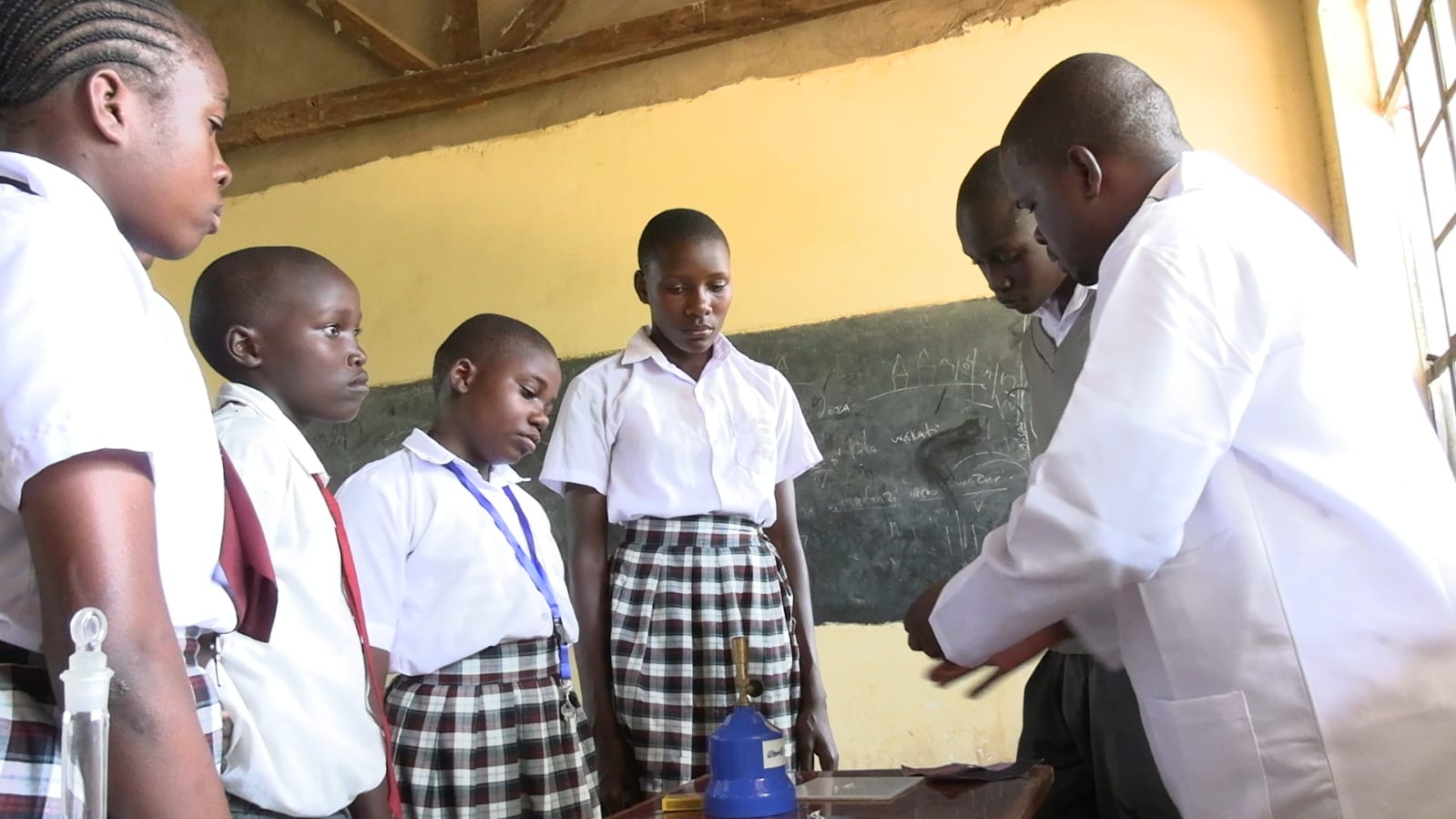
Kuria explained that under the STEM outreach program, CEMASTEA teams visit selected schools to allow learners to directly interact with science equipment, models and experimental materials, an approach designed to demystify science and mathematics.
“For example, we are in Bungoma for five days and each day we visit one school per sub-county. In every school, we give learners an opportunity to interact with our science materials and take part in practical activities with the intention of helping them develop interest in science and mathematics,” Kuria said.
He noted that under the Competency-Based Education system, learners are expected to choose career pathways at senior school level, with STEM being one of the key tracks.
CEMASTEA, he said, has been mandated by the Ministry of Education to promote the STEM pathway and prepare learners to pursue science-related careers in higher education and beyond.
“We are here in Bungoma schools with the intention of promoting the STEM pathway by allowing learners to interact with scientific equipment, materials and activities so that they develop the urge to learn more about sciences,” he added.
However, Kuria observed that the rollout of Junior Secondary School (JSS) under CBE has faced significant challenges, particularly the lack of well-equipped laboratories.
“We know that with science subjects, learners are expected to learn through practical activities in laboratories. But since many schools do not yet have fully equipped labs, we are bringing this equipment and apparatus closer to the learners so that whatever teachers are teaching in classrooms and may appear abstract becomes more practical and easier to understand,” he said.
Anne Aketch, the headteacher of Sinoko DEB Primary and Junior School, welcomed the initiative, saying it would greatly uplift the standards of STEM learning in the institution.
“I’m happy that my teachers have also interacted with the resources because there are some materials we don’t have. Now we understand what is required and what we need to prioritize to strengthen STEM learning in our school,” she noted.
She admitted that teaching STEM subjects has been a major challenge due to inadequate practical materials and the absence of a fully equipped laboratory, urging the Ministry of Education to fast-track infrastructure development in public schools.
“If the government can help us construct modern laboratories and equip them properly, we are going to have an easier time teaching learners and improving performance in science subjects,” she said.
Teachers at Sinoko DEB school applauded the efforts by the science agency to equip learners with practical skills.