
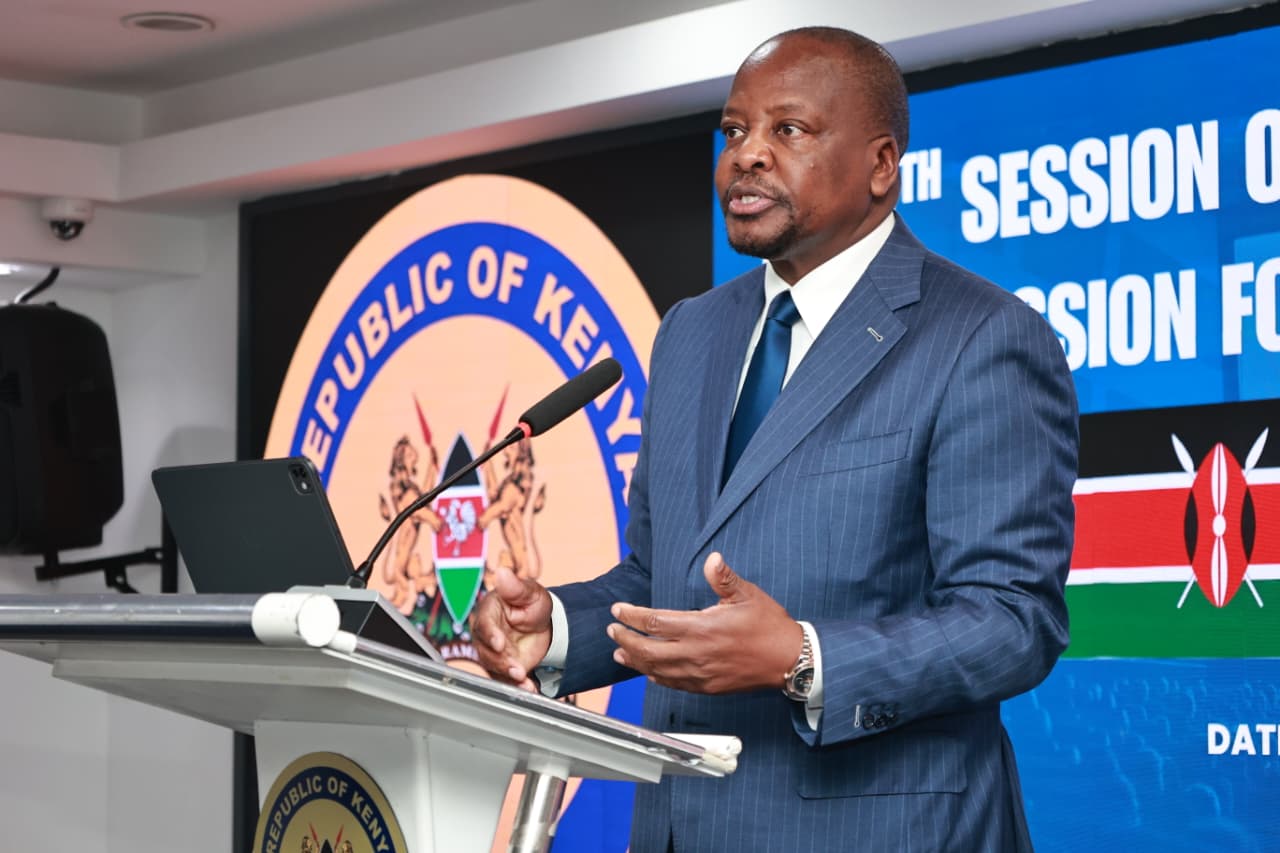
Cabinet Secretary for Agriculture and Livestock Development Mutahi Kagwe has cautioned that uncontrolled land subdivision is threatening the future of agriculture in Kenya, urging a national conversation on strategic land use to secure food security, commercial farming viability, and sustainable economic growth.
Speaking during the official opening of the Jumuia ya Kaunti za Pwani Coastal Agricultural Value Chain Revitalisation Workshop in Malindi, Kagwe stressed that excessive fragmentation undermines the ability to implement modern, mechanized, and climate-smart farming practices.
“In some cases, a single acre has been divided among six children. We cannot afford to continue this fragmentation. Large, consolidated farms are critical for mechanization, investment, and building a resilient agricultural economy. Many successful agricultural nations avoid excessive land subdivision,Kenya must consider a similar approach,” Kagwe said.
The Cabinet Secretary also called on government officials and stakeholders to adopt a pro-investment mindset, warning that suspicion or jealousy toward successful investors and private enterprises undermines growth.
“Investors do not come here to earn stones. They come to make money and that is exactly why they should come. Private profits drive job creation, stimulate local economies, and enable broader agricultural transformation,” Kagwe said.
He urged both national and county governments to streamline approvals, remove bureaucratic bottlenecks, and provide predictable policy frameworks to de-risk long-term agricultural and industrial investments.
Highlighting the Coast’s agricultural potential, Kagwe emphasized that structured value chains, climate-smart practices, modern technology adoption, and public-private partnerships can transform the region’s economy.
He stressed the importance of local value addition: “Why export raw cashew when we can export branded, processed kernels? Why sell raw coconuts when we can produce coconut oil, desiccated coconut, and animal feed locally? Every stage of value addition creates jobs and jobs are what our young people need.”
The six counties of Jumuia ya Kaunti za Pwani — Lamu, Tana River, Kilifi, Kwale, Taita Taveta, and Mombasa — possess ecological advantages such as suitability for tree crops, drought-tolerant cash crops, livestock systems, and a strategic coastal export corridor.
Yet, high unemployment, declining legacy cash crops, and climate vulnerability persist.
Kagwe called for transformation driven by Climate-smart agriculture, modern technology and data,youth-led agripreneurship, structured public-private partnerships and deliberate county-national collaboratio.
The CS said there was a need for community-managed irrigation, water security, and complete value chains from certified seedlings to market linkages.
Organized county-level cooperatives, aggregation centers, and farmer producer organizations will help de-risk private investment and attract processors.
CS Kagwe emphasized that policy alone does not create prosperity — partnership does. County governments must align production priorities, the private sector must invest with confidence, farmers must embrace aggregation, and financial institutions must innovate around agricultural risk.
National institutions like KALRO, KEPHIS, AFA, AFC, NCPB, KADIC, KEVEVAPI, and KAGRC are aligned to support research, innovation, regulatory oversight, structured markets, livestock genetics, and skills development.
He called for frank discussions on investor support, on how counties would actively support agricultural renewal? What do business people require from county and national governments to invest confidently? How can research institutions ensure innovation reaches farmers? And How county extension officers could be professionalized and strengthened through JASCCOM?
“This is not about projects. It is about building a durable agricultural economy for the Coast — climate-resilient, youth-driven, globally competitive, and capable of feeding Kenya while generating wealth for farmers,” Kagwe said.
He concluded with a strong call to action: “We must confront difficult questions on land use, investment, and agricultural organization. The Coast can rise again and together, we shall make it rise.”
Present was the Chairman of Jumuiya ya Kaunti za Pwni Dhado Godhana, Taita Taveta Governor Andrew Mwadime, Kilifi North MP Owen Baya and other dignitaries.