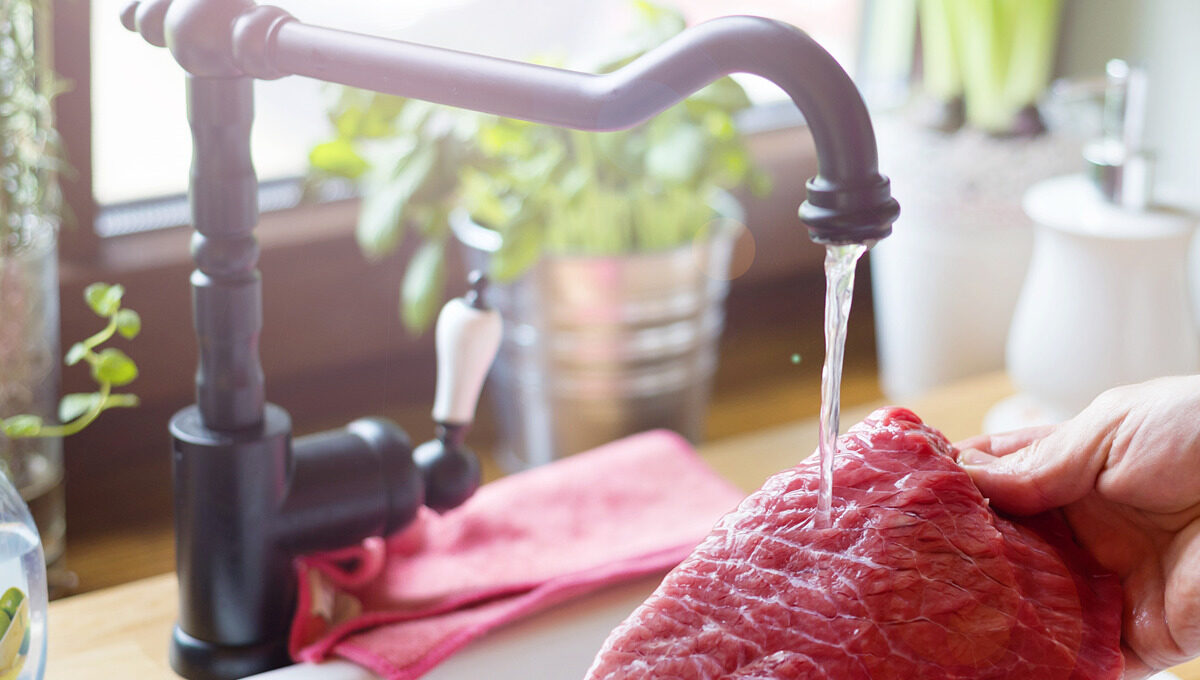
You might think rinsing that chicken breast or beef makes it “cleaner,” but here’s the truth that could save your family from food poisoning: washing raw meat is one of the riskiest things you can do in your kitchen.
I know it feels wrong. Many of us grew up watching our parents rinse meat under the faucet, thinking it removes bacteria or dirt. But according to food safety experts and science-backed research, not only does washing fail to make meat safer but also actually spreads dangerous germs throughout your entire kitchen.
When water hits raw meat, it creates invisible droplets that spray everywhere. These tiny water particles carry bacteria like Salmonella, Campylobacter, and E. coli onto your sink, countertops, dish towels, utensils, and even foods that won’t be cooked, like that fresh salad sitting nearby. This is called cross-contamination, and it’s a leading cause of foodborne illness.
A USDA study found that about 60% of kitchen sinks had bacteria in them after people rinsed raw poultry. Even worse, 26% of participants who washed their chicken ended up contaminating their salads with dangerous bacteria.
Think about that. Your sink becomes a breeding ground for the exact pathogens you were trying to wash away, and those germs are making their way onto foods you’re about to eat raw.
Water doesn’t kill bacteria. The only guaranteed way to eliminate harmful pathogens on meat is cooking it to the proper internal temperature: Poultry at 165°F (74°C), whole cuts of beef, pork, lamb, or veal at 145°F (63°C) with rest time, ground meats at 160°F (71°C), and fish and seafood at 145°F (63°C).
This advice is backed by decades of food safety research from USDA Food Safety and Inspection Service and real-world data on how people actually get sick from contaminated food.
The Centers for Disease Control and Prevention estimates that millions are sickened with foodborne illnesses each year, resulting in roughly 128,000 hospitalizations and 3,000 deaths.
Skip the sink entirely. Handle raw meat with care, keep it away from other foods, use separate cutting boards for meat and vegetables, and wash your hands thoroughly with soap and water for at least 20 seconds after touching raw meat. Clean and sanitize any surface the meat touches. Then cook it properly. That’s it. That’s the formula for safe meat handling.
Washing meat gives you a false sense of security while making your kitchen demonstrably less safe. The bacteria you are worried about? They’re going to die in the heat of cooking anyway. But the bacteria you just splashed across your kitchen? Those could end up making someone sick.
So next time you’re tempted to rinse that chicken, remember: the best thing you can do is leave it alone and let proper cooking do its job.