
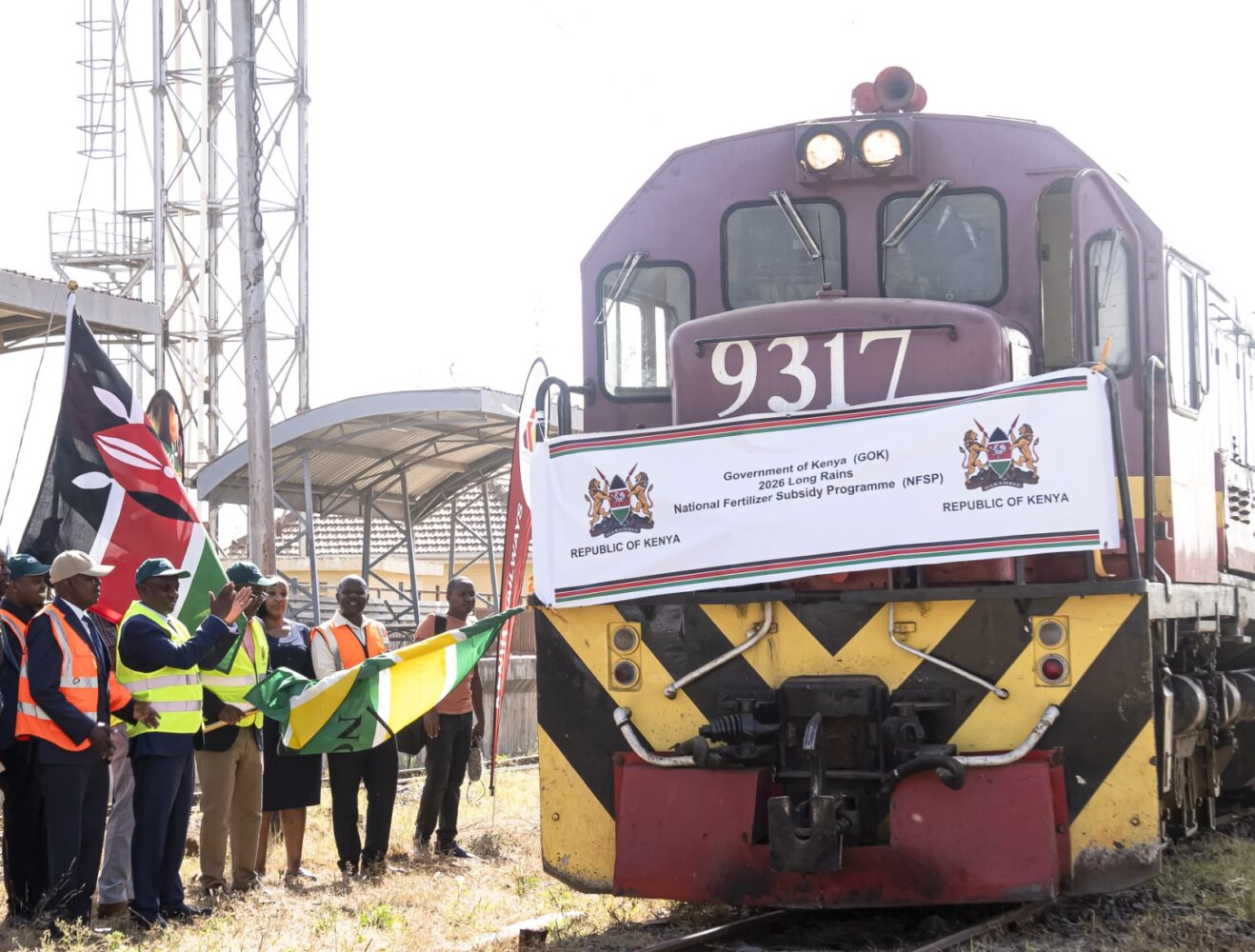
Farmers are set to get fertilisers from National Cereals and Produce Board (NCPB) depots across the country following the Government’s rollout of the 2026 Long Rains National Fertiliser Subsidy Programme.
The Government flagged off the programme in a move aimed at stabilising food production even as Kenya faces a worsening drought that has left millions food insecure.
Speaking during the launch, Dr Paul Kiprono Rono, Principal Secretary, State Department for Agriculture, said the fertiliser will be delivered to NCPB depots using the Standard Gauge Railway, a move intended to speed up distribution ahead of the planting season, lower transport costs and ensure timely access to farm inputs.
The intervention comes against the backdrop of a deepening humanitarian concern linked to poor rainfall performance, with acute malnutrition continuing to rise and affecting over 810,000 children and 104,000 pregnant and lactating women, alongside other vulnerable groups.
In response, the Cabinet noted that the funding supplements allocations made in December 2025 and January 2026 that supported relief food, logistics and limited non-food assistance, with current stocks expected to last only two to three weeks.
Deputy President Kithure Kindiki, speaking when he chaired the high-level meeting at the Official Residence in Karen, Nairobi, that brought together Cabinet Secretaries, Principal Secretaries and heads of agencies, said at least 3.3 million people in 23 counties are affected by the drought occasioned by poor rainfall reported between October and December 2025.
The meeting, which reviewed interventions and sought to streamline response for maximum impact, noted that several counties are now classified in the crisis stage, including Mandera, Wajir, Garissa, Tana River, Marsabit, Turkana, Kwale, Meru North, Samburu and Isiolo.
“Many counties are in need of food for the people and livestock feed. We are tirelessly working on effective last-mile delivery of food so it does not take long to reach the people. We are also trucking water to the people and livestock,” the Deputy President noted.
He said the most vulnerable members of society, including school-going children, women and persons with disabilities, are being prioritised.
“We need food to reach our schools so that learners are not disrupted by the ongoing drought situation. We have reviewed and resolved to upscale the ongoing interventions. We have also resolved to diversify the provision of food to take care of special members of society, including children, women and vulnerable members of society,” he stated.
The Deputy President, however, assured the country that the Government will mobilise all necessary resources to ensure affected communities have sufficient food, water and medical supplies.
Measures have also been put in place to strengthen last-mile delivery of relief supplies, pasture support, water provision and livestock vaccination.
The Cabinet further resolved to spend KSh4 billion every month to procure food and non-food items, livestock feed and water for human, domestic and wildlife consumption, while appealing to development partners to complement the allocation with a KSh2 billion boost.
Officials say the dual approach of subsidised fertiliser and expanded relief programming is intended to cushion households now while safeguarding the next harvest.