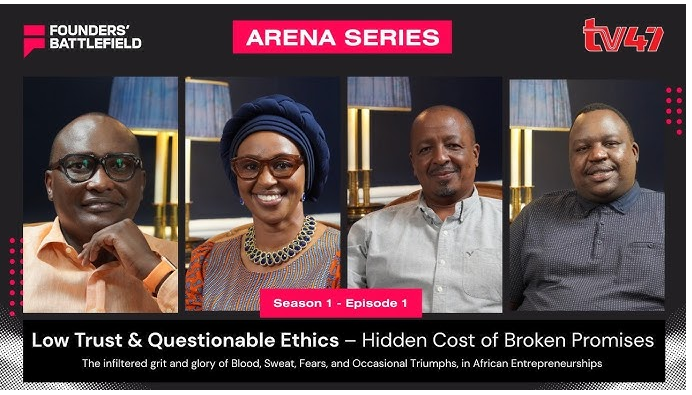
Trust remains both a cornerstone and a challenge in entrepreneurship, shaping relationships with customers, partners, and society at large.
Kevin Mutiso, CEO of OYE Platform Solutions, has spent nearly two decades in entrepreneurship, currently leading what he describes as Kenya’s fastest-growing startup.
His venture addresses a fundamental problem; the exclusion of boda boda riders from relevant insurance products.
“The boda boda driver did not have access to insurance that was relevant to them. We then embedded it in a purchase that they make every day for fuel,” Mutiso explains.
What began as an insurance solution has evolved into a comprehensive one-stop shop for boda boda riders, offering insurance, loans, lubricants, helmets, and reflector jackets.
The platform has distributed over 5,000 helmets and 10,000 reflector jackets, alongside a loan product enabling riders to purchase full tanks of fuel rather than making piecemeal purchases.
Celebrating its third birthday on February 24th, OYE Platform Solutions has crossed a critical milestone in startup survival. For Mutiso, the work extends beyond business metrics to addressing societal perceptions.
“My customer is not trusted, right? The boda boda driver is a pariah in Kenyan society to many people. Yet that same boda boda driver is a guy who drops your kids to school, carries all your sensitive documents from one place to another and delivers your food,” he observes.
This contradiction has driven the company’s “Maisha Ni Kujituma” program, focused on restoring dignity to riders who perform essential services yet face social stigma.
For Michael Antony Macharia, founder and CEO of Seven Sea Technologies, the question of trust carries deeper, more personal wounds.
His experience with broken trust in business forced a reckoning with his own character.
“Trust, it breaks your heart, right? And then it makes you, what kind of person do you become post that? Do you become vengeful? Do you become bitter? Do you become pessimistic?” Macharia reflects.
When pressed on preventive measures by Renee Ngamau, Co-founder and President of CheckUps Medical Credit, Macharia acknowledged a critical oversight.
“What I think I should have done, I should have insured myself against political risk. Political risk could be change of government, change of leadership, or even political destruction,” he admits.
His advice to fellow entrepreneurs is clear: when signing big contracts, especially with public institutions, political risk insurance is essential.
Roy Gitahi, CEO of Art at Work Limited, tackles a different dimension of trust: financial institutions’ perceptions of creative professionals.
His question is pointed; if a dancer or a comedian walked into a bank and asked for a loan, what would the answer be? The response, as Gitahi notes, would typically be dismissive.
Yet this generation’s career aspirations have fundamentally shifted from traditional professions to creative pursuits.
“Unlike us, when we were growing up, what will become a doctor, lawyer, an engineer, pilot, those kind of things, it’s like it was on the back of the birth certificate. This generation is now growing up wanting to become content creators, bloggers, vloggers, footballers, and those kind of things,” Gitahi explains.
This shift raises urgent questions about economic participation. Art at Work’s response has been to pioneer financial inclusion for creatives, developing products that recognize the unique needs and potential of this sector.
“Of course that’s when our trust comes in, because what is the perception that we have of creatives?” Gitahi notes, highlighting how societal biases translate into economic exclusion.
Together, these entrepreneurs illuminate the multifaceted nature of trust in business, from dignifying marginalized workers to protecting oneself from institutional risks, to challenging systemic biases that exclude entire sectors from economic opportunity.
Their experiences reveal that successful entrepreneurship requires not just innovative products, but a willingness to confront and reshape the trust dynamics that underpin commerce itself.