
For centuries, war has been treated as an unavoidable instrument of international politics. From regional conflicts to global confrontations, humanity has repeatedly relied on force to resolve disputes. Yet a critical question continues to echo across the international community: must conflict always end in war?
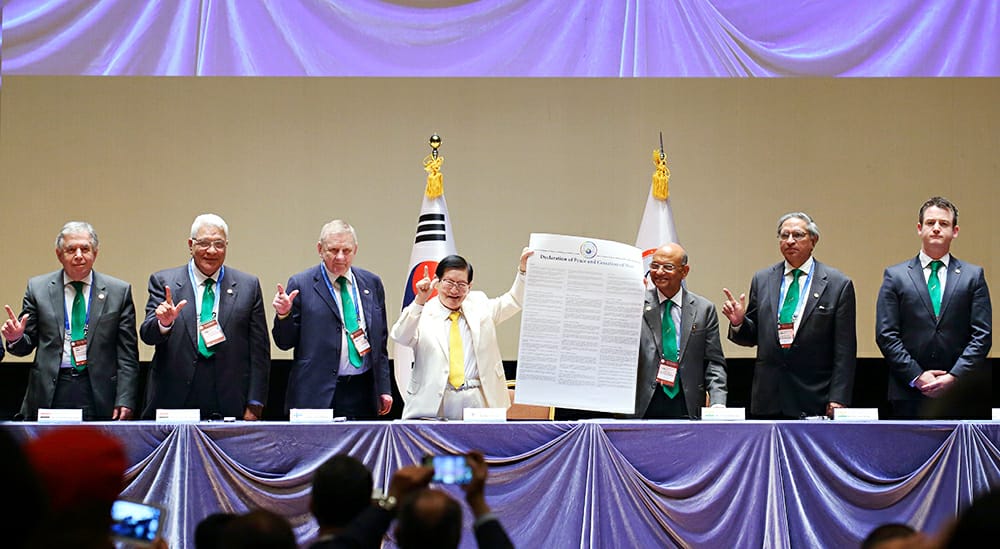
Ten years after the proclamation of the Declaration of Peace and Cessation of War (DPCW), global peace advocates are reflecting on whether the world can transition from a system that tolerates war to one that prioritizes structured peace.
The declaration, announced on March 14th, 2016 by Heavenly Culture, World Peace, Restoration of Light (HWPL) was introduced as a framework aimed at addressing the root causes of war and establishing legal and institutional mechanisms for peaceful conflict resolution.
The initiative is closely tied to the experiences of Man-hee Lee, HWPL’s Chairman whose memories of serving as a student soldier during the Korean War deeply influenced his vision for global peace.
Witnessing the devastation of war firsthand convinced him that future generations should not inherit a world trapped in endless cycles of violence.
This vision gained international momentum during the HWPL World Peace Summit 2014 held in Seoul, South Korea.
The summit brought together 1,933 participants from 152 countries, including political leaders, religious figures and civil society representatives.
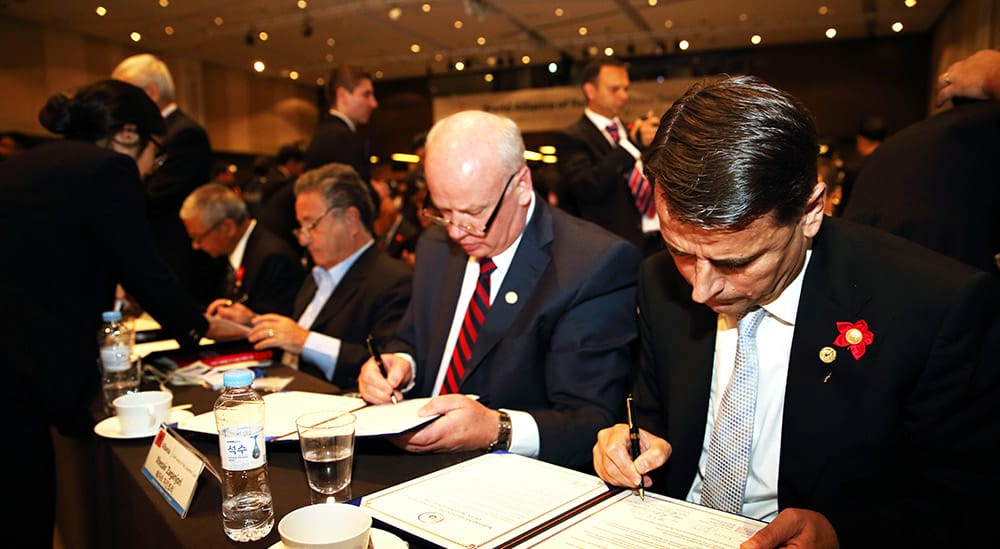
Participants agreed on the urgent need for international standards that could prevent conflicts before they escalate into armed confrontations.
To translate this vision into a practical framework, HWPL established the HWPL International Law Peace Committee (ILPC) in 2015.
The committee, composed of international law experts, developed the DPCW through extensive legal consultation.
The final document consists of 10 articles and 38 clauses outlining principles for the prevention of war, peaceful dispute settlement and stronger international cooperation.
Rather than replacing existing international law, the DPCW seeks to strengthen and clarify the principles already recognized within the global legal order.
It proposes clearer standards on the use of force, mechanisms for peaceful dispute resolution and stronger cooperation between states.
Importantly, the declaration also recognizes the roles of religious institutions and civil society in maintaining peace, expanding responsibility beyond governments alone.
Supporters argue that the initiative represents a significant shift from a global system that historically assumes war as a possible outcome of conflict.
Instead, it calls for disputes to be managed through dialogue, legal frameworks and institutional cooperation, since its proclamation, the DPCW has attracted growing international support.
Regional parliamentary bodies such as the Pan-African Parliament, Central American Parliament and the Latin American and Caribbean Parliament have adopted resolutions endorsing the initiative.
Beyond political institutions, the declaration has also gained traction among ordinary citizens. Nearly 900,000 endorsements have been collected from individuals in 178 countries, reflecting a growing movement within civil society advocating for stronger global peace mechanisms.
However, the reality of international politics remains complex. Armed conflicts continue to erupt in different regions and geopolitical rivalries still shape global decision-making.
While the DPCW presents a structured vision for peace, turning that vision into a fully operational international framework remains a long-term challenge.
The core message of the DPCW is not that conflict can be eliminated entirely. Disagreements between nations, cultures and interests will inevitably arise. The real question, according to its advocates, is how those conflicts are addressed.
For much of history, the international order has relied on military superiority to settle disputes.
The DPCW proposes a different path, one where conflicts are managed through legal standards, cooperation and institutional dialogue rather than armed confrontation.
Over the past decade, the initiative has focused on raising global awareness and building institutional support. The challenge ahead lies in ensuring that these principles move beyond declarations and become embedded within the functioning of international relations.