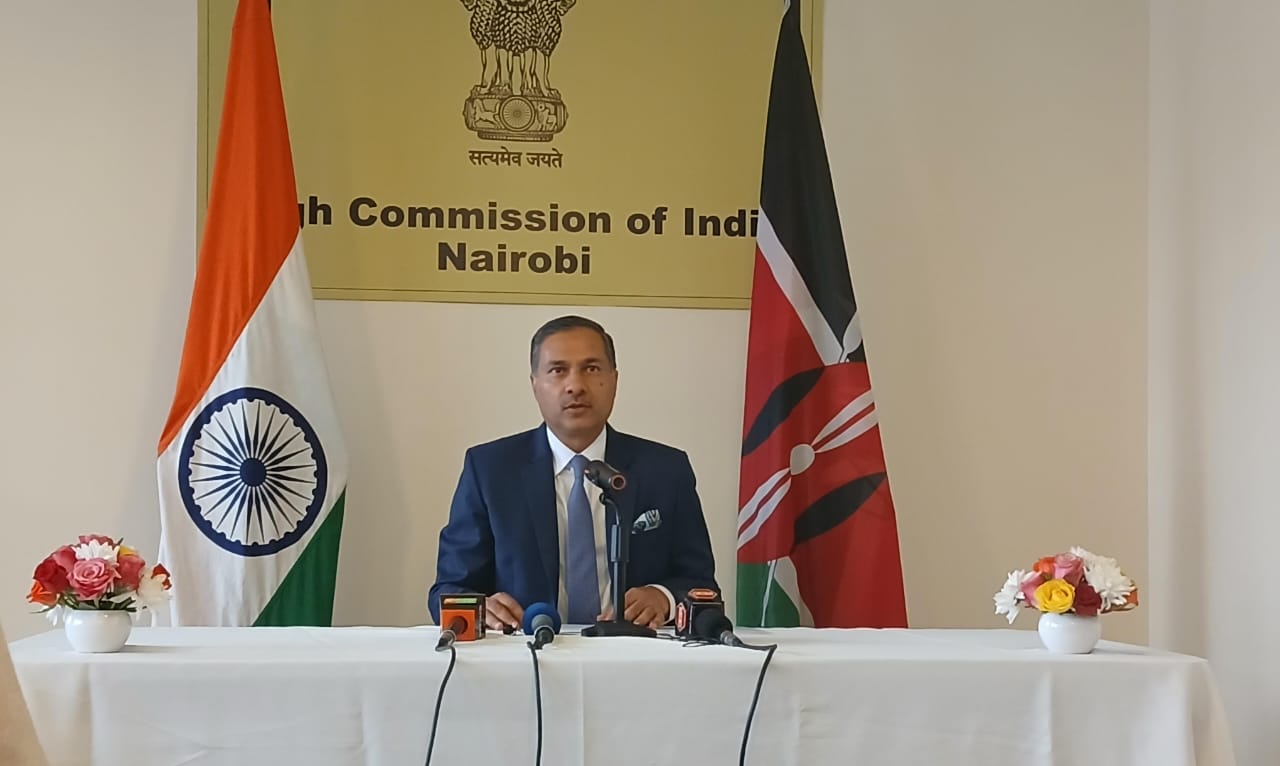
India and Kenya’s relationship continues to be rooted in centuries of shared history, sacrifice, and people-to-people ties is today evolving into a broad-based strategic partnership spanning trade, defence, development cooperation, and culture.
Tracing the origins of the relationship, India’s High Commissioner in Kenya Dr. Adarsh Swaika noted that interactions between the Indian subcontinent and the Swahili coast date back over 2,000 years.
One of the most defining milestones was the construction of the Mombasa–Uganda railway in the late 19th century by more than 32,000 Indian workers.
Despite the loss of nearly 2,500 lives, the railway transformed the region’s economy and laid the foundations of modern Kenya, giving rise to cities such as Mombasa, Nairobi, and Kisumu.
He also highlighted the largely overlooked contribution of Indian soldiers during the First World War, when over 40,000 Indian troops served in East Africa between 1914 and 1918.
Many lost their lives due to combat, disease, and harsh conditions. Earlier this year, India and Kenya jointly unveiled the India–Africa Commemorative Pillar in Taita Taveta to honour the sacrifice of Indian and African soldiers.
Beyond labour and military service, Indians played a significant role in Kenya’s political awakening and freedom struggle.
Figures such as Makhan Singh, regarded as the father of Kenya’s trade union movement, and freedom fighter Pio Gama Pinto were among the earliest voices against racial discrimination and colonial rule.
Indian-run newspapers, schools, and publishing houses helped spread political awareness, influenced in part by Mahatma Gandhi’s philosophy of non-violent resistance.
Dr. Swaika said this shared struggle forged a natural bond between the two nations, reflected even in moments of grief.
He cited India’s facilitation of the repatriation of the mortal remains of former Kenyan Prime Minister Rt. Hon. Raila Amollo Odinga with full honours as a symbol of the deep trust and closeness between the two countries.
Turning to present-day ties, the High Commissioner said India–Kenya relations have intensified through regular high-level engagements.
India is currently Kenya’s third-largest trading partner, with bilateral trade valued at about USD 3.5 billion annually.
Kenyan exports to India have risen by nearly 80 per cent over the past year, while close to 200 Indian companies operate in Kenya across sectors such as manufacturing, pharmaceuticals, telecommunications, banking, and infrastructure.
Defence and security cooperation has expanded into training, peacekeeping, maritime engagement, defence industry collaboration, and humanitarian assistance.
India’s rapid response during Kenya’s devastating floods in May 2024 and the supply of over one million COVID-19 vaccines to Kenya underscored this partnership in times of crisis.
People-to-people links remain a cornerstone of relations. Kenya hosts an Indian diaspora of about 80,000–100,000 people, officially recognized as the country’s 44th tribe in 2017.
India also offers hundreds of fully funded scholarships annually to Kenyans, while nearly 10,000 Kenyan patients travelled to India this year for medical treatment.
Dr. Swaika said India’s economic rise, now the world’s fourth-largest economy and its long-term vision of Viksit Bharat 2047 aligns closely with Kenya’s Vision 2030, creating new opportunities in renewable energy, digital infrastructure, healthcare, education, and youth employment.
At the global level, he reaffirmed India’s commitment to the Global South, noting its role in securing permanent African Union membership in the G20 and advancing Africa’s voice in multilateral institutions.
“India does not see Africa as a destination, but as a partner in shaping the global future,” Dr. Swaika said, adding that Kenya remains central to India’s engagement with the continent.