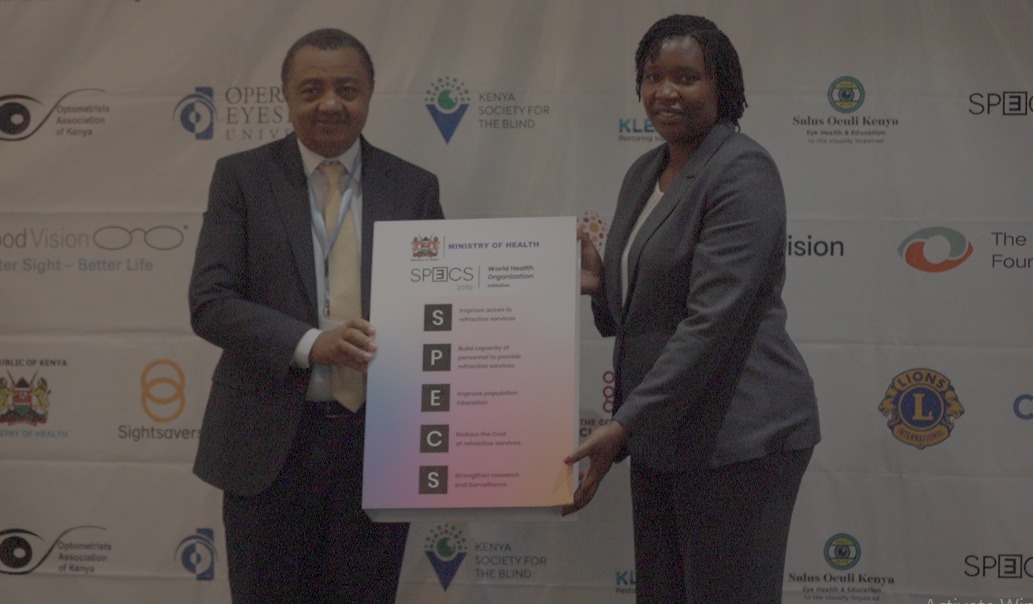
Kenya has officially launched the SPECS 2030 Initiative, a major step aimed at addressing the growing burden of uncorrected poor vision across the country.
The Ministry of Health, in collaboration with the World Health Organization and a coalition of 20 eye health partners, unveiled the initiative in a move that underscores renewed momentum in strengthening eye care services through multi-sectoral collaboration.
SPECS 2030 is a global drive focused on ensuring universal access to quality, affordable, and people-centered refractive error services. The initiative targets a 40 percent increase in effective refractive error coverage by the year 2030.
In Kenya, however, access to vision correction remains critically low. Current estimates indicate that only 6.7 percent of individuals in need of spectacles are able to access them—meaning that out of every 100 Kenyans requiring vision correction, only about seven receive appropriate care.
Health experts warn that the gap has far-reaching consequences, impacting education outcomes, workplace productivity, road safety, and overall quality of life.
Speaking during the launch, Dr. Monicah Bitok, Acting Head of the Eye Health Section at the Ministry of Health, emphasized the urgency of scaling up interventions, noting that uncorrected refractive error remains one of the leading causes of visual impairment in the country.
She said the SPECS 2030 framework offers a structured, evidence-based pathway to expand access, strengthen health systems, and ensure equitable eye care services for all Kenyans.
Dr. Andrew Toro, speaking on behalf of the Director General for Health, reaffirmed the government’s commitment to leveraging the initiative to strengthen primary healthcare systems and foster sustainable partnerships, particularly in reaching underserved communities.
He also called on stakeholders to align their support with national priorities under the SPECS framework, highlighting the critical role of frontline health workers in delivering accessible and quality eye care services.
The initiative will focus on expanding access to refractive services, building the capacity of eye health personnel, enhancing public awareness, reducing the cost of spectacles, and strengthening research, data collection, and monitoring systems.
The launch signals a renewed national push to address what experts describe as a silent public health crisis affecting millions of Kenyans, including school-going children and the working population.
Through coordinated efforts between government, development partners, the private sector, and eye health organizations, Kenya now aims to significantly improve access to spectacles and ensure that clear vision becomes a reality for all.