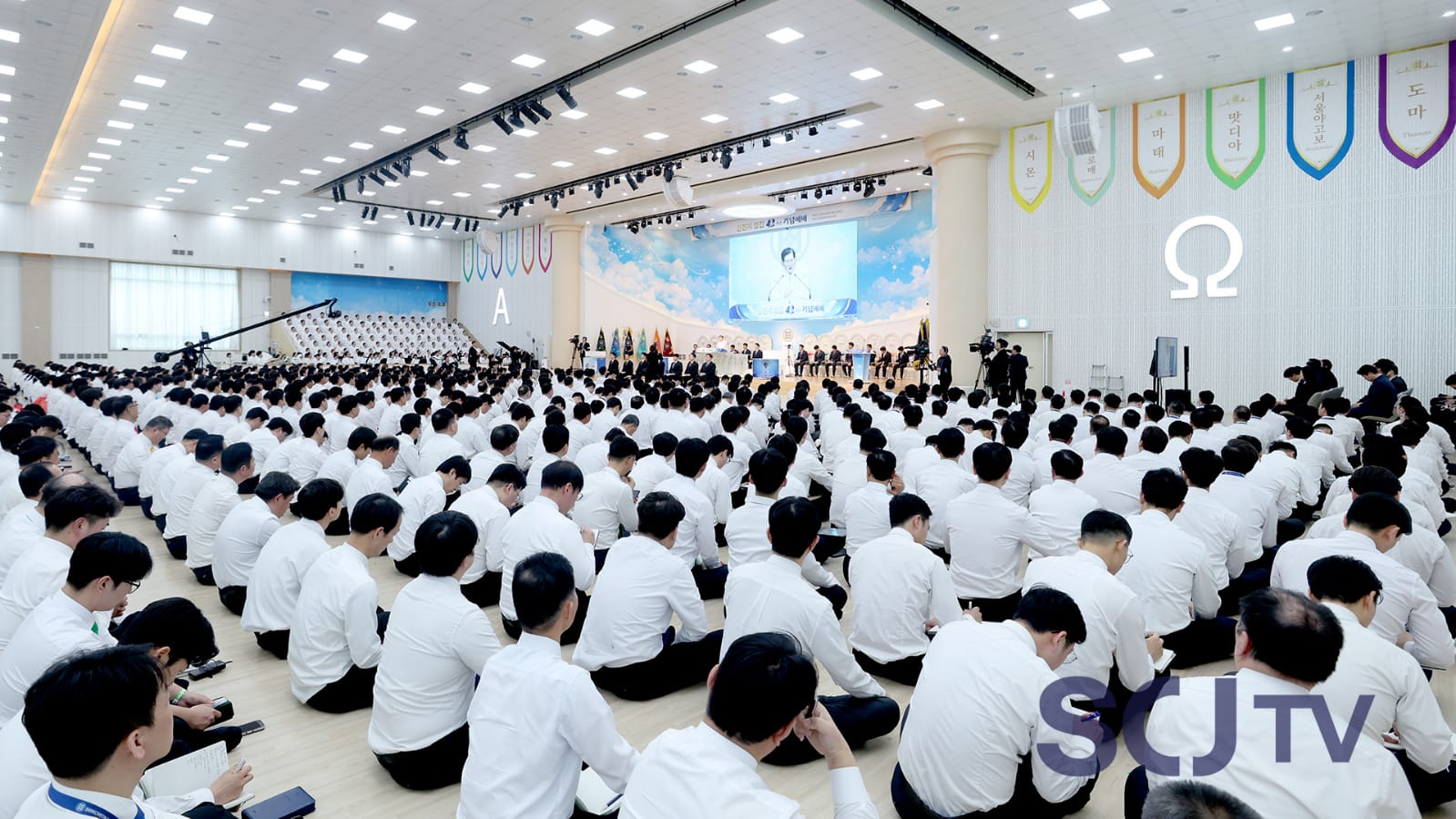
A new opinion poll by Kenya Track Survey has revealed a highly competitive and rapidly evolving race for Nairobi’s gubernatorial seat ahead of the 2027 General Election, with Embakasi East MP Babu Owino emerging as the early frontrunner.
The survey, conducted between February 20 and March 17, 2026, sampled 6,679 respondents across Nairobi County through telephonic interviews, with a margin of error of ±3 percent at a 95 percent confidence level. It paints a picture of a city politically energized, with voters already aligning themselves around different leadership styles and visions for the capital.
According to the findings, Babu Owino commands 38 percent support, positioning him as the candidate to beat in the high-stakes race for City Hall. His popularity is largely driven by strong backing among youth, students, informal settlement residents, and grassroots mobilizers who resonate with his bold, outspoken leadership and advocacy for ordinary citizens.
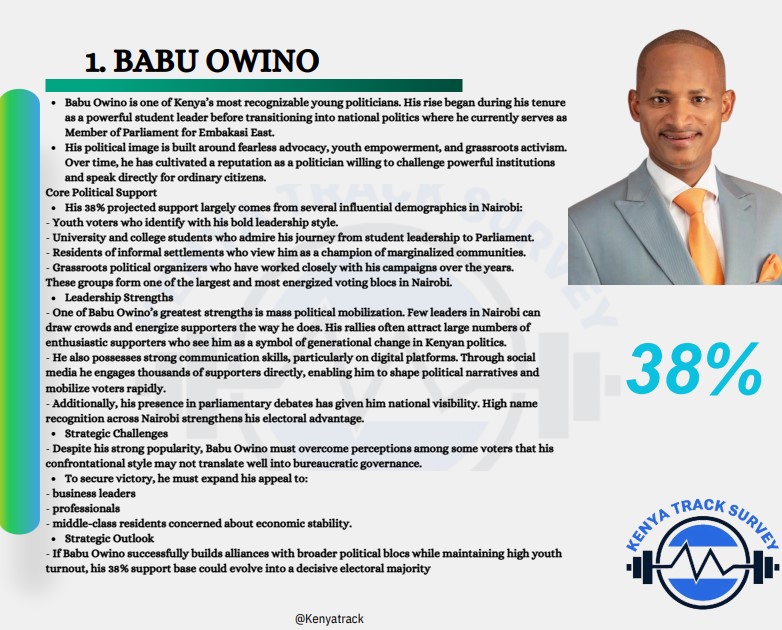
Closely trailing him is Ronald Karauri with 33 percent support. Karauri, associated with corporate leadership and business success, draws his strength from Nairobi’s business community, professionals, and middle-class voters who prioritize efficiency, economic growth, and structured governance.
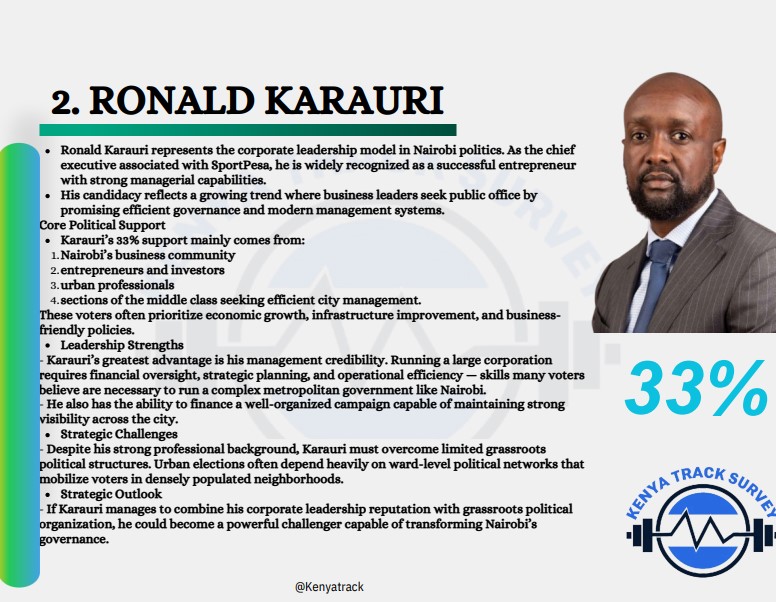
James Gakuya ranks third with 15 percent support, anchored on his long-standing grassroots networks and influence among sections of the Mount Kenya voting bloc within the city. His campaign benefits from strong ward-level mobilization structures and community engagement experience.
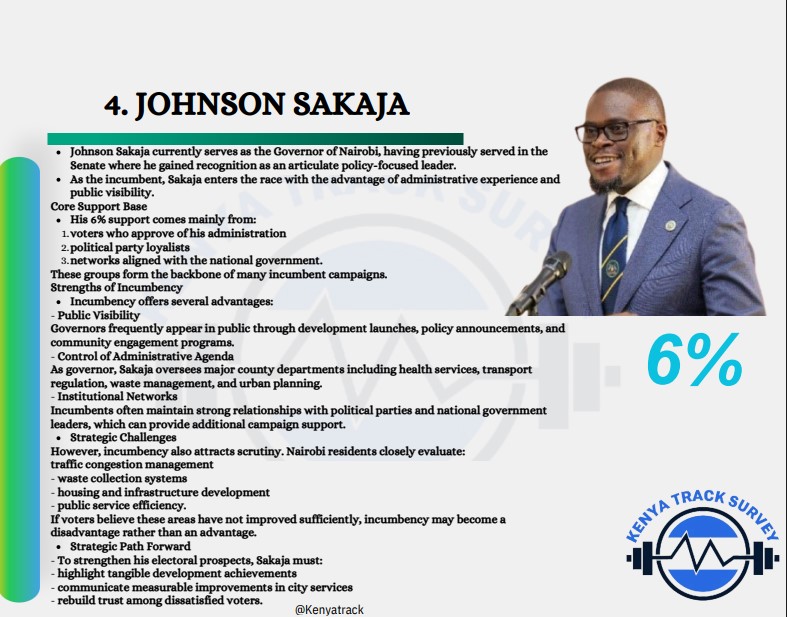
Incumbent governor Johnson Sakaja trails with 6 percent support, reflecting a challenging path ahead as voters assess his performance in key areas such as traffic management, waste collection, housing, and service delivery. While incumbency offers visibility and administrative control, the survey suggests that public scrutiny may weigh heavily on his re-election bid.
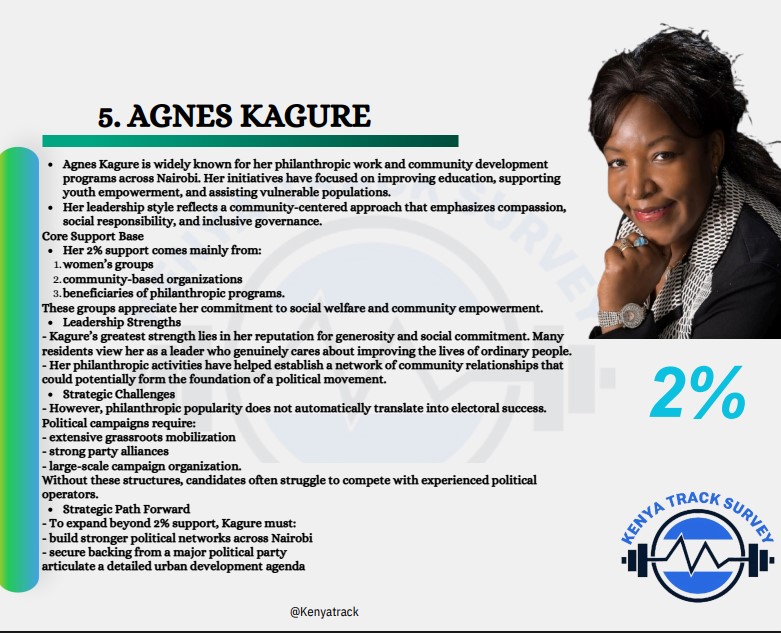
Philanthropist Agnes Kagure and policy-focused technocrat Irungu Nyakera register 2 percent support each. Kagure’s backing stems largely from community groups and beneficiaries of her social programs, while Nyakera appeals to policy-oriented voters and governance reform advocates.
The survey also indicates that about 3 percent of Nairobi voters remain undecided, a small but potentially decisive bloc that could influence the final outcome depending on how campaigns evolve.
These voters are reportedly waiting for clearer policy proposals, stronger alliances, and a more defined demonstration of leadership capability from the candidates.
The findings highlight a broader contest between grassroots populism and technocratic, corporate-style leadership, with alliances, messaging, and voter turnout expected to play a critical role in shaping the final outcome.
As the 2027 race gains momentum, the battle for Nairobi’s governorship is emerging as one of the most closely watched political contests in the country. With the city’s economic significance and complex governance challenges, the eventual winner will need to build a broad coalition, articulate a clear development agenda, and inspire confidence among Nairobi’s diverse electorate.