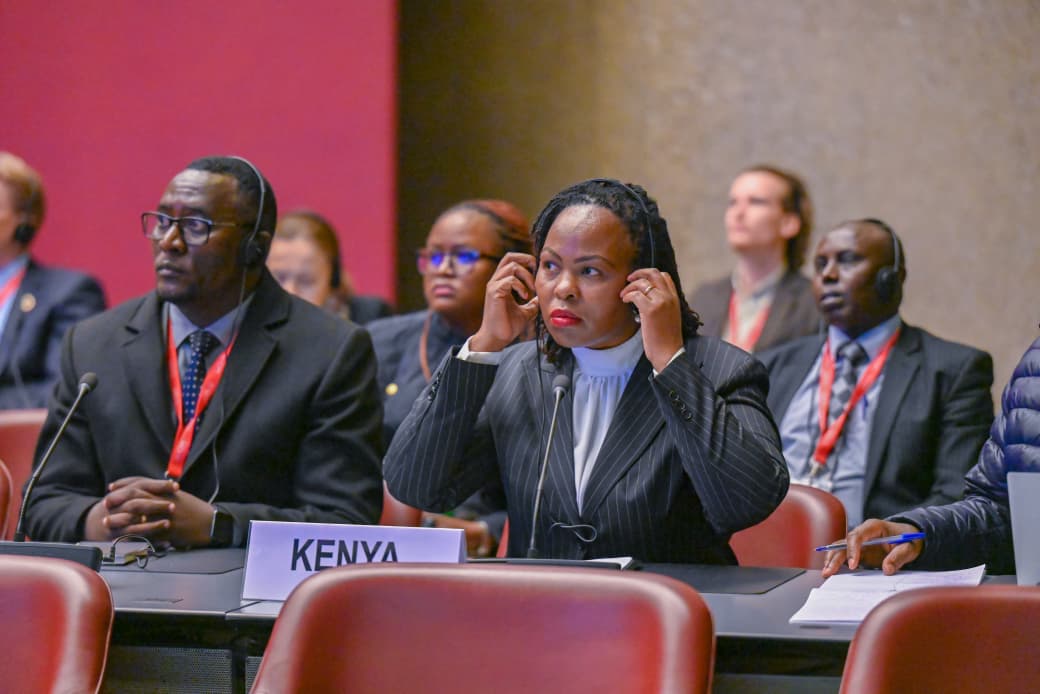
Kenya has reaffirmed its commitment to promoting safe, orderly and development-oriented migration, spotlighting the historic rise in diaspora remittances, now at USD 4.95 billion, as a key driver of national development.
Delivering the statement on behalf of Cabinet Secretary for Interior and National Administration Kipchumba Murkomen, Kenya’s Permanent Representative to the UN in Geneva, Ambassador Dr. Fancy Too, told delegates at the High-Level Segment of the 116th IOM Council Session that migration remains a powerful instrument for resilience and socio-economic advancement when well governed.
“Migration is universally acknowledged as a purposeful and positive choice for many who leave the comfort of their habitual residences in search of better opportunities. It yields significant benefits for migrants themselves as well as for both origin and destination societies,” the statement read.
According to the government, remittances from Kenya’s growing diaspora community reached between USD 4.94 billion and USD 4.95 billion in 2024, equivalent to about Ksh 640 billion, an 18 per cent increase from 2023.
The statement noted that this growth reflects the expanding economic footprint of Kenyans working abroad.
“Kenyan diaspora contributes significantly to national development through skills, knowledge transfer, investments, and remittances,” the Cabinet Secretary said, underscoring migration as a central pillar of the country’s transformation agenda.
Amb. Too emphasised that Kenya’s migration model is grounded in the humanitarian–peace–development nexus, and aligned with global and regional frameworks, including the Global Compact for Migration, Agenda 2030, AU Agenda 2063, and the AU Migration Policy Framework for Africa.
She added that Kenya is finalising its first-ever National Migration Policy by mid-2026 to consolidate commitments and enhance governance.
Kenya’s “whole-of-government and whole-of-society approach” was also highlighted, with reforms such as the visa-free regime, Electronic Travel Authorisation, new permit classes, and strengthened border governance seen as key to creating safer, more predictable migration pathways.
On refugee management, Kenya reaffirmed its commitment to the Shirika Plan, launched earlier this year to shift refugee support from humanitarian aid to socio-economic inclusion. With more than 1 million migrants, including 849,625 refugees and asylum seekers, Kenya said integrated settlement models in Turkana and Garissa are already yielding positive results.
The Cabinet Secretary urged deeper international partnerships and predictable long-term financing, noting that migration governance “is a shared responsibility.
”In her closing remarks, Amb. Too reiterated Kenya’s commitment to championing migration that supports development. “We demonstrate that with vision, collaboration, and political leadership, migration can be transformative not only for migrants, but also for host communities,” the statement concluded.