The Kenya National Examinations Council (KNEC) has issued a stern warning to schools, urging them to stop misleading the public with fake or inaccurate analyses of the Kenya Junior School Education Assessment (KJSEA) results.
In a statement, KNEC noted that some schools have been presenting KJSEA outcomes using aggregate scores and so-called school mean scores, practices KNEC said are inconsistent with the design and philosophy of the Competency-Based Curriculum (CBC).
“We urge schools to stop misleading the public with fake and inaccurate KJSEA results analysis,” KNEC stated.
KNEC clarified that, unlike the previous exams under the 8-4-4 education system, KJSEA does not provide an aggregate score, overall total, or school mean score.
Under CBC, each subject is assessed independently, and learners’ achievements are reported using performance levels rather than cumulative marks.
“Unlike the former system, KJSEA does not provide an aggregate score. Why? Because CBC is about nurturing individual potential, not ranking learners,” KNEC added.
The examinations body emphasized that the assessment approach ensures a learner’s excellence in one subject is recognised independently and not overshadowed by weaker performance in another.
KNEC has termed such analyses misleading and inaccurate, stating that they do not reflect official assessment practices and warns that such practices undermine the principles of the CBC.
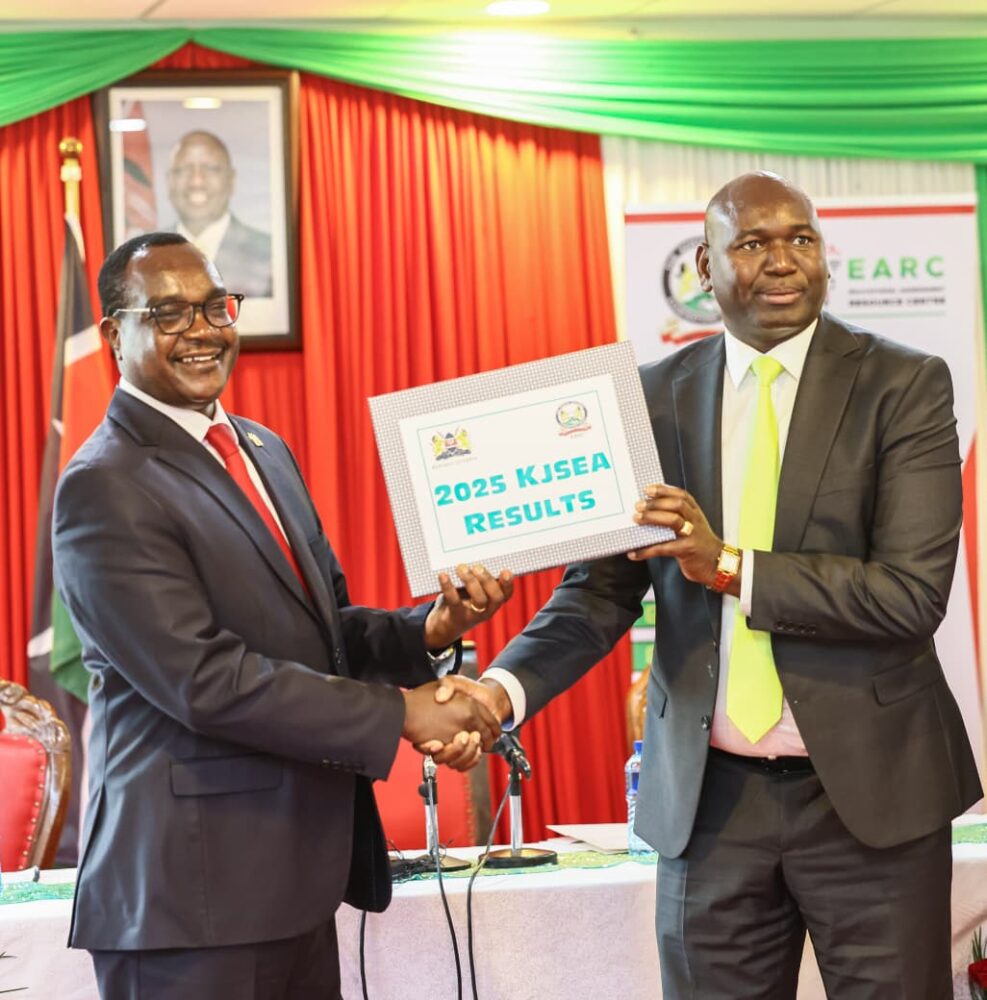
This comes after the Ministry of Education released the 2025 KJSEA results on December 11, 2025.
The release of the inaugural KJSEA results caused confusion among parents and learners, especially over the grading system.
KNEC, however, provided clarification on how the results were generated and reported across the nine learning areas, as well as the cumulative total.
The council explained that learners’ performance was assessed across nine learning areas, with scores reported on a scale of 1 to 8. A score of 8 represents the highest level of exceeding expectations, while 1 represents the lowest level of below expectations.
Education Cabinet Secretary Julius Ogamba confirmed that all 1,130,459 candidates who sat the assessment will transition to senior school in 2026 and be placed into one of the three pathways: Arts and Sports Science, Social Sciences, or Science, Technology, Engineering and Mathematics (STEM).
The CS explained that each subject has a maximum of eight points, giving a possible maximum score of 72 across the nine subjects assessed. Overall learner performance was categorised into: exceeding expectation, meeting expectation, approaching expectation, and below expectation.