A coalition of civil society, religious and social organizations in Korea has warned that recent remarks by senior South Korean government officials targeting specific religious groups risk promoting hatred and the misuse of state power.
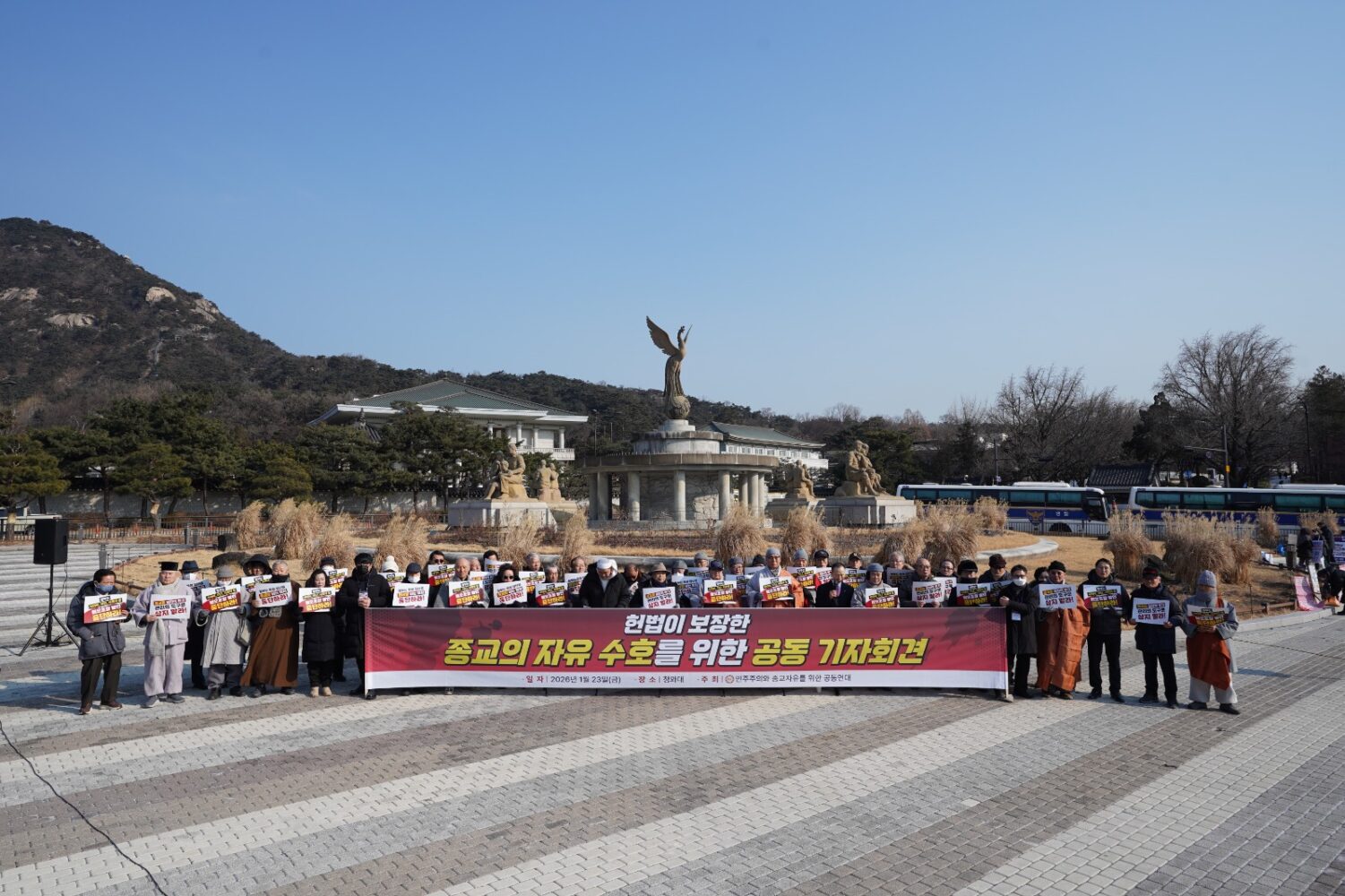
The Coalition for Democracy and Freedom of Religion (CDFR) issued the warning during a joint press conference held at the Blue House fountain in Seoul, marking the coalition’s official launch.
The group said that state-led stigmatization of particular religions threatens constitutionally guaranteed freedom of religion and the principle of separation between religion and state.
CDFR brings together representatives from Buddhist, Christian and Islamic communities, alongside legal experts, university professors and civil society leaders.
About 100 people attended the event dubbed “Joint Press Conference for the Protection of Constitutionally Guaranteed Freedom of Religion”.
Reading the joint statement, Ven. Beop San, executive chief of the Jogye Order of Daegak Buddhism and a co-representative of the Coalition, cautioned that repeated official references to certain religions as “pseudo-religious,” “heretical,” or “harmful” undermine religious neutrality and equality before the law.
The Coalition cited Articles 10, 11, and 20 of the South Korean Constitution, which guarantee human dignity, equality and freedom of religion, respectively.
It argued that broad negative labeling by senior officials regardless of whether criminal investigations are ongoing could erode democratic principles and public trust in state impartiality.
The statement followed remarks made during a January 12, 2026 luncheon between President Lee Jae-myung and religious leaders, where the President reportedly agreed with comments describing groups such as the Unification Church and Shincheonji as causing severe social harm.
The following day, Prime Minister Kim Min-seok referred to the same groups as “social evils” during a Cabinet meeting and ordered a comprehensive government-wide investigation.
CDFR warned that such rhetoric, especially when delivered at the highest levels of government, risks inciting public hostility and blurring the constitutional boundary between state authority and religious freedom.
The coalition noted that some of the targeted religious organizations have also been involved in social welfare activities yet have faced sweeping condemnation without specific criminal findings being presented publicly.
Emphasizing South Korea’s obligations under international human rights instruments, including the International Covenant on Civil and Political Rights (ICCPR), the Coalition called for independent reviews by the United Nations and global human rights organizations to assess whether recent government actions align with constitutional and international standards.
Further, CDFR urged the government to halt actions that may incite hatred against particular religious groups, issue a public apology for discriminatory remarks and establish inclusive communication frameworks that respect all beliefs equally.
“Freedom of religion is not an issue concerning a single group,” the Coalition said, adding that it’s a fundamental standard for the entire democratic society.