A new survey by Ipsos has ranked Ndindi Nyoro as the most influential Member of Parliament in 2026, cementing his position as a dominant force in the country’s political landscape.
The survey, conducted between February 15 and March 18, 2026, places the Kiharu legislator at the top with an impressive 96 percent influence rating, reflecting his strong presence in national politics, legislative engagement, and grassroots connection.
Coming in second is Majimbo Kalasinga of Kabuchai Constituency, who scored 90 percent, followed closely by Babu Owino of Embakasi East at 88 percent.
The outspoken Nairobi MP continues to command significant public attention through his bold political stance and active engagement in national discourse.
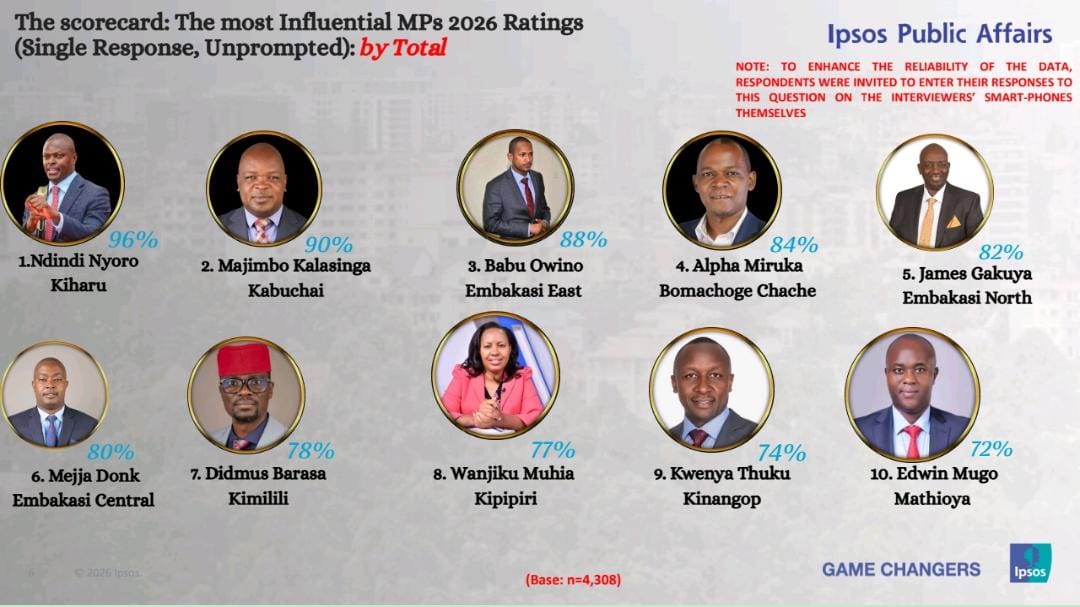
Alpha Miruka of Bomachoge Chache ranks fourth with 84 percent, while James Gakuya of Embakasi North closes the top five with 82 percent, underlining the growing influence of Nairobi-based legislators in shaping political conversations.
The survey further ranks Mejja Donk of Embakasi Central in sixth place with 80 percent, followed by Didmus Barasa at 78 percent.
Wanjiku Muhia takes the eighth position with 77 percent, while Kwenya Thuku ranks ninth at 74 percent. Rounding off the top ten is Edwin Mugo with 72 percent.
The survey captures public perception of MPs based on their influence in Parliament, visibility in national politics, effectiveness in service delivery, and their ability to connect with constituents.
The findings reflect a dynamic and evolving leadership landscape, where both seasoned politicians and emerging voices are shaping the country’s governance trajectory.
According to Ipsos, the competition for political relevance is intensifying as leaders position themselves ahead of future electoral contests.
The rankings highlight a blend of development-focused leadership, vocal political engagement, and strategic visibility that continues to define Kenya’s legislative space.
The study was based on a nationally representative sample of 8,497 respondents drawn from all 47 counties, with a margin of error of plus or minus 3 to 4 percent at a 95 percent confidence level.
Interviews were conducted through both face to face and telephone methods, ensuring a balanced representation of urban and rural populations.
While the survey offers a compelling snapshot of public sentiment, analysts note that such rankings remain fluid and subject to change depending on shifting political, economic, and social dynamics across the country.
As Kenya’s political environment continues to evolve, the latest findings underscore the growing importance of performance, visibility, and public trust in shaping the influence and future prospects of Members of Parliament.