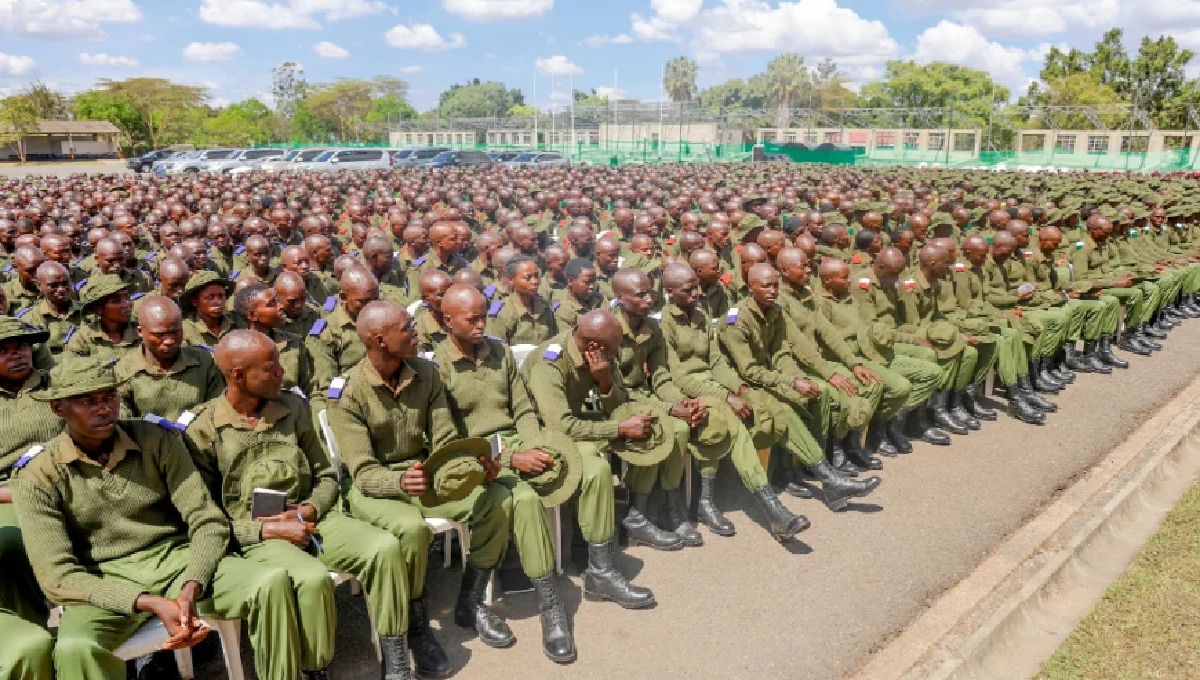
Police, Prisons and National Youth Service officers are set to receive the last phase of their salary increases in July, the government has announced, in what officials describe as the highest cumulative pay rise for security personnel in three consecutive years since independence.
The announcement followed a meeting of the National Steering Committee on reforms in the National Police Service (NPS), Kenya Prisons Service (KPS) and National Youth Service (NYS), chaired by Principal Secretary for Internal Security and National Administration Dr. Raymond Omollo.
“This will be the highest cumulative pay increases for officers over three consecutive years since independence,” the committee noted, adding that lower-ranked officers are the main beneficiaries of the new salary payments directed by the President.
Lower-ranked officers stand to benefit the most. A police constable, the lowest cadre in the NPS, will now earn a maximum of KSh57,700, up from KSh38,975, representing a 48 percent raise. Newly graduating constables from police training colleges will take home a starting salary of KSh29,296, up from KSh20,390, a 44 percent jump.
A similar increase has been applied to their equivalents in the Kenya Prisons Service.
NYS officers in the lowest cadre will earn between KSh26,222 and KSh37,912, compared to a previous range of KSh19,800 to KSh32,315.
At the top of the pay scale, the highest-ranking police officer will earn a maximum monthly basic pay of KSh345,850, up from KSh289,090, a 20 percent increase.
The highest-paid KPS officers will earn between KSh301,548 and KSh584,903, with comparable adjustments applied in the NYS.
The phased salary increases took effect from July 1, 2024, following a government directive covering all three services.
Overall, the three institutions have now implemented more than 50 percent of planned reform actions.
“The National Police Service leads with 57.2 percent overall implementation, while the Kenya Prisons Service and the National Youth Service are progressing at comparable levels,” the committee said.
The reforms are being driven under a four-pillar transformation framework focusing on Institutional Capacity Development, Operational Preparedness, Oversight and Accountability, and Human Resource Management, designed, officials say, to strengthen service delivery, professionalism and accountability across the three services.