
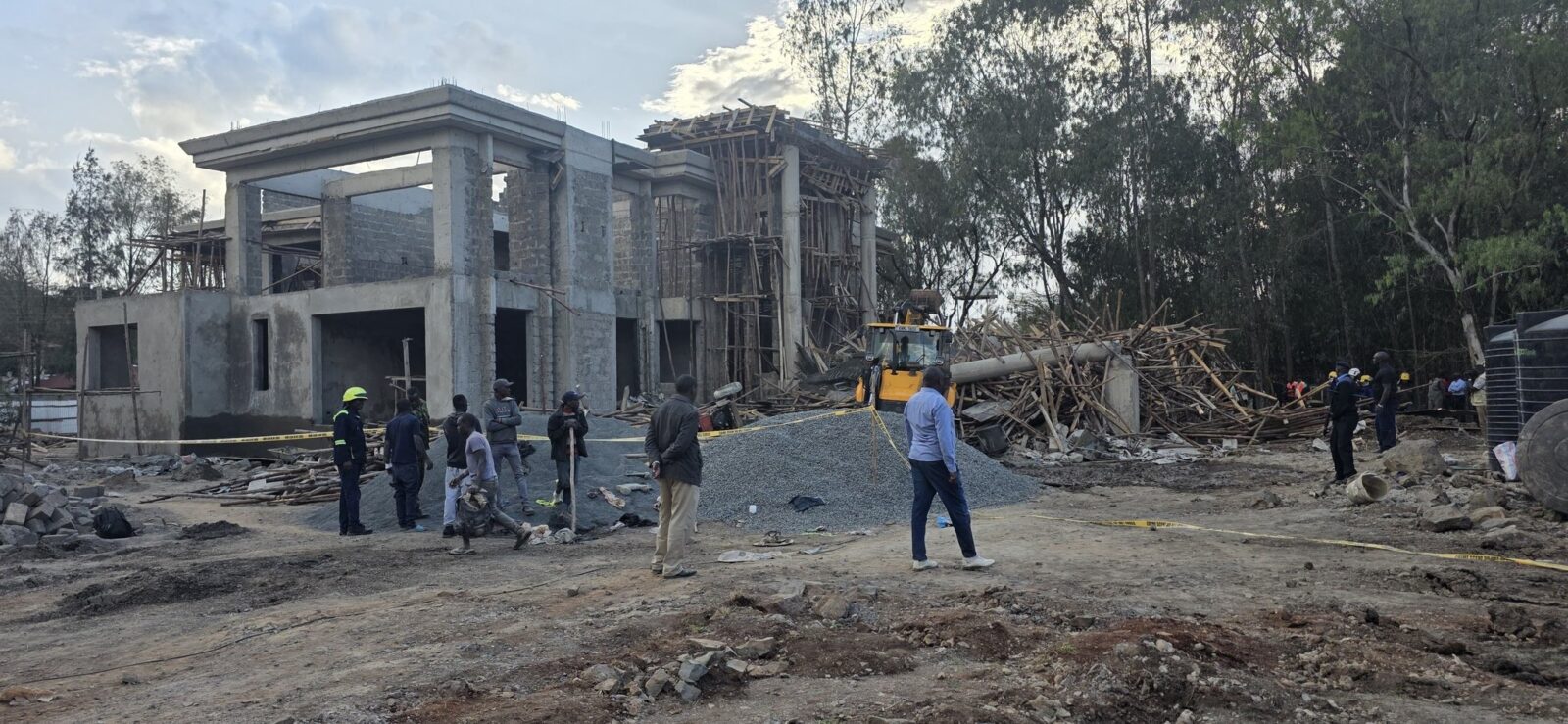
Preliminary investigations by Nairobi City County Government have established that the collapse of a residential building under construction in Karen was caused by structural failure arising from poor workmanship and inadequate formwork.
County spokesperson Analo said early findings show that substandard materials were used at the site, including timber gum tree supports instead of the required steel props for a double-volume slab, significantly weakening the structure.
The building collapsed on Saturday, January 10 at Plot No. 12882/197 along Karen View Lane in Lang’ata Sub-County, killing two people and injuring seven others.
Following the incident, emergency and rescue teams from the county, working with the National Disaster Management Unit and the Kenya Red Cross, were deployed to the scene.
Seven injured victims were rescued from the rubble and rushed to hospital, while the bodies of the two victims, who succumbed to severe crush injuries, were transferred to Nairobi Funeral Home.
Analo noted that while the architectural plans were approved on November 14, 2024, and structural plans on November 27, 2024, preliminary findings indicate that the failure occurred during construction due to non-compliance with approved standards rather than flaws in the approval process.
Further investigations are ongoing to establish the full circumstances surrounding the collapse and determine responsibility.
As the probe deepens, focus has shifted to the mandatory indemnity form signed by developers upon approval of their building plans by Nairobi City County.
The indemnity document has emerged as a key instrument in determining liability, as it clearly places full responsibility for the safety and structural integrity of a project on the developer and the registered architect and engineers engaged.
Under the indemnity form, developers indemnify the county and the County Structural Engineer against any claims arising from collapse, injury or loss of life. The document explicitly states that approval of drawings does not transfer liability to the county, firmly placing accountability on the developer as investigations continue.
The form further requires developers to assume full legal responsibility for their buildings from design through completion. By signing it, developers agree to take liability for structural failure, design errors, construction defects and any non-compliance with approved plans.
It also obliges them to engage only qualified and registered professionals, strictly adhere to approved drawings, building codes and by-laws, ensure proper site supervision, and submit mandatory material test results, including concrete strength tests, to county engineers.