A new Kenyatrack survey has ranked Kenya’s Principal Secretaries based on their impact across key sectors, offering a snapshot of how technocrats are shaping the country’s economic and social transformation.
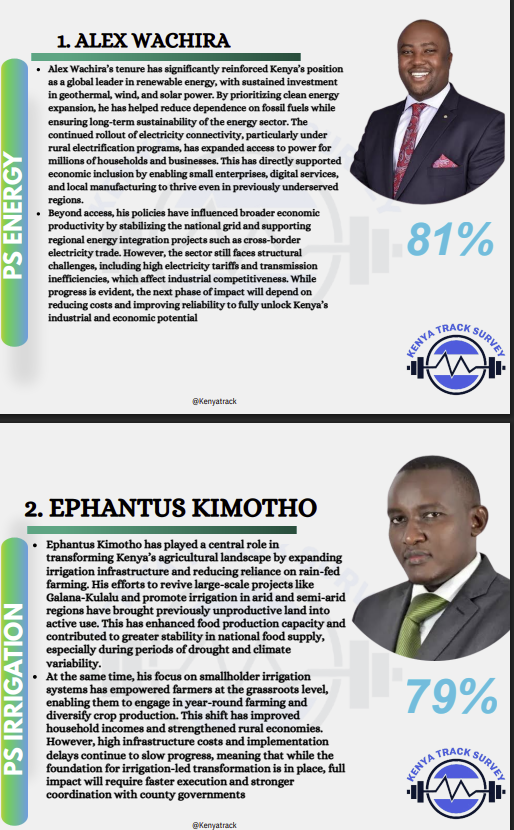
Leading the rankings is PS Alex Wachira, who emerged as the most impactful with a score of 34 percent. His tenure has been defined by a strong push toward renewable energy and expanded electricity access, positioning Kenya as a leader in clean energy while supporting growth in businesses and rural economies.
Coming in second is PS Ephantus Kimotho at 30 percent, credited for advancing irrigation projects that are steadily reducing reliance on rain-fed agriculture. His work has contributed to improved food production and greater resilience in the face of climate variability.
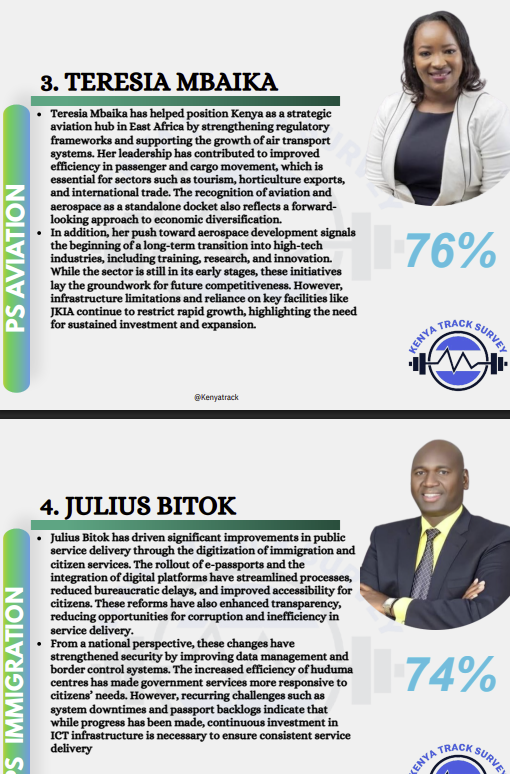
PS Teresia Mbaika ranks third with 24 percent, reflecting her role in strengthening Kenya’s position as a regional aviation hub and improving the efficiency of passenger and cargo movement, key to trade and tourism.
A cluster of officials tie at 24 percent, underscoring a shared level of influence across multiple sectors.
PS Julius Bitok stands out for digitizing citizen services, including the rollout of e-passports and streamlined huduma services that have improved access and transparency.
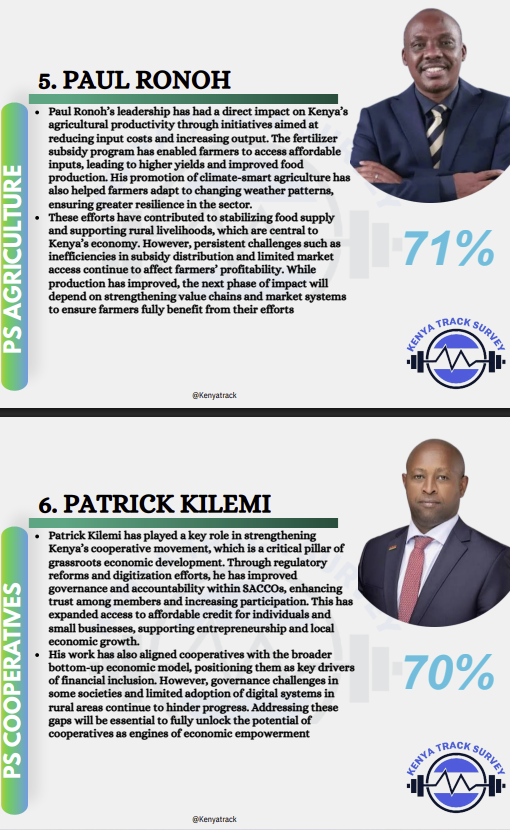
PS Paul Ronoh follows closely, with his fertilizer subsidy programme and climate-smart farming initiatives boosting productivity and supporting farmers across the country.
In the cooperatives sector, PS Patrick Kilemi has strengthened SACCO governance and expanded access to affordable credit, enhancing financial inclusion at the grassroots level.
PS Fikirini Jacobs has focused on empowering young people through skills development, entrepreneurship programmes, and job creation initiatives aimed at tackling unemployment.
PS Juma Mukhwana has driven efforts to promote local manufacturing and reduce reliance on imports, although challenges such as high production costs continue to slow the pace of growth.
PS Jonathan Mueke has improved animal health and productivity through vaccination programmes and value chain development, particularly benefiting communities in arid and semi-arid regions.
Rounding off the list is PS Roseline Njogu, whose work in strengthening engagement with Kenyans abroad has boosted remittances, investment opportunities, and knowledge transfer into the local economy.
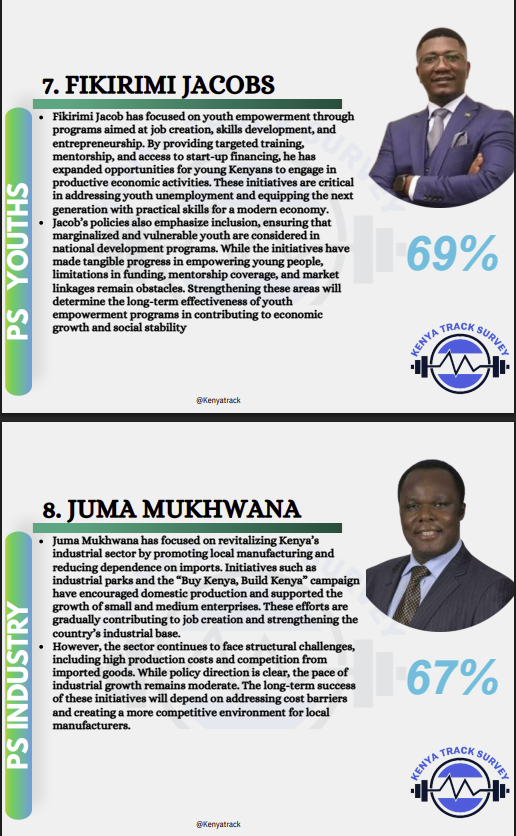
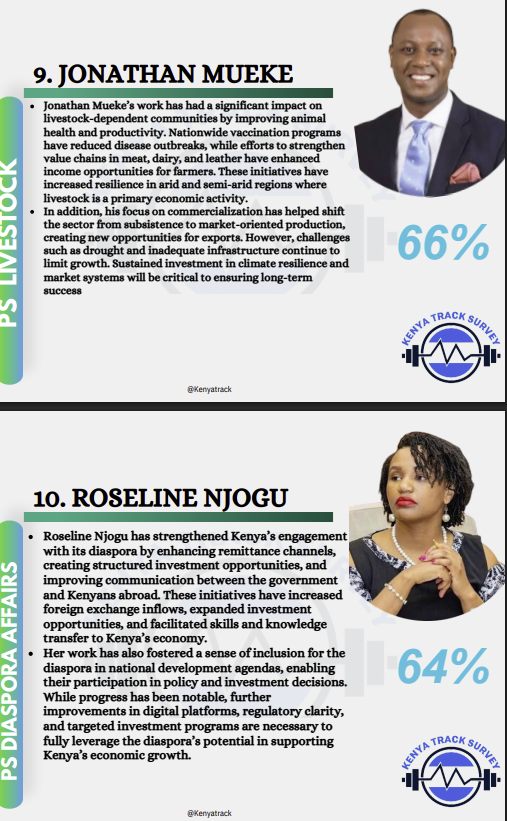
The survey, conducted between February and March 2026 with over 6,000 respondents nationwide, highlights the central role Principal Secretaries play in translating policy into real outcomes. While progress is evident across sectors, challenges such as implementation delays, funding gaps, and systemic inefficiencies continue to shape delivery.
Even so, the rankings reflect a government increasingly driven by results, where performance is measured by tangible impact on citizens’ lives and the broader economy.