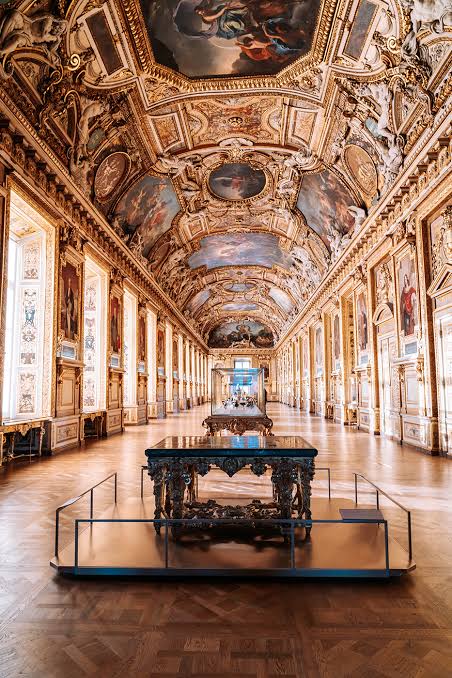
On the morning of 19 October 2025, just after 9:30 a.m., an audacious robbery unfolded at the Louvre Museum in Paris, targeting the legendary Galerie d’Apollon, where France’s crown-jewels collection is displayed.
In broad daylight, a group of masked thieves disguised in construction-worker vests arrived with a truck-mounted basket lift parked along the Seine-facing façade, used as a makeshift platform to reach a balcony window. They cut through a glass pane with a disc cutter, entered the gallery and in what officials call a “lightning” strike, lasting only seven minutes, smashed display cases and fled with treasures.
The Louvre Museum, located in the heart of Paris, France, is the world’s most visited and one of its most prestigious art museums. Originally built as a medieval fortress in the late 12th century and later transformed into a royal palace, it became a public museum in 1793 after the French Revolution.
Today, the Louvre houses over 35,000 works of art spanning more than 9,000 years of human history. Its vast collection includes masterpieces such as Leonardo da Vinci’s Mona Lisa, Eugène Delacroix’s Liberty Leading the People, and the ancient Greek statue Venus de Milo.
The museum also safeguards treasures like the Winged Victory of Samothrace, Egyptian antiquities, Islamic art, and France’s crown jewels, displayed in the opulent Galerie d’Apollon, the very hall targeted in the recent high-profile robbery.
The stolen items are of breathtaking historical significance. Among them: a tiara, necklace and single earring from a sapphire set once belonging to Queen Marie-Amélie and Queen Hortense; an emerald-and-diamond necklace and a pair of emerald earrings from Empress Marie-Louise’s set; and a diadem, a large bodice bow brooch and other jewellery belonging to Empress Eugénie.
The most famous gem in the gallery, the “Regent” diamond, was left untouched. One of the items, the crown of Empress Eugénie, was dropped by the robbers during their escape and later found broken outside the museum.
The French prosecutor’s office has valued the loss at approximately €88 million (about 13.2 Billion Kenya Shillings), though the cultural damage is regarded as incalculable.
The investigation is underway and moving at full pace. Authorities have opened an inquiry, assigning dozens of investigators to comb through surveillance footage from inside the museum, from the Seine riverside and from departure roads.
Forensic teams have recovered tools including; angle grinders, a blower torch, gloves, gasoline traces and other equipment abandoned by the robbers at the scene.
Investigators believe the thieves were part of a highly professional, well-scouted gang, possibly with links to organised crime, given the precision, speed and equipment used.
On the escape route, the robbers used motor scooters and a predetermined plan, which allowed them to be gone before the museum’s security and responding forces could effectively stop them.
The museum’s Apollon Gallery remains closed while the investigation continues; the rest of the Louvre reopened a few days later.
This heist has raised serious questions about the security of even the world’s most famous museums. Despite upgrades in recent years, the fact that intruders could access a premium gallery using a truck-mounted device, power tools, and scooters in broad daylight suggests significant vulnerabilities.
Michel guards, alarms and display cases all failed to deter what was described as an operation lasting mere minutes. At the heart of the investigation is not only the recovery of the jewels but also uncovering how the planning was carried out: whether there was inside assistance, how the tools were obtained and how the escape route was secured so efficiently.
As time passes, risks grow that the items may be dismantled, stones recut and melted down, making recovery much harder. Experts warn that in such thefts the historic context, the collection as a whole, is more valuable than price tags.
Meanwhile the world watches, waiting to see if the treasures can be brought back and the perpetrators brought to justice.