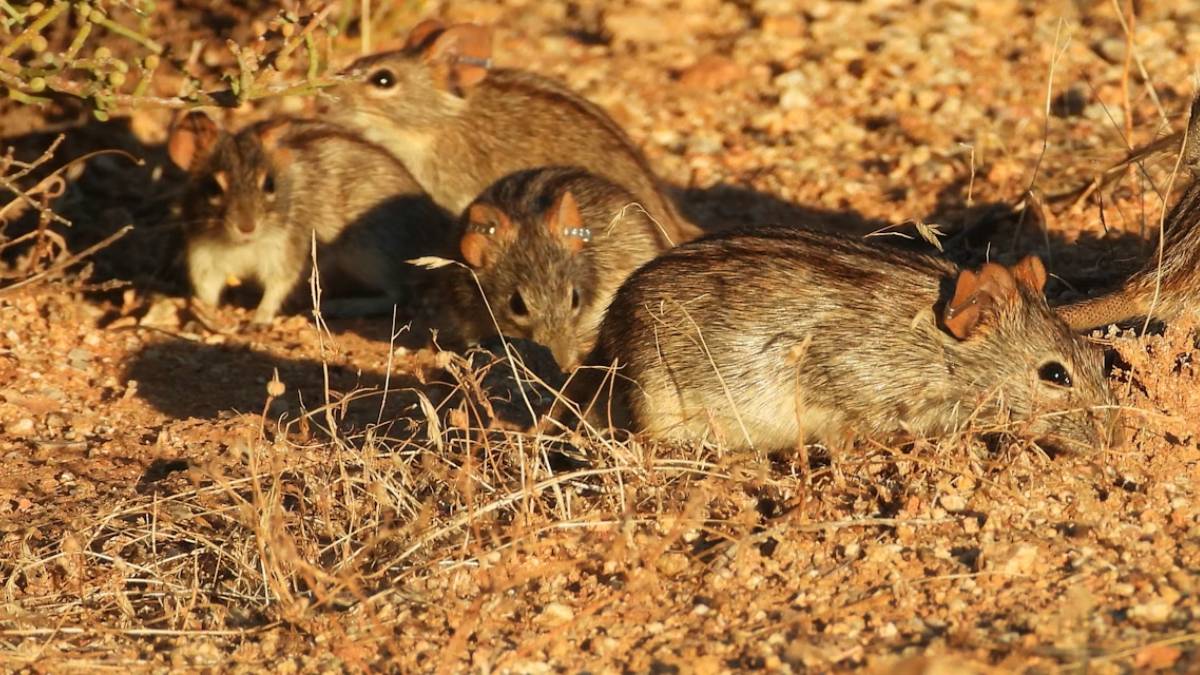
For decades, ecologists lumped everything bad for animals under one word: stress. But what if animals don’t experience harsh environments as stressful at all? What if it is the opposite?
Animals have adapted over millions of years to cope with harsh environments – places where food and water is scarce for long periods, and that are very hot or extremely cold. For example, striped mice (Rhabdomys pumilio) in the semi-arid Succulent Karoo of South Africa have adapted to their long, dry and food-restricted summers by suppressing their stress hormone levels, metabolism and activity.
This allows the tiny, 60 gram rodents to save energy and survive the harshness of the place they’re living in. This is now known as a harshness response.
Adaptations to such harsh environments are very different to adaptations to stressful environments. Animals usually respond to harsh environments by reducing energy expenditure, for example by hibernating. On the other hand, they respond to stressful environments by fighting hard for survival. In other words, stress tells an animal: invest energy to fight or flee. Harshness says: conserve energy or die.
The difference is really important because by confusing harshness with stress, we risk misreading the ways that animals find to survive.
I am a behavioural ecologist and eco-physiologist who studies the social evolution of mammals. I have been leading a team who studied the African striped mouse in the Succulent Karoo semi-desert in South Africa for over 25 years to understand how being flexible in their behaviour and their bodily responses allows them to succeed in a changing world.
We carried out extensive behavioural observations of the mice in the field. We also collected blood samples to measure hormones and other markers of health (similar to those measured by doctors for humans).
Surprisingly, we did not find any indication that striped mice were stressed by their harsh environment. Instead, we found that they took it easy to save energy.
This shows how important energy saving is for these little desert dwellers. This is important because harsh environments will become even harsher under climate change. Knowing how animals cope with harsh, rapidly heating environments now will help us understand how they might survive in future.
Reversible brain shrinkage and other ways of surviving
In South Africa’s Succulent Karoo semi-desert, mild, moist winters from June to August are followed by long, dry summers from December to March, when no rain falls and temperatures reach 40°C. Food plants are superabundant in spring (September to December), but these dry up in summer. The green, colourful landscape transforms into a brown, sandy desert, leaving the striped mice with very little to eat.
However, they’ve evolved multiple ways to deal with low food availability in summer. They reduce the secretion of stress and metabolic hormones, basically turning down their internal engines and burning less energy.
In this way, they reduce the amount of energy they use daily in summer by 30%. In lowering their metabolism, they automatically reduce the amount of water they use too. This is crucial to survive in a food and water restricted environment.
Another interesting energy saving tactic is where the striped mice temporarily shrink the organ that uses the most energy – their brain! (This phenomenon is known as the Dehnel’s effect, first reported from shrews surviving the food restricted winter in Europe.) When conditions improve, their brains return to their normal size.
To save even more energy, they bask in the sun and are largely inactive during the hottest parts of the day. Nights in the semi-desert can be cold even in summer, so the mice warm each other in the nest to save energy.
Our research showed clearly that striped mice survive the dry season not by activating their stress response and fighting back against harsh conditions – they find ways to survive and endure it instead.
The power of quiet endurance
In animals, a response to harshness (finding ways to endure) is the opposite of a physiological stress response, when an animal’s adrenal glands release hormones to overcome stress.
These stress hormones activate energy for the animal to react. That’s the famous fight or flight response. But not all animals can escape or fight all bad conditions. For example, droughts are expected to become more common and more severe. To survive, animals must either escape these conditions through migration or cope by saving energy and water. But only birds, bats and large mammals can migrate, while small mammals must survive where they are.
Also, harsh conditions last longer than a normal stress event like the appearance of an opponent or predator. When harsh environmental conditions are simply mislabelled as stressful environments, this can mislead conservation efforts.
The human experience can be very similar. Imagine yourself investing time and energy into problems that cannot be solved by trying harder, but can only be endured until conditions improve. Creating unnecessary stress for yourself in a situation like this doesn’t help at all – it only induces suffering and illness.
Modern life contains many situations where it is worth asking whether a challenge requires action, endurance, or change.
What needs to happen next
Species that did not evolve in harsh environments, and which also cannot migrate, will need to reduce the amount of energy they use, enabling them to endure harshness. Like the striped mouse, they can do this via behavioural and physiological flexibility.
If animals can’t do this, their chances of surviving climate change are low.
Thanks to our long-term studies identifying the harshness response of the striped mouse, it is now possible to examine these same traits in other species and assess how flexible they are.
It’s also crucial for conservationists to find ways of reducing stress for animals in harsh environments. For example, to prevent animals from being startled by tourists such as hikers, or by stray dogs. Even animals that have evolved ways of enduring harshness must be supported to avoid stress that would increase energy expenditure.
In an energy-limited environment, increasing the amount of energy animals expend on trying to survive can be the difference between life and death.
Carsten Schradin, Director of Research, Université de Strasbourg; University of the Witwatersrand