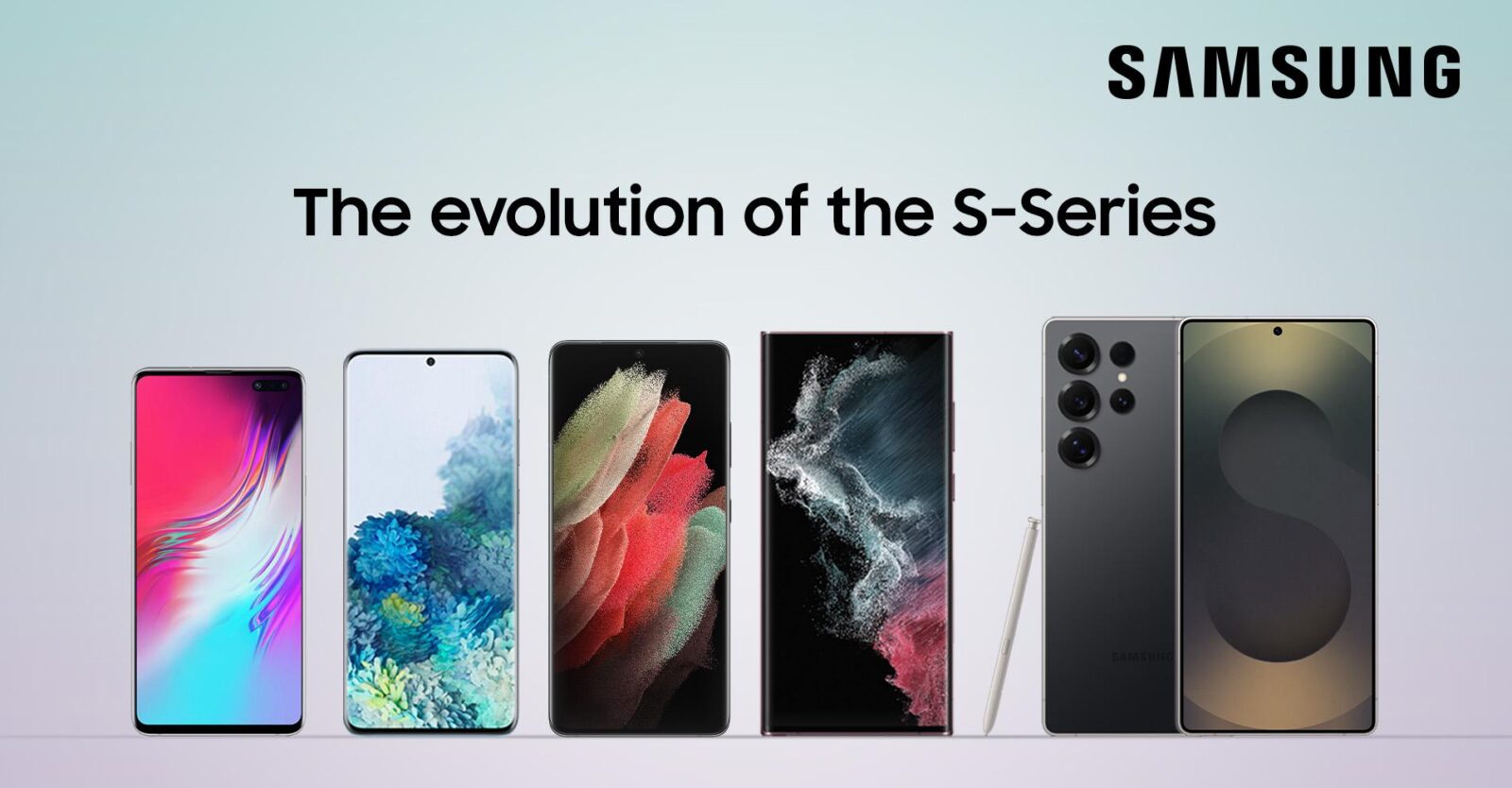
It’s hard to believe the Galaxy S series has now been with us for 16 years since the original launched back in 2010. Remember when a phone felt like a polished river stone? Slippery, shiny and oh-so-elegant? That was the Galaxy S series in its early days. But if you look at the latest models in stores today, they tell a completely different story. Over the past 16 years, Samsung’s flagship line has evolved its design, camera experience and more recently AI integration in ways that feel logical and driven by real needs like bigger sensors, better photos in any light, easier handling, tougher builds and smarter everyday use.
The journey kicked off with the original Galaxy S (2010). It had a simple, rounded plastic body that felt light and grippy in hand, with a bright Super AMOLED screen that popped. The camera was basic, a 5MP rear shooter, but it delivered decent shots for the time and marked Samsung’s entry into serious smartphone photography.
Samsung quickly refined the formula. The Galaxy S II (2011) slimmed down even more with a sleek, curved plastic design that felt premium and comfortable. The camera jumped to 8MP with better low-light performance and Full HD video. By the Galaxy S III (2012) and S4 (2013), the pebble-like organic shapes continued, with glossy finishes and slightly larger screens. Cameras hit 8MP then 13MP, adding features like faster autofocus and 4K video on the S5 (2014), while the design stayed practical with removable backs and water resistance.
A big shift came with the Galaxy S6 (2015) and S6 Edge (2015). Samsung ditched plastic for glass and metal, introducing curved edges on the Edge for that seamless, immersive look. The camera improved to 16MP with optical stabilization for sharper shots. The S7 (2016) and S7 Edge kept the curved elegance but added dual-pixel autofocus for lightning-fast focus and excellent low-light results.
The curved design peaked with the Galaxy S8 (2017) and S9 (2018), near-bezel-less Infinity Displays that wrapped around the sides, hole-punch cameras starting on the S10 (2019) and stunning prismatic glass backs that shifted colours in the light. Cameras on the other hand evolved from dual setups on the S9+, ultra-wide lenses on the S10, and pro-level controls. These phones felt like luxury accessories, all elegant, slippery and fingerprint magnets.
As camera hardware grew bulkier to pack in more sensors and larger megapixels, the design adapted. The Galaxy S20 (2020) introduced a large rectangular camera bump that broke the smooth back for the first time, while keeping curved edges. The S21 (2021) went further with a frame that blended the cameras into the side rails, switched to matte finishes (plastic on the base model) for better grip and moved toward neutral colours. The camera experience leaped forward with higher-res main sensors and improved zoom.
The Galaxy S22 (2022) completed the turn to flat screens and boxy aluminum frames, which are easier to hold, simpler screen protectors, no accidental edge touches. Individual metal camera rings gave a clean, premium look. The S23 (2023) refined it with slimmer bezels, consistent materials and the Ultra’s built-in S Pen slot for natural integration.
The Galaxy S24 (2024) polished the flat design further, where it had uniform bezels, titanium on the Ultra for strength and lightness, earthy tones and even brighter displays. The camera system pushed boundaries with advanced processing for natural colours and detail.
Samsung pushed the evolution further with the Galaxy S25 series in 2025 by introducing thoughtful refinements to an already solid foundation. The flat screens stayed, but the Ultra gained more rounded corners for comfort during long sessions, while the base S25 and S25+ became slightly thinner and lighter with subtle frame adjustments. The overall feel remained solid and durable. Cameras took another step with a new 50MP ultra-wide on the Ultra (up from 12MP), keeping the beloved 200MP main sensor and delivering sharper detail, better vibrancy, and enhanced Nightography across ranges.
These changes happened gradually and for practical reasons. Bigger, more advanced camera systems demanded structured bodies that curved designs couldn’t support as well. Flat screens cut down on edge-touch frustrations, made protectors easy to apply and improved one-handed use. As phones became essential tools rather than just luxury accessories, Samsung leaned into function, durability and consistent handling.
The result is a lineup that’s more unified, capable, and user-focused than ever, with each generation building on feedback to deliver better photos, smarter processing and designs that just feel right in daily life. From that first 5MP shooter to today’s AI-powered titanium devices, the Galaxy S series has matured into a tool perfectly adapted for daily utility. Yet, even as the current series sets a new standard, the momentum of the last 16 years suggests that the next chapter is already being written, quietly preparing to shift our expectations once again.
Source: Samsung Newsroom- The History of the Galaxy S Series