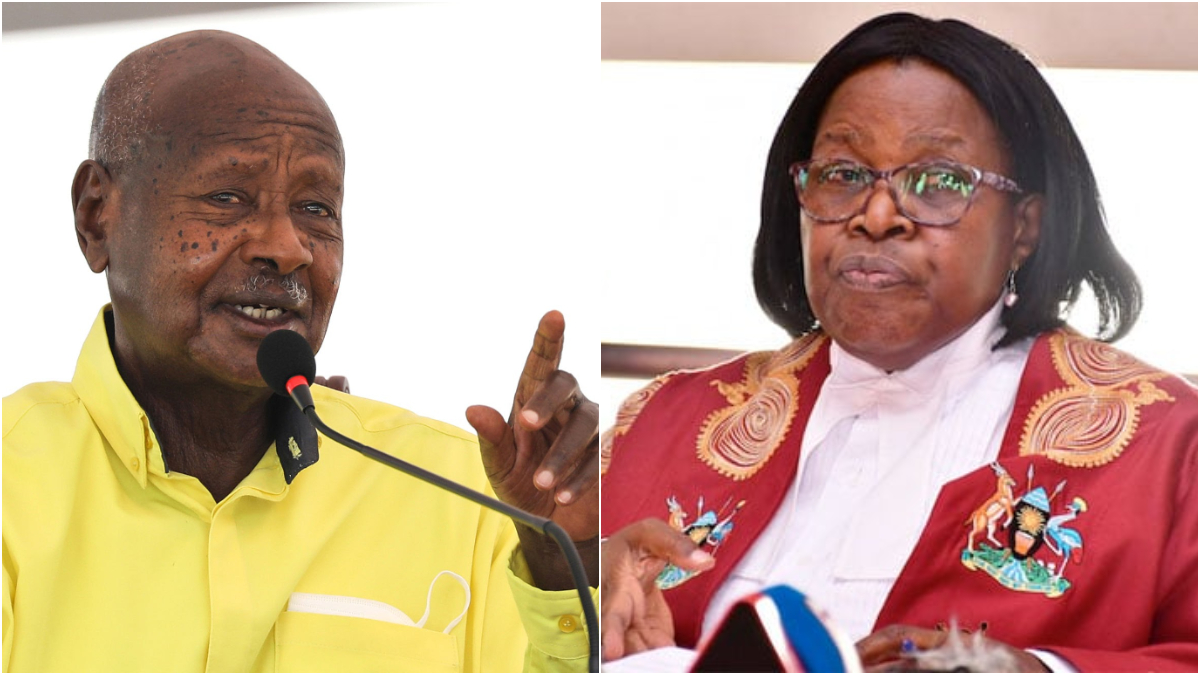
Today, former Uganda Supreme Court Justice Esther Kitimbo Kisaakye is asking hard questions concerning the just-concluded 2026 Presidential Election.
In a statement dated January 27, 2026, and addressed to Electoral Commission Chairperson Simon Byabakama, Justice Kisaakye has questioned the legality, transparency and constitutionalism of the declaration of the results that saw President Yoweri Museveni secure his seventh term in office.
In the strongly worded public letter, Kisaakye argues that the “orally declared” results of the 2026 Uganda Presidential Elections, as announced by Byabakama, did not meet the threshold of Article 61(d) of the Constitution, which requires the Commission to ascertain, publish, and declare in writing under its seal.
“Announcements made through public media do not satisfy this Constitutional requirement,” Justice Kisaakye says. “This requirement must be read together with Article 1 of the Constitution, which vests sovereignty in the people of Uganda and mandates that all authority be exercised in their name and for their benefit.”
She says that the Electoral Commission has yet to publish the results both on its website and in the Uganda Gazette Notice.
She is now raising eight questions, demanding clarification from the Commission. The questions raise serious concerns about the integrity of the electoral process, especially after the nationwide failure of the biometric voter verification machines.
Justice Kisaakye’s hard questions
- How did the Electoral Commission ensure there was no ballot stuffing and multiple voting in light of the nationwide failure of the biometric machines?
- What steps has the Electoral Commission taken to address videos online showing its officials, members of security forces, and other civillians ticking multiple ballots and/or stuffing multiple ballots at different polling stations or at other venues?
- How did the Electoral Commission ascertain the results of the Presidential Elections within 48 hours in the absence of duly signed and transmitted Declaration of Results (DR) Forms from each polling station?
- How were the Presidential Election results transmitted to the National Tallying Centre during the nationwide internet shutdown, and what verifiable audit trail exists to demonstrate the integrity, chain of custody, and authenticity of those results?
- Has the Electoral Commission published the 2026 Uganda Presidential Election results for each polling station?
- If so, where has the Electoral Commission published these results and when was that publication made?
- If the publication of these results has not been made, why has the Electoral Commission not complied with this clear mandatory Constitutional requirement, 10 days after your announcement? Such a publication would also enable Ugandan citizens who wish to access these results, to do so.
- What steps is the Electoral Commission taking to recover the 69 million United States Dollars of taxpayers’ money expended on non-functioning biometric machines, including any civil recovery actions against suppliers and Electoral Commission officials involved in the procurement, approval and testing of this equipment prior to their dispatch to the respective polling stations?
Kisaakye, she says, is asking these questions as a citizen of Uganda, taking into account that the Electoral Commission bears a positive and constitutional duty to conduct elections that are not only free and fair, but which are also transparent and verifiable through the results declared.
“The burden to prove compliance with its constitutional obligations rests with the Electoral Commission and not with the candidates who contested in the elections, the Ugandans who voted, those who opted not to vote, or those who were rendered unable to vote,” she concludes.
Museveni’s win marred by malpractices
Uganda’s electoral commission declared President Museveni as the winner of the January 15 elections, securing his seventh term in office with 71 percent of the vote.
However, the opposition — led by National Unity Platform Presidential Candidate Bobi Wine — have since rejected the election results, claiming ballot stuffing, and police intimidation to the advantage of Museveni.
In the weeks leading up to the elections, security officers reportedly beat and arrested hundreds of people during opposition rallies, indiscriminately fired teargas, and kicked and slapped journalists trying to cover the events.
On November 28, 2025, the Human Rights Watch reports that security officers shot and killed Mesach Okello, an opposition supporter, in Iganga in Eastern Uganda. At the time, the police claimed they were responding to “stone throwing” and “hooliganism.”
On December 8, Bobi Wine claimed that soldiers beat him and his supporters with clubs during a rally in the northern city of Gulu.