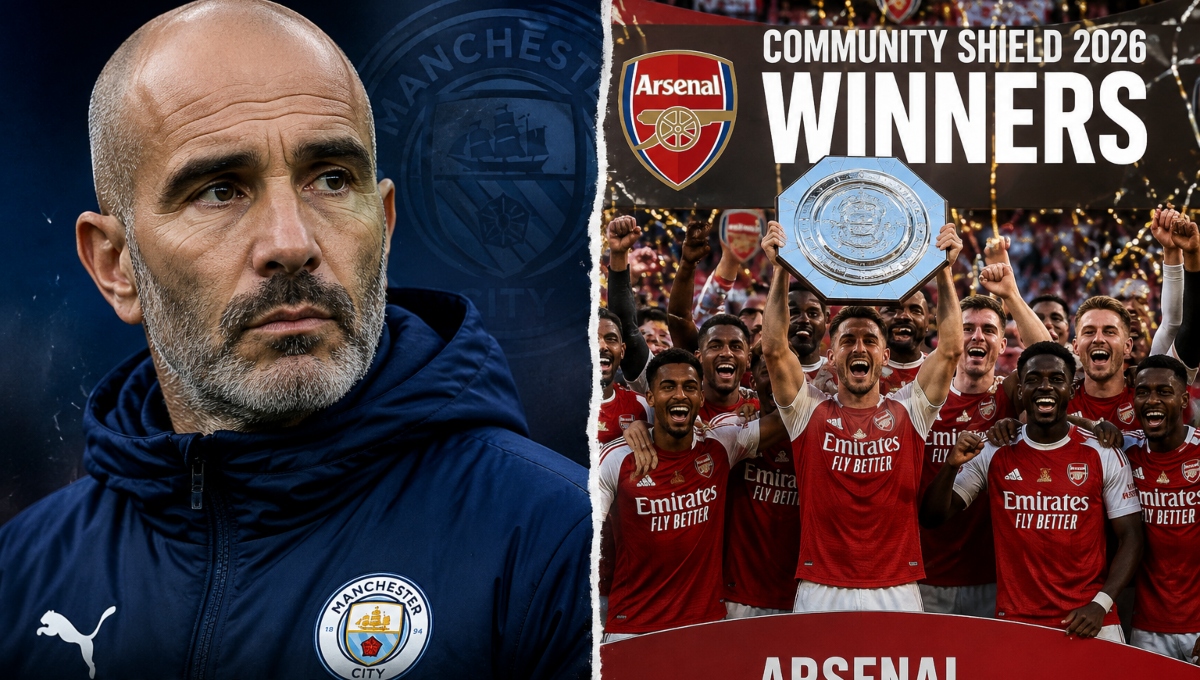
Enzo Maresca could hardly have imagined a more difficult introduction to life in the Manchester City dugout.
The Italian’s first competitive match in charge ended in a bruising 3-0 defeat to Arsenal in the Community Shield on Sunday, with the result raising early questions about City’s tactical direction and how quickly the club can adapt to life after Pep Guardiola.
For Arsenal, it was a statement of intent. For City, however, it was a reminder that replacing Guardiola is not simply about appointing another coach with a similar football philosophy.
Maresca arrived at the Etihad with strong credentials and familiarity with City’s footballing culture, having previously worked within the club’s system. But against Mikel Arteta’s side, his team looked short of the control, structure and attacking cohesion that became synonymous with the Guardiola era.
The warning arrived almost immediately.
Riccardo Calafiori put Arsenal ahead inside the opening minute, with the Gunners taking advantage of City’s inability to settle. Kai Havertz then doubled the advantage before Martin Ødegaard completed the scoring after the break. Christos Tzolis was particularly influential for Arsenal, providing two assists.
Tactical questions for Maresca
The biggest concern for City was not simply the scoreline but the manner of the defeat.
Maresca’s challenge is to build a team capable of controlling matches without simply attempting to recreate Guardiola’s system. Sunday’s performance suggested that City are still searching for the right balance between possession, defensive security and attacking penetration.
Arsenal repeatedly found spaces between City’s defensive and midfield lines, while City’s own attacks lacked the fluidity required to consistently trouble David Raya.
The absence of Rodri was particularly significant. The midfielder has been central to City’s ability to control the tempo of matches, and his situation remains one of the major issues surrounding the club. Reports have linked him with a possible move to Barcelona.
Without that control in midfield, City struggled to impose themselves on Arsenal.
Arsenal exposed the difference
Mikel Arteta’s side looked far more settled.
Arsenal pressed with purpose, moved the ball quickly and used their width effectively. Their midfield also provided enough energy and control to prevent City from building sustained attacks.
What made the performance particularly significant was the depth available to Arteta.
Bruno Guimarães made an impressive debut in midfield, while Arsenal were able to leave established stars such as Declan Rice and Bukayo Saka out of the starting XI. The depth of the squad has already been identified as a potential advantage in the title race.
That contrast was difficult to ignore.
While Arsenal appeared to have a settled identity, City looked like a team still learning the demands of a new system.
Does Maresca need more than time?
It would be premature to judge Maresca’s Manchester City reign on one match.
The Community Shield is the first competitive fixture of the season, and City are undergoing a major transition following Guardiola’s departure. Maresca himself has acknowledged that the club remains active in the transfer market, with further recruitment expected before the window closes.
City have already spent heavily, including a club-record £116 million on Elliot Anderson, while further additions have been reported as part of Maresca’s rebuilding process.
But recruitment alone will not solve the tactical problems exposed against Arsenal.
Maresca must establish how City will defend without the ball, how they will replace Rodri’s influence if he leaves, and how the midfield will progress possession against aggressive opponents.
He must also find a way of getting more from Erling Haaland, Jeremy Doku and the rest of the attacking unit. Against Arsenal, City’s attacking players were largely contained and struggled to generate clear opportunities.
A warning rather than a verdict
The 3-0 defeat is unlikely to define Maresca’s first season, but it has certainly provided an early warning.
Manchester City are no longer operating under the certainty of the Guardiola era. The club now has to develop a new identity while competing against an Arsenal side that appears increasingly comfortable with its own.
Maresca’s task, therefore, is bigger than replacing one manager.
He has to convince a squad accustomed to winning under Guardiola that a different tactical approach can produce the same level of dominance.
Sunday’s defeat showed that the process will not be straightforward.
The real test begins when the Premier League season starts. City will need to respond quickly, because Arsenal’s performance in Cardiff suggested that the reigning champions are not prepared to wait for their rivals to find their feet.