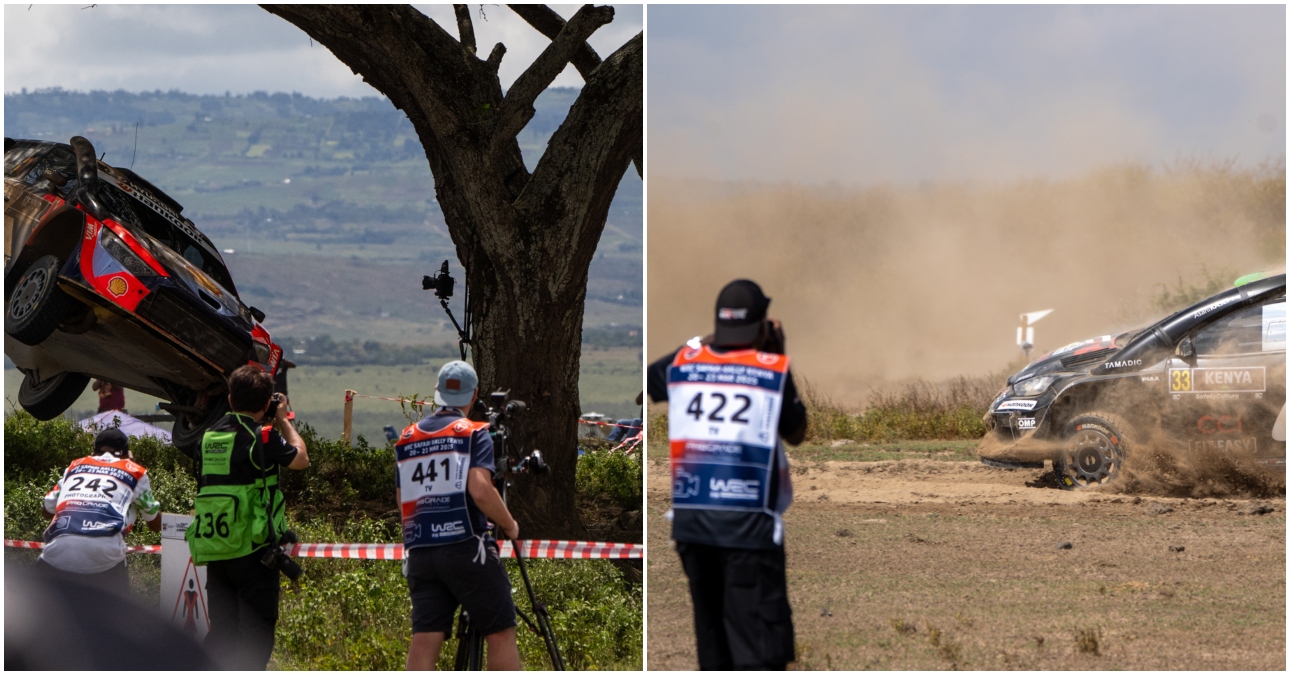
The 2026 WRC Safari Rally Kenya gets underway in Naivasha, Nakuru County, marking the third round of the FIA World Rally Championship calendar.
On Thursday morning the drivers tested their vehicles in the shakedown, a final, high-speed test session held on a purpose-built stage just before the official event start, allowing teams to tune cars for the harsh Kenyan terrain.
Unlike the previous edition, the shakedown stage was moved to Naivasha as opposed to Nairobi.The rally route has undergone significant changes this year, with the ceremonial start and Kasarani Super Special Stage in Nairobi removed in favour of a fully Naivasha-based itinerary.
The new shakedown first climbs uphill on a medium-wide road which is bumpy and sandy. At 1.47km the stage enters a quarry with a rocky backdrop reminiscent of Saudi Arabia.
After exiting the quarry, the road becomes rougher on a very narrow and bumpy section at 2.35km before continuing on a wider one after a junction.
The rest of the stage varies in roughness, with some faster sections as it heads downhill.
The four-day rally, which concludes on Sunday, will feature 20 competitive stages and usher in a new chapter for the iconic motorsport event that has long been regarded as the toughest rally in the WRC series.
For the first time since the Safari Rally returned to the global championship in 2021, the event will not begin in Nairobi. Changes to FIA regulations have reduced rally week from five days to four, meaning the entire event will now be based in and around Naivasha in the Great Rift Valley.
President William Ruto rallied Kenyans to attend the event, describing the Safari Rally as more than just a race but a key part of the country’s sporting identity.
A historic motorsport event
This year’s rally marks the 74th edition of the famous competition that began in 1953 as the East Africa Coronation Rally before joining the WRC in 1973 and later adopting the Safari Rally name.
The event exited the WRC calendar in 2002 but made a celebrated return in 2021 after the 2020 edition was cancelled due to the COVID-19 pandemic.
Since its comeback, Toyota Gazoo Racing has dominated the rally, winning every edition. Welsh driver Elfyn Evans returns this year to defend the title he claimed in 2025.
Evans is part of a strong Toyota line-up that also features multiple-time champion Sébastien Ogier, Sweden’s Oliver Solberg, Japan’s Takamoto Katsuta and Finland’s Sami Pajari.
Hyundai and M-Sport eye breakthrough
Toyota’s closest rivals, Hyundai Shell Mobis World Rally Team, are also targeting their first Safari Rally victory after finishing second and third last year.
Reigning world champion Thierry Neuville leads the Hyundai charge alongside French driver Adrien Fourmaux and Finland’s Esapekka Lappi, who will debut the team’s upgraded “Evo” car in Kenya.
Meanwhile, M-Sport Ford World Rally Team will field Irish drivers Josh McErlean and John Armstrong in the Rally1 category.
Kenyan drivers in Rally2 battle
The Rally2 category has also attracted strong entries, including Britain’s Gus Greensmith, who won the class in Kenya last year.
Kenyan hopes will rest on drivers such as Karan Patel, Samman Singh Vohra and Jeremiah Wahome, all competing in Skoda Fabia Rally2 cars.
Former Rally3 champion Nikhil Sachania has stepped up to the Rally2 category this season, leaving the Rally3 title race wide open.
Action begins with the 6.31km Nawisa Shakedown on Thursday morning before crews tackle the opening stages — Camp Moran 1 and Mzabibu 1 — later in the day.
Friday features the longest schedule with stages including Loldia, Geothermal and Kedong, while Saturday will see drivers battle through Soysambu, Elementaita and Sleeping Warrior sections.
The rally concludes Sunday with stages at Oserengoni and Hell’s Gate, where the Wolf Power Stage will offer drivers the chance to earn bonus championship points before the ceremonial finish.
In total, competitors will cover 350km of competitive stages and 843km of liaison sections, with Loldia (25.6km) the longest stage and Mzabibu (8.27km) the shortest.