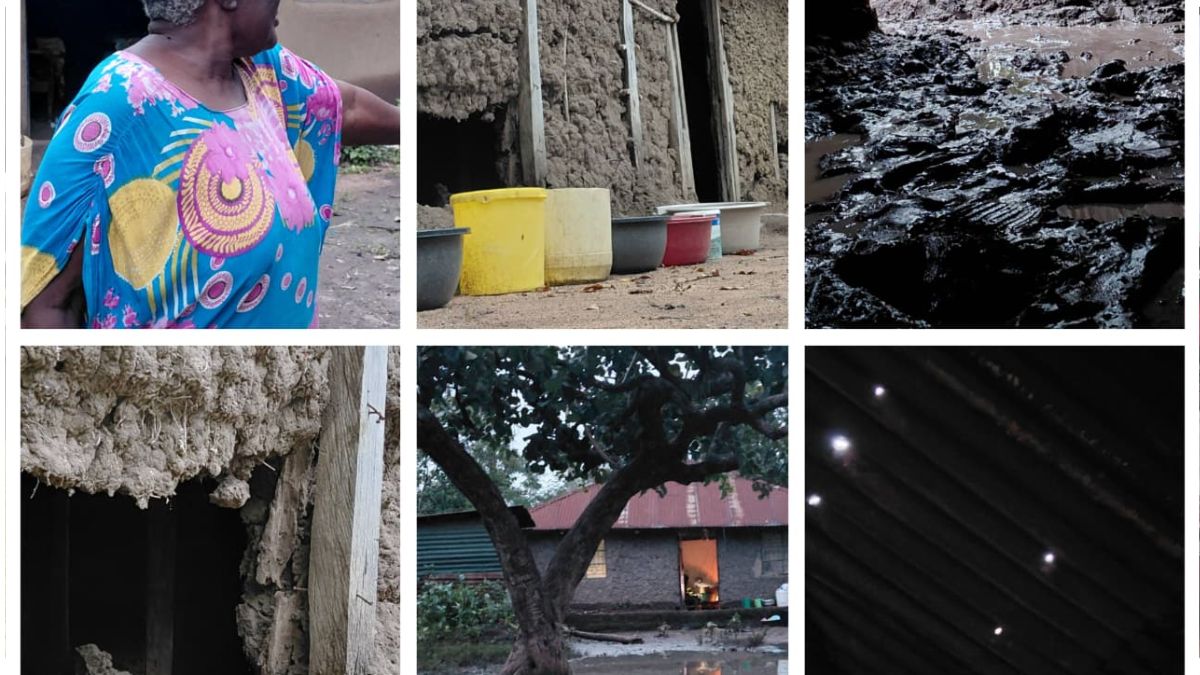
On a quiet Sunday evening, what began as a steady downpour quickly turned into a devastating flood that swept through Kotunga Area in Kajulu Ward, Kisumu East Sub-County, leaving destruction, despair and displaced families in its wake.
For 48-year-old Jackline Achieng’ Adoyo, a widow and mother of five, the floods did not just wash away her home but also dismantled her sense of security.
Standing on what used to be her compound, now reduced to muddy debris, she clutches a few salvaged belongings, her children huddled close by.
“I have nowhere to take my children,” she says, her voice trembling. “Everything we had is gone.”
Just a few meters away, 75-year-old Serphine Abayo Oluoch surveys the damage to her fragile home. The walls are soaked and weakened, the roof perforated and sagging dangerously. Each passing moment feels like a countdown to collapse.
“I fear sleeping inside,” she admits. “But I have no other place to go.”
Both women are among more than 250 households affected by the latest wave of flooding that has once again exposed the vulnerability of communities in Kisumu East.
The area, particularly Kotunga in Wathorego Sub Location, has become synonymous with seasonal floods, driven by poor drainage systems, low-lying terrain and soil that retains water for prolonged periods.
According to local estimates, over 1,200 residents have been directly affected in this latest incident alone, with women and children bearing the brunt of the crisis.
With no designated rescue or evacuation centre in place, many families are forced to remain in waterlogged homes, while others seek refuge in overcrowded borrowed spaces in relatively safer areas.
The consequences stretch beyond immediate displacement. Health risks are rising as stagnant water creates breeding grounds for mosquitoes and waterborne diseases.
Access to clean water and sanitation has become a daily struggle, further compounding the suffering.
Yet, even as the waters recede, the cycle remains painfully predictable.
Residents say the flooding is not new but an annual disaster that has, for years, lacked a lasting solution.
“This happens every year, and nothing changes,” says a local community member. “We rebuild, then the rains come again and destroy everything.”
Kisumu East Sub-County now stands at the centre of urgent calls for intervention. Community leaders and residents alike are appealing for immediate humanitarian assistance, ranging from food supplies, bedding and clean water to temporary shelter for displaced families.
More critically, there is a growing demand for long-term solutions: proper drainage infrastructure, flood control systems and planned resettlement for the most vulnerable households.
As night falls over Kotunga, families like Jackline’s and Serphine’s prepare to endure yet another uncertain evening, under leaking roofs or in the kindness of neighbors.
Their stories are a stark reminder that behind the numbers are lives interrupted, dignity tested and resilience stretched to its limits.
Until meaningful intervention is realized, Kisumu East remains on the frontline of a crisis that returns with every heavy rain, each time leaving deeper scars than the last.