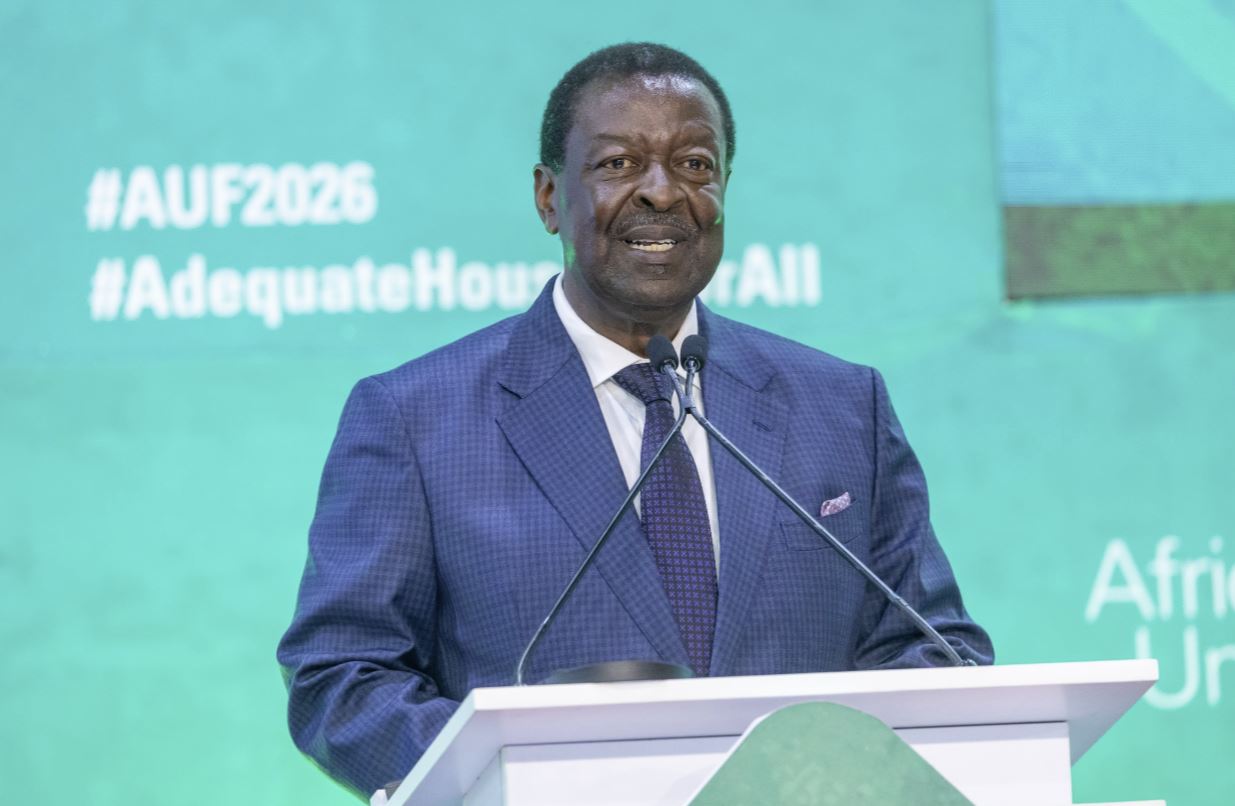
The second edition of the Africa Urban Forum (AUF) 2026 held in Nairobi could never have come at a better time, this is according to Prime Cabinet Secretary Musalia Mudavadi.
Speaking to stakeholders gathered at KICC on Wednesday, April 8, Mudavadi noted that Africa is urbanizing at a high pace and scale, with “our cities” expected to absorb hundreds of millions of new residents.
It is for this reason that Mudavadi advocated for a total overhaul in how we plan our cities, and initiate transformation agendas that will shape the physical form of settlements, the structure of economies, the resilience of societies, and the trajectory of our cities, to factor in population growth.
“The central question before us is not whether Africa will urbanize, but whether this process will be guided with intention, foresight, and discipline,” Mudavadi remarked, underscoring that African countries are facing urgent and familiar realities: the rapid expansion of informal settlements, persistent housing deficits, overstretched infrastructure, and growing exposure to climate-related risks.
However, Mudavadi added that initiating transformation agendas to plan our urban set-ups face challenges that are worsened by constrained fiscal space, limited access to long-term financing, and uneven institutional capacity. “If left unaddressed, they risk entrenching inequality and undermining the promise of our cities.”
Well-planned, well-financed cities drive industrialisation
Mudavadi advised African governments to approach the whole aspect of urbanisation strategically, so as to offer the continent one of its most powerful pathways to transformation.
“Well-planned and well-financed cities can drive industrialization, unlock productivity, create employment at scale, and serve as engines of innovation,” Mudavadi said, adding, “They can connect markets, deepen regional integration, and expand opportunity for millions. Urbanization is therefore no longer a sectoral issue confined to housing, planning, or infrastructure; it has become a defining economic and political question that shapes how we grow, how we compete, and how we secure the well-being of our citizens.”
Mudavadi, who also doubles up as Kenya’s Foreign Affairs Cabinet Secretary, highlighted how Kenya, under the tutelage of President William Ruto, was taking the challenge of urban centres head-on.
The Kenya Kwanza Administration has placed affordable housing as a key pillar of its Bottom-Up Economic Transformation Agenda (BETA), driving both dignity and economic opportunity.
The programme aims to create over 1 million new homeowners, while generating jobs for youth and women in sectors such as construction and skilled trades. Already, over 112,000 housing units are completed or under construction, reflecting real progress in delivering decent, affordable homes for our people.
The AUF is a continental platform established by the African Union to facilitate dialogue and coordination on sustainable urbanisation and human settlements in Africa.
The Forum brings together political leaders, policymakers, local and regional governments, development partners, the private sector, academia, civil society, and other relevant stakeholders to discuss Africa’s urban challenges and opportunities.
In his remarks during the second edition of this forum, Mudavadi urged the stakeholders to strive in executing all the deliberations discussed and recommendations proposed. “We cannot afford for our deliberations to remain at the level of diagnosis. The time has come to move from conversation to execution—towards bankable projects, investable pipelines, and implementable policies that translate our ambitions into results on the ground.”
The First Africa Urban Forum (AUF1) was held in Addis Ababa, Ethiopia. AUF2 built on the outcomes of AUF1 and sought to further strengthen dialogue and coordination on Africa’s urban development priorities.