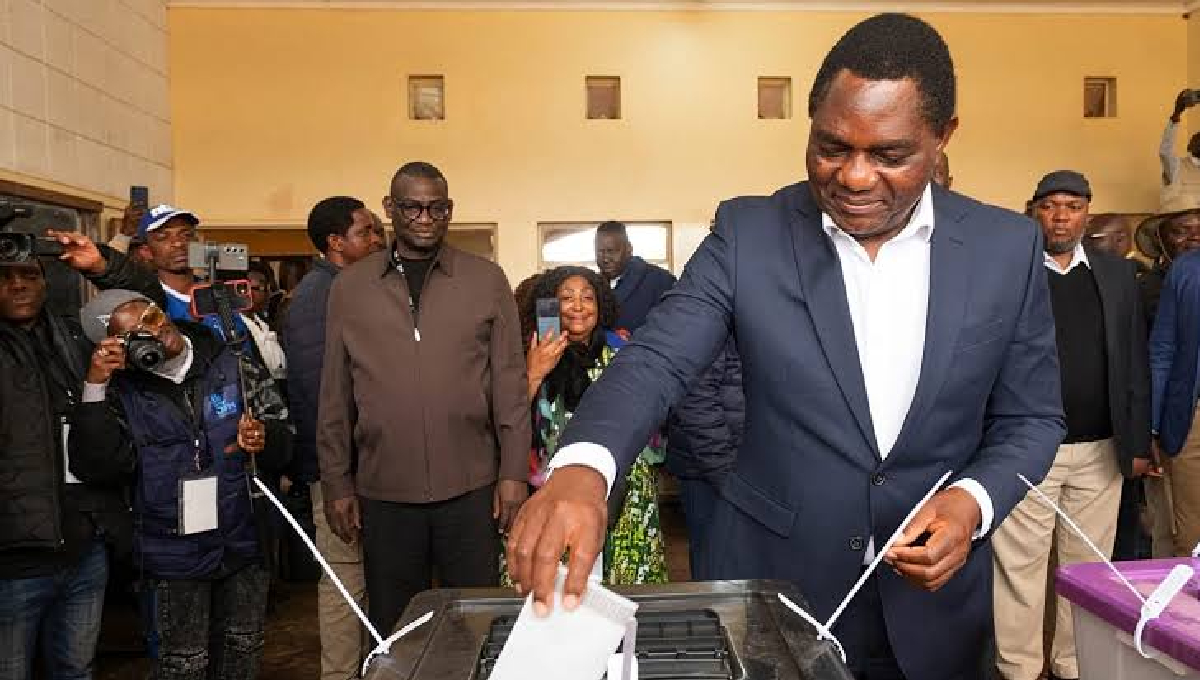
Zambian President Hakainde Hichilema has been re-elected for a second term after securing 60 percent of votes cast in last Thursday’s election, the Electoral Commission of Zambia announced on Tuesday, in a result overshadowed by opposition allegations of irregularities, arrests, and violence during the campaign period.
Hichilema, 64, who has been in power since 2021, faced a crowded field of 13 challengers, with his closest rival, former provincial minister Brian Mundubile, securing nearly 38 percent of the vote.
Five of the 226 constituencies had not yet been tallied at the time of the announcement, though Electoral Commission chairperson Mwangala Zaloumis said the outstanding results were unlikely to materially affect the overall outcome.
In his victory statement, Hichilema acknowledged both his supporters and those who voted against him.
“We are truly humbled by the trust you have placed in our hands. To those citizens who preferred the ideas presented by our opponents, we hear you, and we will continue to work for you,” he said.
Hundreds of his supporters poured onto the streets of the capital Lusaka, celebrating in the red colours of his UPND party.
The mood was far less celebratory in the opposition camp. Mundubile alleged on Monday that result documents had been tampered with and that officials in Southern Province had been pressured to modify figures, claims he made without providing supporting evidence.
His NRPUP party also angrily rejected government claims that its members had been involved in militia or insurgent activity, following police raids at Mundubile’s home in which 11 people were arrested, including six opposition figures, on suspicion of possessing high-grade military weapons and materials for “armed insurrection.”
The party said shots were fired during the raid and a parliamentarian was wounded.
The electoral commission drew criticism after suspending vote counting for around six hours on Friday following reports of violence against polling staff and alleged ballot theft.
International observer missions, including the European Union, warned the pause risked undermining credibility and voter confidence, and also flagged that restrictions on the opposition during the campaign period may have contributed to an uneven playing field.
Oxford Economics Africa said events surrounding the vote had “raised serious questions about the integrity of the results,” adding that “hopes of a calm and credible election in Zambia have been dashed” and warning the country was “very tense.”
The election was seen as a referendum on Hichilema’s first five years in office, during which the economy has returned to growth following debt restructuring and a reduction in inflation. Critics, however, say these gains have yet to translate into meaningful improvements for ordinary Zambians, with more than 70 percent of the country’s 22 million people living on less than three dollars a day, according to the World Bank.
Zambia has a long and largely enviable record of peaceful transfers of power through the ballot box, with every change of president since the return to multiparty politics in 1991 achieved through elections.