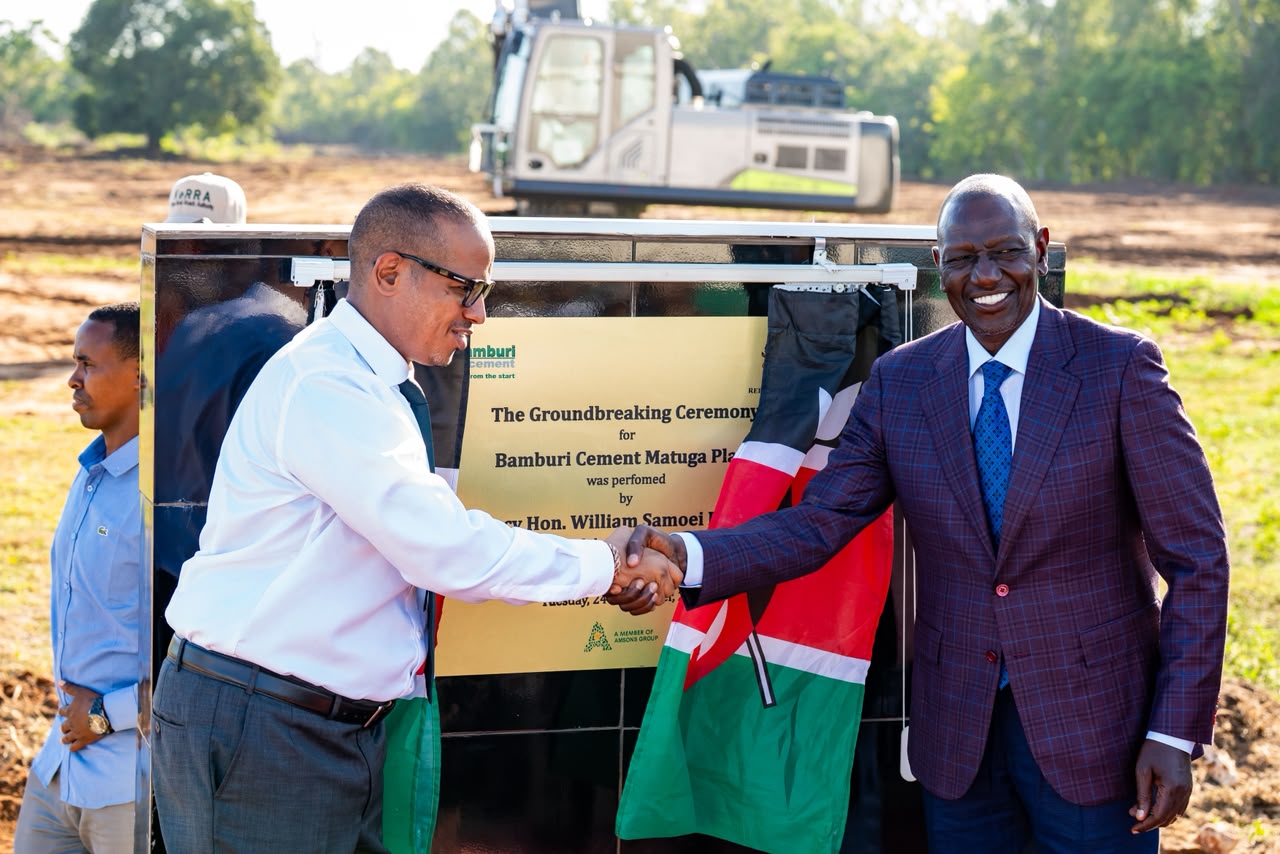
- The investment is expected to create more than 10,000 jobs, boost local manufacturing and open new business opportunities for Coast entrepreneurs.
President William Ruto has launched a Sh32 billion clinker manufacturing plant in Matuga, Kwale County, in a major industrial investment expected to boost cement production, create thousands of jobs and strengthen Kenya’s manufacturing sector.
The groundbreaking ceremony, held on November 24, 2026, marks the start of a Sh32 billion (US$250 million) project by Bamburi Cement Plc, a member of Amsons Group, expected to significantly expand the country’s clinker production capacity and reduce reliance on imported raw materials.
The project, which is expected to generate more than 10,000 direct and indirect jobs, is also projected to unlock business opportunities for local entrepreneurs, transporters, suppliers and other enterprises across the Coast region.
President Ruto said the investment was a demonstration of the government’s commitment to strengthening local manufacturing, attracting capital and creating employment opportunities for Kenyans.
“Investments of this scale are important in building our manufacturing capacity, creating jobs for our young people and strengthening our economy. We want Kenya to increasingly produce locally what we consume and reduce our dependence on imports,” he said.
He said industrial investments should also translate into tangible benefits for communities, particularly through employment, business opportunities and improved livelihoods.
The plant will have an annual clinker production capacity of 1.6 million tonnes, with Bamburi Cement expected to increase its clinker output from approximately one million tonnes to 2.6 million tonnes annually.
The expansion will also raise the company’s cement production capacity from 1.8 million tonnes to four million tonnes per year, positioning it to meet growing demand driven by infrastructure development, housing and construction projects.
Clinker, a key ingredient in cement manufacturing, is partly sourced from imports, exposing manufacturers to fluctuations in global prices, foreign exchange pressures and disruptions in international supply chains.
The new facility is expected to strengthen local production, improve supply stability and support the government’s industrialisation agenda.
Beyond employment, the project is expected to create opportunities for small and medium-sized enterprises operating in transportation, logistics, construction supplies, equipment maintenance, quarrying and other supporting services.
Local businesses are expected to benefit from increased demand for goods and services as construction progresses and the plant begins operations.
The project will also provide opportunities for skills development and technology transfer, with workers expected to gain technical expertise and industrial experience that could support future manufacturing investments in the region.
For entrepreneurs in Kwale and neighbouring counties, the investment presents an opportunity to integrate into the supply chain of a major industrial facility.
The plant is expected to incorporate modern technologies aimed at improving energy efficiency and reducing its environmental footprint.
Bamburi plans to use Alternative Fuels and Raw Materials (AFR), including coconut husks, cashew nut husks and municipal solid waste sourced from the Coast, as part of its energy mix.
The initiative is expected to create additional opportunities for farmers, waste collectors, recycling enterprises and other players in the circular economy.
The use of agricultural residues and suitable waste materials in industrial production is also expected to support efforts to reduce reliance on conventional fuels while promoting sustainable manufacturing practices.
Amsons Group Managing Director Edha Nahdi said the investment reflected the group’s confidence in Kenya’s economic prospects and its commitment to supporting industrial development.
“Investing in a project of this magnitude reflects our confidence in Kenya and its economic potential. We believe local manufacturing is key to economic growth, job creation and building a more resilient industrial sector,” he said.
Nahdi said the project would strengthen local manufacturing capacity while contributing to economic growth and employment creation across the region.
Construction of the facility will be undertaken by Sinoma CBMI Construction Co. Ltd, an engineering firm specialising in cement plant construction.
The plant will incorporate a six-stage precalciner system, a modern technology designed to improve production efficiency.
Bamburi Cement has also outlined plans to support communities affected by the project through its Mwachome Village relocation programme, backed by Sh250 million.
The company said 112 project-affected persons from 42 households had undergone financial literacy training ahead of the second phase of compensation.
Bamburi Cement Board Chairman Dr John Simba said the investment must deliver benefits to surrounding communities alongside its industrial and economic objectives.
“The success of this project will not only be measured by the production capacity of the plant, but also by the positive impact it has on the communities around us. Their welfare, inclusion and participation in the opportunities created by this investment remain important,” he said.
Kwale Governor Fatuma Achani attended the ceremony alongside other national and county leaders.
The project comes as the government pursues a Sh5 trillion, 10-year development roadmap anchored on infrastructure expansion, industrialisation and economic transformation.
For Kwale County and the wider Coast region, the investment is expected to strengthen the industrial base while creating employment and opening new avenues for local businesses.