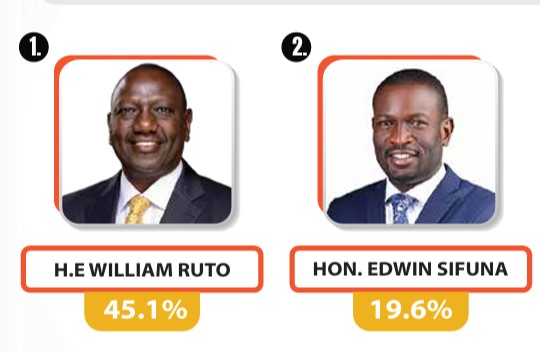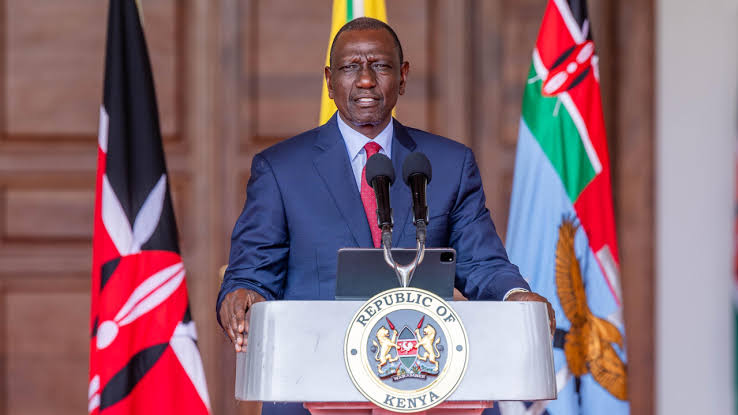
President William Ruto leads the presidential preference tally with 45.1 per cent, according to a new national survey that places Nairobi Senator Edwin Sifuna at 19.6 per cent and former Vice-President Kalonzo Musyoka at 10.3 per cent.
Speaking while releasing the findings, Emmanuel Kutosi, Data Reporting Officer at Politrack Africa, said the poll captures the current political mood across the country ahead of 2027.
The findings by the Politrack Research Team, based on fieldwork conducted between September 15 and 25, 2026, put Ruto ahead of the other named contenders in a survey of 20,419 respondents drawn from across the country.
The survey was weighted against a registered-voter base of 22,102,532, with national estimates adjusted according to each county’s share of registered voters. Data was collected through a text-based technology platform, with sampling structured at county level to generate usable county and national estimates.
Former Cabinet Secretary Fred Matiang’i follows Musyoka with 7.2 per cent, while former Deputy President Rigathi Gachagua records 6.0 per cent.
A further 8.4 per cent of respondents were undecided, indicating a sizeable segment of the surveyed population had not settled on a presidential preference at the time of the fieldwork.
The party figures in the same survey place the United Democratic Alliance, Ruto’s party, at the top with 32.0 per cent popularity.
The Democracy for the Citizens Party, or DCP, follows at 11.7 per cent, with the Orange Democratic Movement at 10.6 per cent. Jubilee records 6.9 per cent, Wiper 5.6 per cent, the Kenya Kwanza coalition 3.5 per cent and the Azimio coalition 3.2 per cent.
Party preference was not stated by 9.1 per cent of respondents, while 7.3 per cent said they had no party affiliation and 2.3 per cent were unsure.
The survey also found a country divided almost evenly over its direction. Some 45.2 per cent said Kenya was moving in the right direction, compared with 44.6 per cent who said the country was headed in the wrong direction. Another 10.2 per cent were unsure.
On government performance, Housing and Roads each received 16.3 per cent when respondents were asked to identify areas of major achievement. Health services, SHIF and SHA followed at 13.0 per cent, while Agriculture stood at 10.0 per cent.
At the same time, health services, SHIF and SHA management attracted the highest criticism at 18.4 per cent, followed by the fight against corruption at 19.2 per cent and the economy and cost of living at 12.0 per cent.
The findings provide a snapshot of voter sentiment during the September 15–25 fieldwork period, rather than a projection of an election outcome.