
What happens when more Kenyans live longer but the country’s systems are not ready to support them?
That is the question taking centre stage as Kenya prepares to mark the International Day of Older Persons, with experts warning that the country must act now to prepare for a rapidly ageing population.
About 2.7 million Kenyans aged 60 and above were recorded in the 2019 Population and Housing Census, representing 5.7 percent of the population. The number is projected to rise to about 6.4 million by 2045.
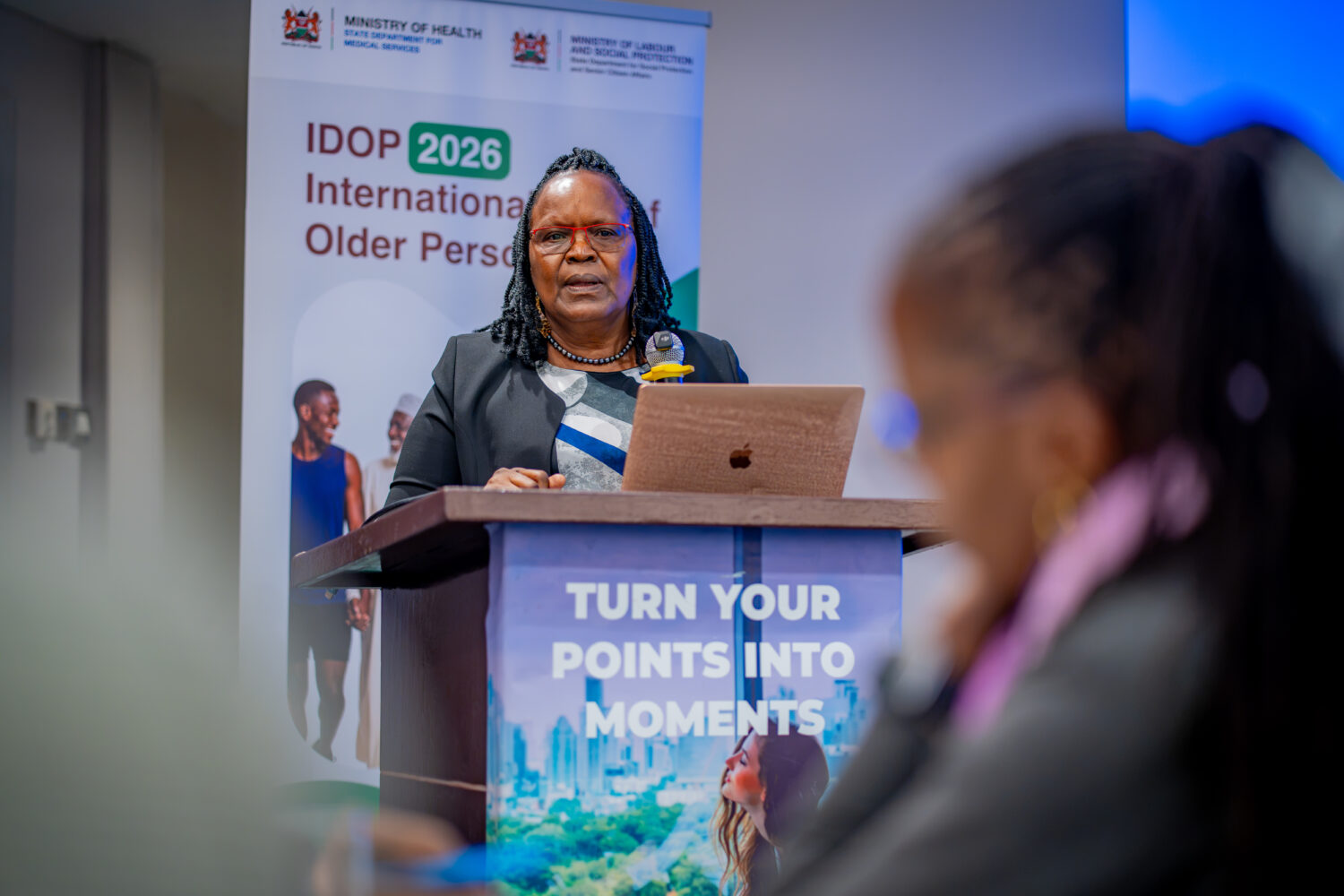
Speaking ahead of the inaugural International Day of Older Persons Kenya 2026, experts said the country must begin preparing now for the social and economic impact of longer life expectancy.
IDOP Conference Chair Dr. Lydia Atambo said Kenya cannot afford to wait for the projected increase before taking action.
“By 2045, Kenya could have 6.4 million people aged 60 and above. We cannot wait until 2045 to prepare. Let us rethink Kenya for longer lives.”
Atambo called for increased investment in preventive healthcare, financial security, caregiving and age-friendly communities.
Dr. Tasneem Yamani, Technical Advisor at Suqoon Kenya, said healthcare services must also adapt to the needs of an ageing population.
“The question before Kenya is no longer whether we will live longer, but whether our medical infrastructure will allow us to live better.”
Yamani called for a shift from reactive treatment to proactive and dignity-centred care, taking into account mobility, cognition, medication and the overall wellbeing of older persons.
The State Department for Social Protection and Senior Citizen Affairs says stronger social protection and income-security systems will be critical as the older population expands.
Assistant Director Julie Omollo posed a key question on the country’s preparedness:
“If we are living longer, are our public systems prepared for longer lives?”
The Ministry of Health is also calling for healthy ageing to be addressed throughout a person’s life.
Dr. Esther Muinga, a member of the IDOP Kenya 2026 Organising Secretariat, said:
“Healthy ageing does not begin at sixty. It begins in the womb.”
Non-communicable diseases currently account for an estimated 41 percent of deaths in Kenya, further highlighting the need for stronger prevention and age-responsive healthcare.
The International Day of Older Persons Kenya 2026 will be held from September 30 to October 2 at the Kenya Institute of Special Education in Nairobi.
The event is expected to bring together about 500 participants, while 130 research abstracts have been submitted on healthy ageing, geriatric care, long-term care, social protection and health-system preparedness.
Organisers are also calling for a change in how ageing is portrayed, urging the media to move beyond narratives of dependency and vulnerability and highlight the contributions of older persons to families, workplaces and communities.