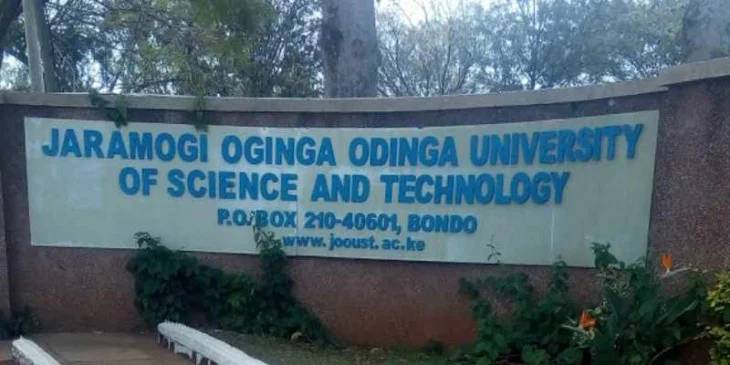
Jaramogi Oginga Odinga University of Science and Technology (JOOUST) has launched a comprehensive, multi-stress agricultural research initiative in partnership with a consortium of German institutions to address severe declines in maize productivity.
The ambitious project, running under an initial four-year term with prospects for an eight-year extension, aims to reverse decades of diminishing crop yields that have heavily compromised regional food and feed security.
Speaking during a field visit at the JOOUST agricultural faculty, project leader Prof. Denis Ochuodho noted that maize remains a vital staple food experiencing mounting pressures from climate change, water limitations, nitrogen stress, and biotic factors like stemborer and leaf rust.
”As researchers and a university with the local community, our role is to solve challenges that are affecting our local community, and one key challenge is food security,” Prof. Ochuodho stated.
The initiative incorporates seven sub-projects investigating various environmental stresses across the Lake Victoria basin in Kenya alongside parallel components in Germany.
Prof. Agrey Thuo, DVC in charge of Planning, Administration, and Finance, emphasized that the research directly targets community hardships following widespread crop failures.
”Specifically this year, the 2026, almost all the regions of this country had a crop failure,” Prof. Thuo said, pointing to critical shortages affecting household food supplies and animal feed stocks like ugali meal.
The consortium brings together expertise from six German universities, including the University of Göttingen, the University of Hohenheim, and key international collaborators.
Prof. Reimund Rötter of the University of Göttingen highlighted the necessity of understanding interactive biotic and abiotic stressors to breed multi-stress-tolerant maize cultivars for future climate scenarios.
Statistically structuring the complex experimental designs across multiple environmental factors is overseen by Prof. Hans-Peter Piepho of the University of Hohenheim, ensuring rigorous data analysis to separate treatment effects from environmental variation.
Prof. Julius Manyala, DVC in charge of Research, Innovation, and Extension, added that the project aligns with JOOUST’s broader portfolio of 18 active projects valued at approximately 1.8 billion Kenyan shillings. He emphasized that the initiative will build global visibility while translating scientific findings directly into actionable advice for small-scale and large-scale farmers.
By integrating agronomy, crop phenotyping, entomology, and socio-economic assessments, the consortium expects to train a new interdisciplinary generation of postgraduate scientists and provide sustainable, localized solutions to safeguard East Africa’s agricultural future.