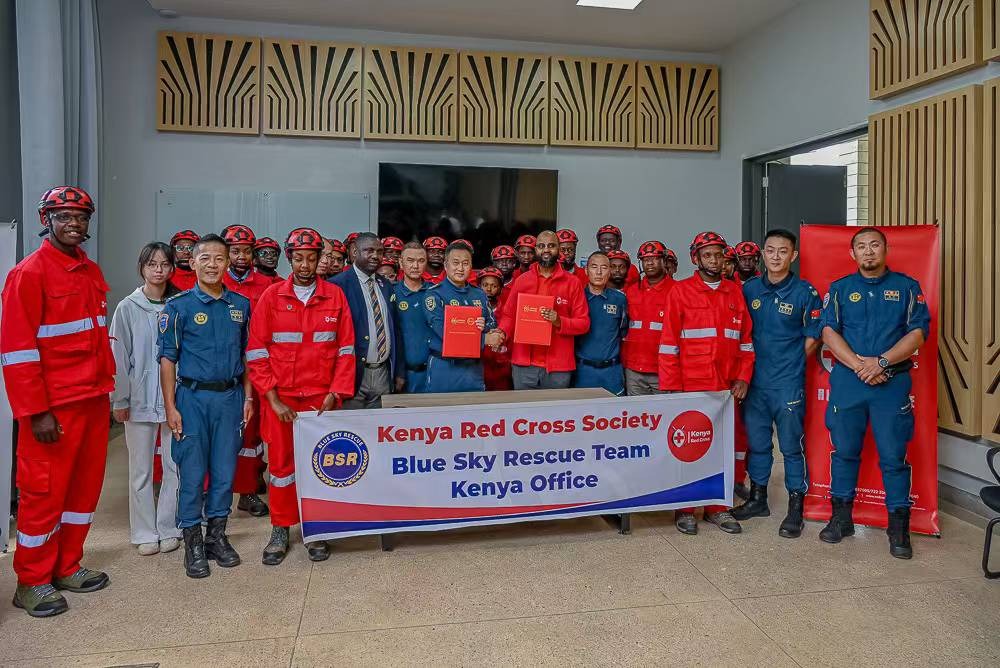
Kenya is set to strengthen its emergency response capacity through a new partnership between the Kenya Red Cross Society (KRCS) and China’s Blue Sky Rescue (BSR), aimed at developing professional volunteer search-and-rescue teams across the country.
The partnership was formalised on August 5, 2026, when BSR founder and chairman Zhang Yong and KRCS Secretary General Dr Ahmed Irshad Idris signed a Memorandum of Understanding. The agreement seeks to establish a structured system for training, developing and equipping volunteer rescue teams capable of responding to emergencies across Kenya and, eventually, the wider region.
At the centre of the partnership is the establishment of a joint office at the KRCS headquarters. Through the office, BSR will provide rescue training, team-building strategies and technical guidance as Kenya works towards developing professional search-and-rescue units in different counties.
The partnership also aims to establish an elite rescue force that will prepare for the INSARAG Light Classification, an international standard under the United Nations Office for the Coordination of Humanitarian Affairs (OCHA). The goal is to create a team capable of responding to disasters within Kenya while also providing humanitarian assistance to neighbouring countries.
Training has already begun, with an eight-day programme held at the Kenya Army’s Humanitarian and Peace Support School. The training brought together KRCS operations leaders from several counties and search-and-rescue personnel from the Kenya Army.
Participants were trained in Urban Search and Rescue, including shoring, structural support, breaching and breaking and confined-space operations. The programme also covered swift-water rescue, including boat handling, water rescue equipment, rescue techniques and coordination during operations.
The training marked the first time a Chinese rescue force had delivered systematic rescue training in Kenya.
For Raymond Odhiambo, a KRCS USAR trainee with more than a decade of experience in the Red Cross movement, the programme stood out for its practical approach.
“Having been part of the Red Cross movement for over 10 years, I can confidently say that this has been one of the most practical, skilful, and impactful trainings I have experienced,” Odhiambo said.
He said the expertise shared during the programme demonstrated the value of strengthening technical skills among emergency responders.
“The level of expertise and knowledge transfer is truly commendable,” he added.
The partnership comes as Kenya continues to face significant disaster risks, particularly flooding. BSR officials said discussions with the National Disaster Operations Centre focused on expanding the training to include elite official rescue personnel from every county.
The two sides also discussed the importance of strengthening water rescue capabilities as Kenya faces recurring floods and concerns over future extreme weather events.
Beyond the Red Cross and government disaster-response structures, BSR has sought to widen participation in emergency preparedness. Its delegation met representatives of the Kenya Chinese Community Association to encourage Chinese enterprises operating in Kenya to participate in bilateral emergency capacity-building initiatives.
The delegation also held discussions with the Social Organizations Management Authority, where both sides agreed to establish a dedicated training session for representatives of Kenyan non-profit organisations involved in disaster relief.
At the Ministry of Labour and Social Protection, the Director of Social Development welcomed BSR’s expanding role. The meeting was also attended by Meshack Odede, chairperson of the Volunteer-Involving Organisations Society.
BSR also visited the United Nations Office at Nairobi and met officials from OCHA. The discussions centred on the organisation’s model of developing professional volunteer rescue teams using a practical, low-cost and comprehensive approach suited to developing countries.
The organisation said it intends to explore replicating the model in other African countries.
For Kenya, the partnership represents an attempt to move beyond emergency response that depends largely on isolated interventions towards a more structured network of trained volunteer rescuers.
The planned county-by-county approach could also help strengthen local preparedness by ensuring that rescue capabilities are developed closer to communities exposed to disasters.
BSR views Kenya as a potential gateway for expanding cooperation across eastern and southern Africa. The partnership is expected to develop gradually through training, team building and technical support, with the longer-term ambition of creating a professionally prepared volunteer rescue force capable of supporting disaster response both nationally and regionally.