
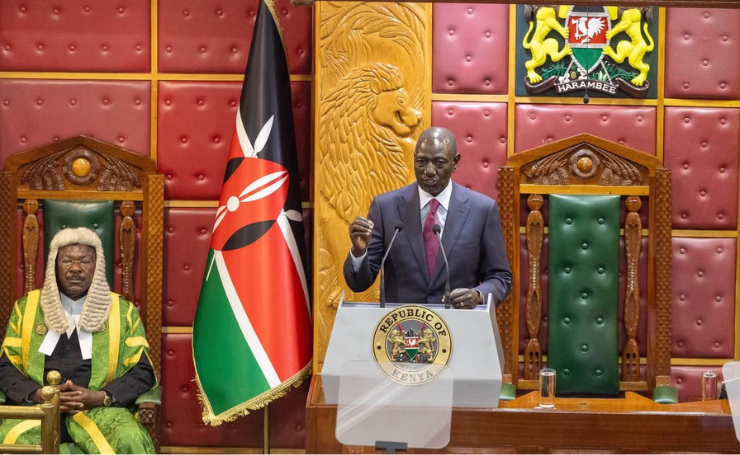
The government has saved Kenyan taxpayers approximately KSh 1.5 billion following a radical shift to print national examination papers locally, President William Ruto has announced.
Delivering his fourth State of the Nation address during a joint sitting of the Senate and the National Assemblythe 14th such address in Kenya’s historythe Head of State revealed that for the first time since 1965, all national assessment papers were produced within the country.
The locally printed papers cover the Kenya Certificate of Secondary Education (KCSE), the Kenya Junior School Education Assessment (KJSEA), and the Kenya Primary School Education Assessment (KPSEA).
President Ruto explained that the policy shift was born out of a challenge he posed to top officials at the Ministry of Education regarding the country’s domestic production capabilities.
“The question I asked our ministerial officials is this: If we are printing currency in Kenya, why can’t we print exams in Kenya?” Ruto told lawmakers. “And in this single undertaking, we have taken off close to a billion and a half shillings that would have been wasted.”
According to the President, ending the decades-long reliance on external printing firms has freed up critical public funds that the administration can now redirect toward essential services that directly benefit citizens.
He noted that the assessments have proceeded in a calm and orderly environment, marking a deliberate departure from the heavy police presence that has traditionally characterized national exams in recent years.
“In short, we have conducted exams without the presence of a single policeman. This is how it should be,” the President remarked, emphasizing that national assessments should be treated as a normal milestone in the learning process rather than high-stakes security operations that induce unnecessary anxiety among students.
Beyond the cost-cutting measures, President Ruto commended the smooth administration of the ongoing examination cycle, which has brought together roughly 3.6 million candidates across the KPSEA, KJSEA, and KCSE levels making it the largest examination cohort in Kenya’s history.