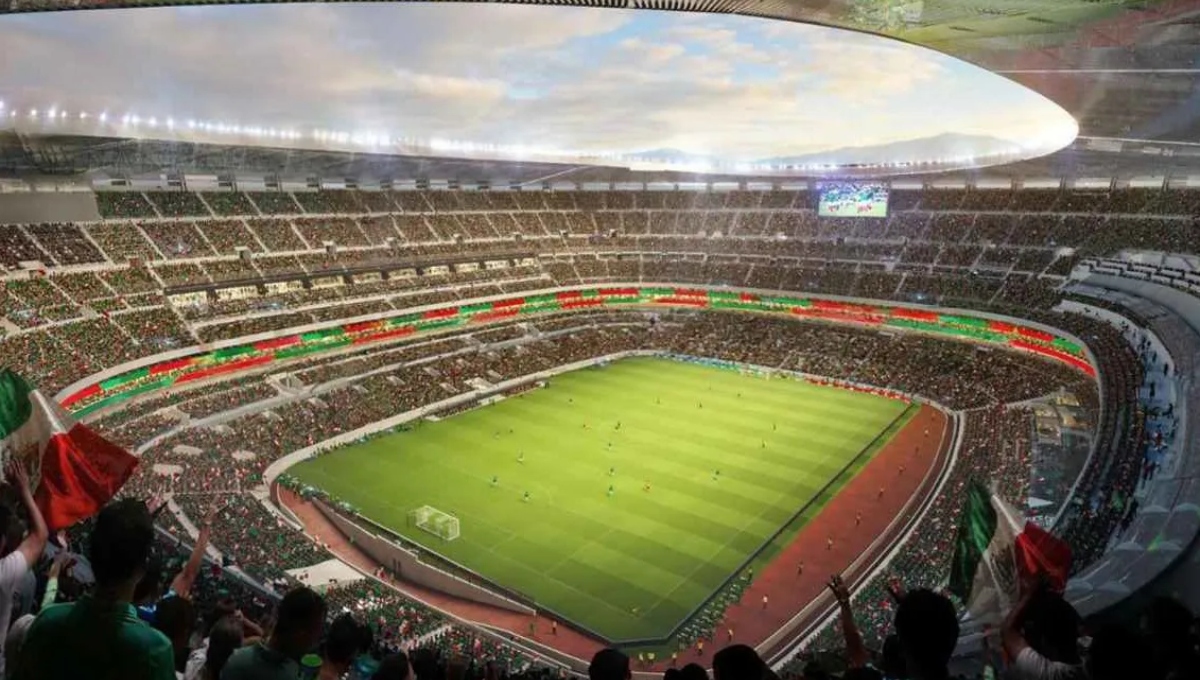
All eyes will turn to Mexico City’s iconic Estadio Azteca on Thursday night as the 2026 FIFA World Cup gets underway with hosts Mexico taking on South Africa. While the tournament will be spread across three countries, the famous Mexican venue once again takes centre stage, thanks to a history that few stadiums in world football can match.
The legendary arena is set to break new ground by becoming the first stadium ever to host matches in three different FIFA World Cups, having previously welcomed the global showpiece in 1970 and 1986.
The 2026 tournament is being jointly staged by Mexico, the United States, and Canada, with Estadio Azteca joining Guadalajara and Monterrey as Mexico’s selected venues. Its inclusion further underlines its enduring importance in world football.
Situated in the bustling Mexican capital, the stadium first opened in 1966 after being designed by renowned architects Pedro Ramírez Vázquez and Rafael Mijares Alcérreca. Owned by media giant Televisa, the venue can accommodate more than 87,000 spectators, making it the largest stadium in Mexico and one of the most impressive football arenas globally.
Over the decades, Estadio Azteca has witnessed some of the sport’s greatest moments. It remains the only stadium to have staged two FIFA World Cup finals.
In 1970, football fans watched as the great Pelé inspired Brazil to World Cup glory, securing a third world title and cementing his place among the game’s immortals.
The stadium’s mythology grew even further during the 1986 World Cup when Argentine icon Diego Maradona produced one of the most memorable performances in football history against England.
Speaking after that unforgettable quarter-final, Maradona famously described one of his goals as being scored with “a little with the head of Maradona and a little with the hand of God,” a phrase that has since become part of football folklore.
That same match also produced what many consider the greatest goal ever scored at a World Cup, as Maradona dribbled past multiple England players before finding the net. He would later captain Argentina to victory in the final against West Germany, forever linking his legacy to the famous stadium.
Beyond the World Cup, Estadio Azteca has hosted several major international events, including the 1999 FIFA Confederations Cup final and the 2011 FIFA U-17 World Cup final.
Domestically, the venue has served as the home of Mexican giants Club América since it opened its gates. Other notable clubs, including Cruz Azul and Necaxa, have also used the stadium as their home ground at various points. Its vast capacity has made it a preferred destination for numerous Liga MX title deciders and historic domestic clashes.
Ahead of the 2026 World Cup, the stadium has undergone significant renovations aimed at enhancing fan experience, media facilities, and technological infrastructure while preserving the character that has made it one of football’s most cherished landmarks.
Architecturally, Estadio Azteca stands out for its blend of Mexican modernist design and Brutalist influences. Massive concrete structures, steep open-air stands, and a partially covered bowl combine to create one of the most intimidating atmospheres in world football.
The venue will host five matches during the 2026 World Cup. The schedule begins with the tournament opener between Mexico and South Africa on June 11, followed by Uzbekistan versus Colombia on June 17 and Czechia against Mexico on June 24 during the group stage.
The stadium will then welcome a Round of 32 fixture on June 30 before staging a Round of 16 clash on July 5.
As another World Cup chapter begins, Estadio Azteca continues to stand as more than just a football stadium. It remains a symbol of the sport’s rich history, a stage for unforgettable moments, and a place where new legends are ready to be written. With its unique status as the first three-time World Cup host venue, the iconic arena is once again prepared to take its place at the heart of football’s greatest spectacle.