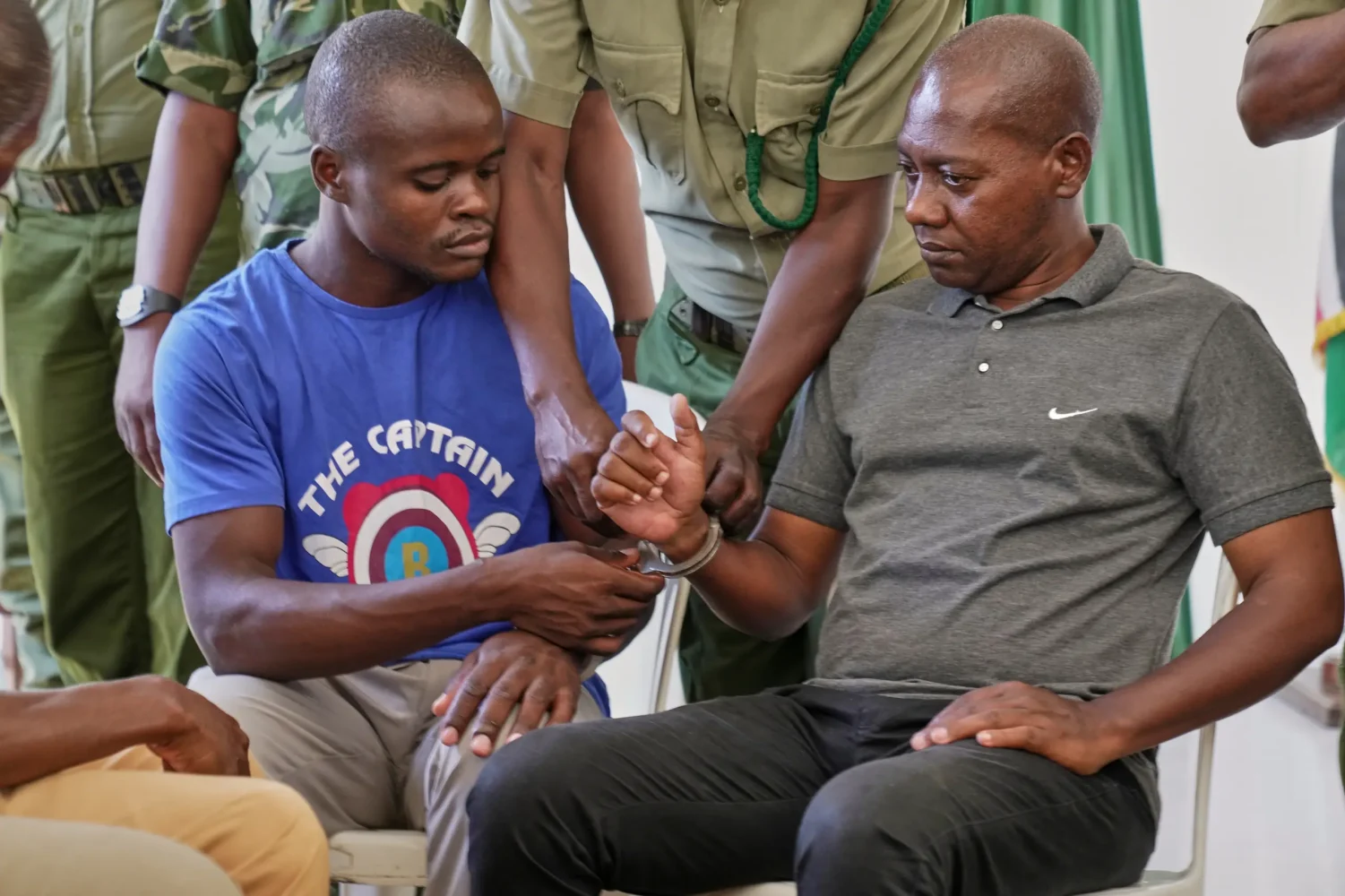

The Director of the Public Prosecution (DPP) on Friday, November 6 secured a jail term of 200 years for the controversial 53-year-old preacher Paul Nthenge Mackenzie and a jail term of between 100 years and 160 years for 26 co-convicts for the murder of 191 persons at Shakahola Forest in Malindi Sub-County, Kilifi County, between January 2021 and September 2023.
Justice Diana Kavedza sentenced Mackenzie to 200 years; 15 convicts were sentenced to 160 years imprisonment; 10 convicts were jailed for a term of 140 years; one accused was jailed to 100 years, and two (Enos Amanya and Lucas Owino) were each jailed for 10 years.
Lady Justice Diana Kavedza sentenced Enos Amanya Ngala to serve 10 years in jail after he entered a plea-bargaining agreement with the ODPP, where he pleaded guilty to all 191 counts of murder.
The court was satisfied that that prosecution proved the case against all the accused persons for the murder of 190 children and one adult, contrary to Section 203 of the Penal Code.
The convicts were sentenced on 183 counts of murder by starvation, 8 counts of murder by direct homicide, and one count of death of an adult.
Delivering the sentence, Lady Justice Kavedza ruled that prosecution established death in all 191 counts, with starvation as the cause of death in 72 cases and additional deaths from asphyxia, manual neck compression, and traumatic head injury. The court also found that in 110 cases, the cause of death was unascertained due to decomposition and the surrounding circumstances supported the inference that these victims also died from starvation under the fasting regime.
The court found that Mackenzie radicalized members of Good News International, with the teaching satisfying the definition of an extreme belief system.
Mackenzie of Good News International Church registered his church as a religious society in 2020 as the chairman and Smart Deri as the secretary. The church had its headquarters at Furunzi, Malindi, and some 35 branches across Kenya.
In the court’s judgement, Justice Kavedza found that Mackenzie’s church denounced formal education as satanic, rejected modern medicine and hospitals as instruments of the devil, and portrayed the government and its identification programmes, including the Huduma Number and civic institutions, as the beast of Revelation.
The evidence also established that he required his followers to separate themselves from “watu wa mataifa” and ultimately required them to relocate to “kanisa Jangwani,” the church in the wilderness at Shakakhola. His followers sold property, resigned from employment, withdrew children from school, destroyed identification documents, and relocated to Chakama Ranch, divided into biblical villages including Galilaya, Judea, Tiro, Bethlehem, Sidoni, Samaria, and Sikari.
Mackenzie later directed his followers to fast to death to “meet” Jesus in a prescribed sequence: children first, followed by youth, women, men, and finally Mackenzie and his family. Those who resisted were to be forced to comply through kicks and blows.
The evidence established Mackenzie issued a directive requiring followers to fast to death, beginning with children, and that the directive was enforced through violence, confinement, and the withholding of food and water until unascertained death. The court held that the pathologist could not determine the cause of death in 110 cases to decomposition or the surrounding circumstances of the fasting regime.
The court also held that parental responsibility is a legal duty to protect the child’s life, health, and welfare, with no right of ownership. A parent has no legal entitlement to determine that a child should die in pursuit of a religious belief.
Where the evidence established that a parent knowingly subjected a child to the fatal fasting regime and maintained the conditions that prevented the child from obtaining nourishment or escaping, those acts and omissions could establish a direct causal connection with the child’s death.
The prosecution team was led by the DPP and comprised Peter Kiprop, Head of the Coast Region; Jami Yamina; Victor Owiti; Ngina Mutua; Betty Rubia; and Yassir Mohammed.