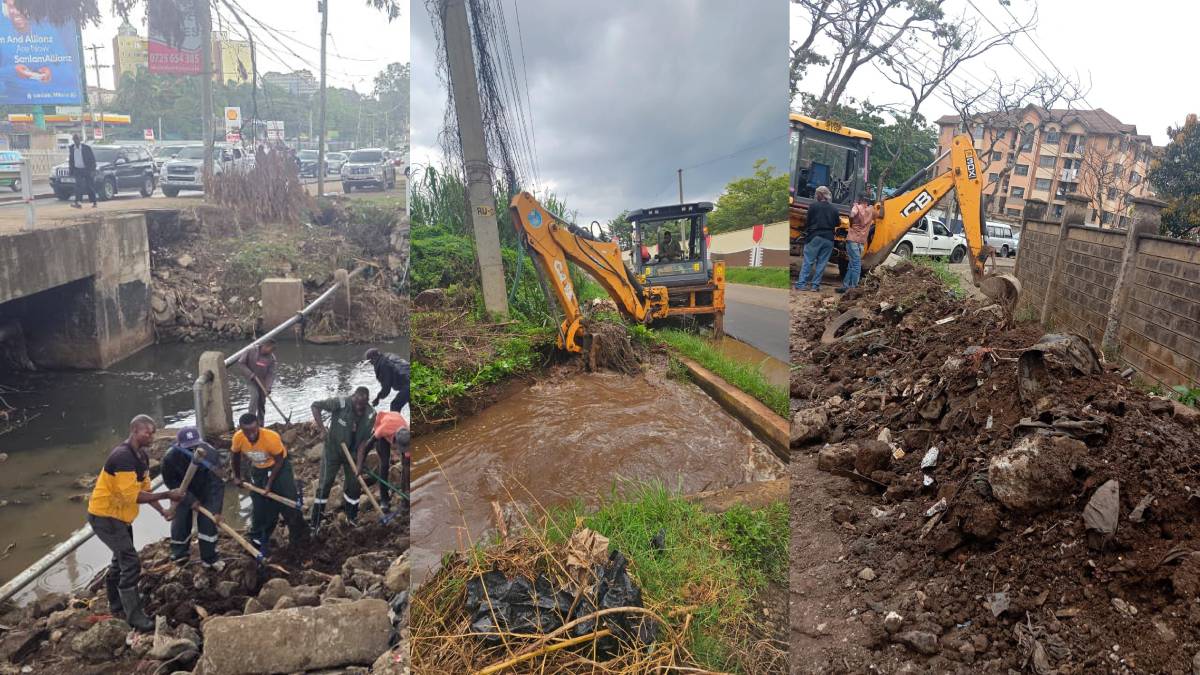
Nairobi County has stepped up an aggressive, citywide flood mitigation campaign, deploying additional teams across critical hotspots as relentless rains continue to test the capital’s drainage and road infrastructure.
In a statement issued by Disaster Management Chief Officer Bramwel Simuyu, the county detailed a stepping up of its coordinated response that has seen intensive desilting of drainage systems, rehabilitation of rivers, installation of culverts, and restoration of flood-damaged roads across multiple wards.
The operations are targeting some of the city’s most vulnerable areas, including informal settlements, major transport corridors, and fast-growing neighborhoods where drainage systems have struggled to cope.
This efforts are a continuation of measures that began in March in notorious hotspots following last month’s deluge.
County teams, working round the clock, have been clearing blocked stormwater channels, expanding waterways, and removing solid waste blamed for recurrent flooding.
The intervention, the statement says, is designed to not only respond to the current crisis but also strengthen long-term resilience against extreme weather.
But with Nairobi’s roads managed by different agencies, the county has also pushed for a unified front.
Governor Johnson Sakaja has also directed national road agencies to urgently fix flood-prone corridors under their control, triggering fresh activity on key highways.
“The city cannot afford fragmented action in the face of flooding,” Sakaja said. “I have directed all relevant road agencies to immediately sort out the corridors under their jurisdiction. We must act with urgency, coordination, and accountability to keep Nairobi moving and protect lives and livelihoods.”
Following the directive, the Kenya National Highways Authority (KeNHA) has mobilized teams along Ruai Bypass, Mombasa Road, and Uhuru Highway to tackle flooding, while the Kenya Urban Roads Authority (KURA) has redeployed contractors in Westlands and nearby areas to restore road functionality and improve drainage.
Beyond emergency works, the county says it is doubling down on investments in modern drainage systems, protection of riparian land, enforcement against illegal dumping, and climate-smart urban planning.
Residents have also been called upon to play their part by disposing of waste responsibly and cooperating with ongoing works.