
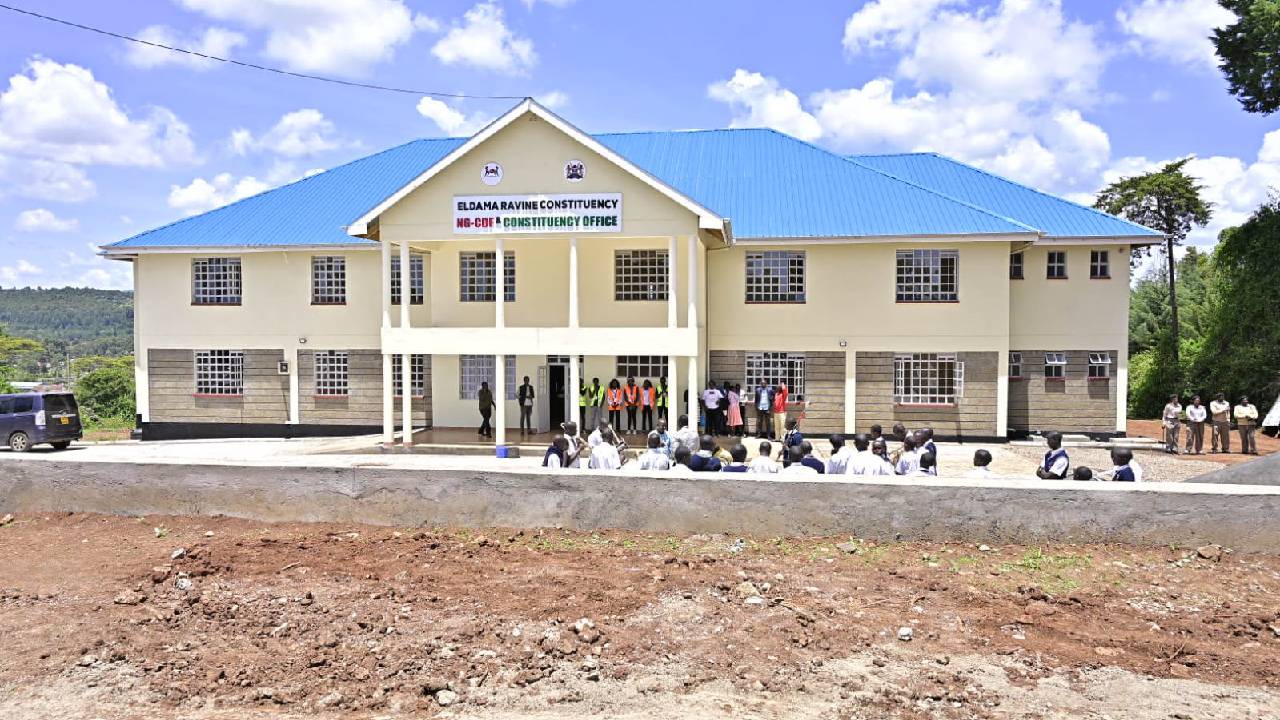
Education infrastructure and bursaries remain the largest claims on National Government Constituencies Development Fund (NG-CDF) resources. Historical figures from the Fund show the scale of its investment in education infrastructure since its establishment in 2003.
According to NG-CDF figures, the Fund has supported the establishment of 3,120 new primary and secondary schools—1,389 primary schools and 1,731 secondary schools—adding an estimated annual capacity of 882,026 learners.
NG-CDF education infrastructure
| Facility type | Units completed |
|---|---|
| New schools established | 3,120 total (1,389 primary / 1,731 secondary) |
| New classrooms (2020–2025) | 26,614 |
| Administration blocks | 1,906 |
| Science laboratories | 1,269 |
| Special-needs schools | 16 |
| Technical training institutes (with MoE) | 168 |
| KMTC campuses | 61 new / 14 upgraded |
| Annual learner capacity added | ≈882,026 |
Bursary scheme and accountability concerns
The NG-CDF bursary scheme allocates roughly KSh15 billion annually to support an average of 1.2 million students across primary, secondary and tertiary institutions.
The eligibility criteria give greater weight to applicants from single-parent and needy households, each accounting for 30 per cent, followed by orphans at 25 per cent and persons with disabilities at 15 per cent.
Applicants apply through their constituency offices or the NG-CDF online portal and are required to submit documents including fee structures, transcripts, guardian identification, admission letters and evidence of vulnerability, such as death certificates or disability documentation.
However, successive reports by the Auditor-General have raised concerns over the documentation and accountability of a significant portion of bursary expenditure.
In her report for the year ended June 2024, Auditor-General Nancy Gathungu found that 86 constituencies could not provide supporting documents, including receipts, student acknowledgement forms and admission numbers, for KSh2.12 billion in bursary disbursements.
A further 39 constituencies could not account for an additional KSh1.97 billion, bringing the total amount of bursary spending that could not be verified to approximately KSh4.1 billion for that financial year.
The Auditor-General’s report for the year ended June 2025 flagged further cases. These included KSh76.2 million in a single constituency that could not be confirmed as having reached the intended beneficiaries, school projects that had been paid for in full despite being incomplete, and missing bank reconciliation records covering tens of millions of shillings.
Individual constituency-level findings have also emerged. An audit of Kiambu Town’s 2024/2025 accounts, for instance, questioned more than KSh69 million in bursary spending over issues including duplicate awards, missing admission numbers and payments to ineligible institutions.
MPs and Auditor-General clash over accountability
The National Assembly’s Decentralised Funds Accounts Committee has strongly challenged some of the Auditor-General’s findings.
The committee has argued that Members of Parliament have an oversight role, while responsibility for the actual disbursement and management of bursary funds rests with Fund Account Managers, who are employees of the NG-CDF Board rather than MPs.
Committee chair Gideon Mulyungi described the Auditor-General’s characterisation of some of the findings as misleading. The committee has also indicated that it intends to summon the Auditor-General to explain the methodology used in the audits.
The dispute highlights a structural tension in the NG-CDF system: MPs play a prominent role in championing projects funded through the programme while also being involved in the oversight structures responsible for scrutinising how the funds are managed.
While the Fund’s education investments have expanded access to infrastructure and learning opportunities, questions over bursary documentation and accountability continue to place scrutiny on how constituency-level resources are managed.