

The Parliament of Kenya has officially published the Finance Bill 2026, paving the way for renewed national debate over taxation, revenue collection, and government spending as the country awaits details on how the proposed measures could affect businesses and ordinary Kenyans.
In an update shared on its Facebook account on Saturday, 9 May 2026, Parliament confirmed that the bill was published on 5 May and formally submitted to the National Assembly of Kenya by the Cabinet Secretary for the National Treasury.
According to Parliament, the proposed legislation introduces a raft of revenue-raising measures aimed at strengthening tax collection and adjusting key provisions within the country’s tax framework.
“𝐔𝐏𝐃𝐀𝐓𝐄: 𝐓𝐡𝐞 𝐅𝐢𝐧𝐚𝐧𝐜𝐞 𝐁𝐢𝐥𝐥, 𝟐𝟎𝟐𝟔, has been published,” Parliament announced.
The institution added that the bill “formulates proposals relating to revenue raising measures including liability to, and collection of taxes,” signalling a broad review of how taxes are assessed, collected, and managed in Kenya.
Parliament further revealed that the bill seeks to amend six major tax laws that play a central role in the country’s revenue system.
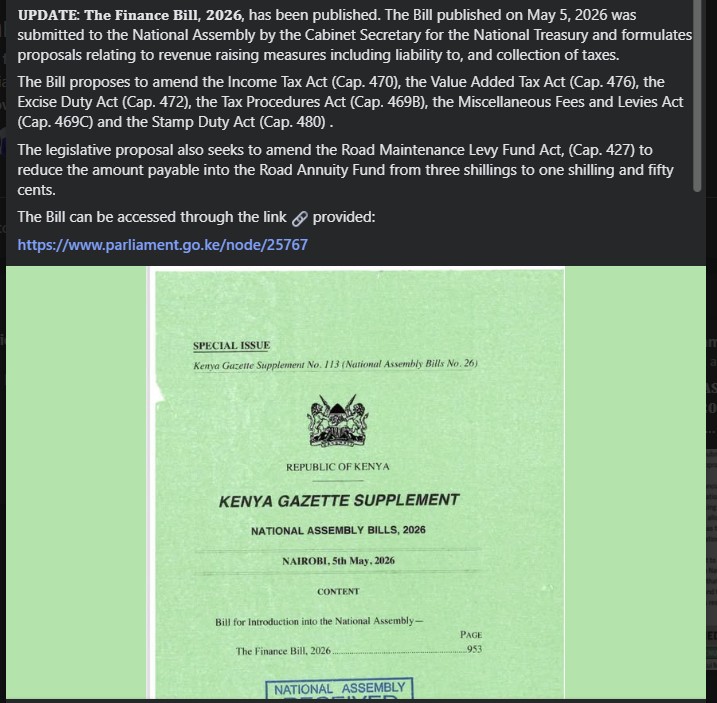
“The Bill proposes to amend the Income Tax Act (Cap. 470), the Value Added Tax Act (Cap. 476), the Excise Duty Act (Cap. 472), the Tax Procedures Act (Cap. 469B), the Miscellaneous Fees and Levies Act (Cap. 469C) and the Stamp Duty Act (Cap. 480),” Parliament stated.
Beyond tax laws, the proposed legislation also introduces changes to road funding allocations. Parliament said the bill seeks to amend the Road Maintenance Levy Fund Act by lowering the amount directed to the Road Annuity Fund.
“The Bill published also seeks to amend the Road Maintenance Levy Fund Act, (Cap. 427) to reduce the amount payable into the Road Annuity Fund from three shillings to one shilling and fifty cents,” Parliament said.
The publication of the Finance Bill 2026 now opens the legislative process, where lawmakers, stakeholders, and members of the public are expected to scrutinise its proposals before debate in the National Assembly.
With taxation often at the centre of public concern, the bill is likely to spark widespread discussion on its economic impact, particularly at a time when many Kenyans continue to grapple with the rising cost of living.