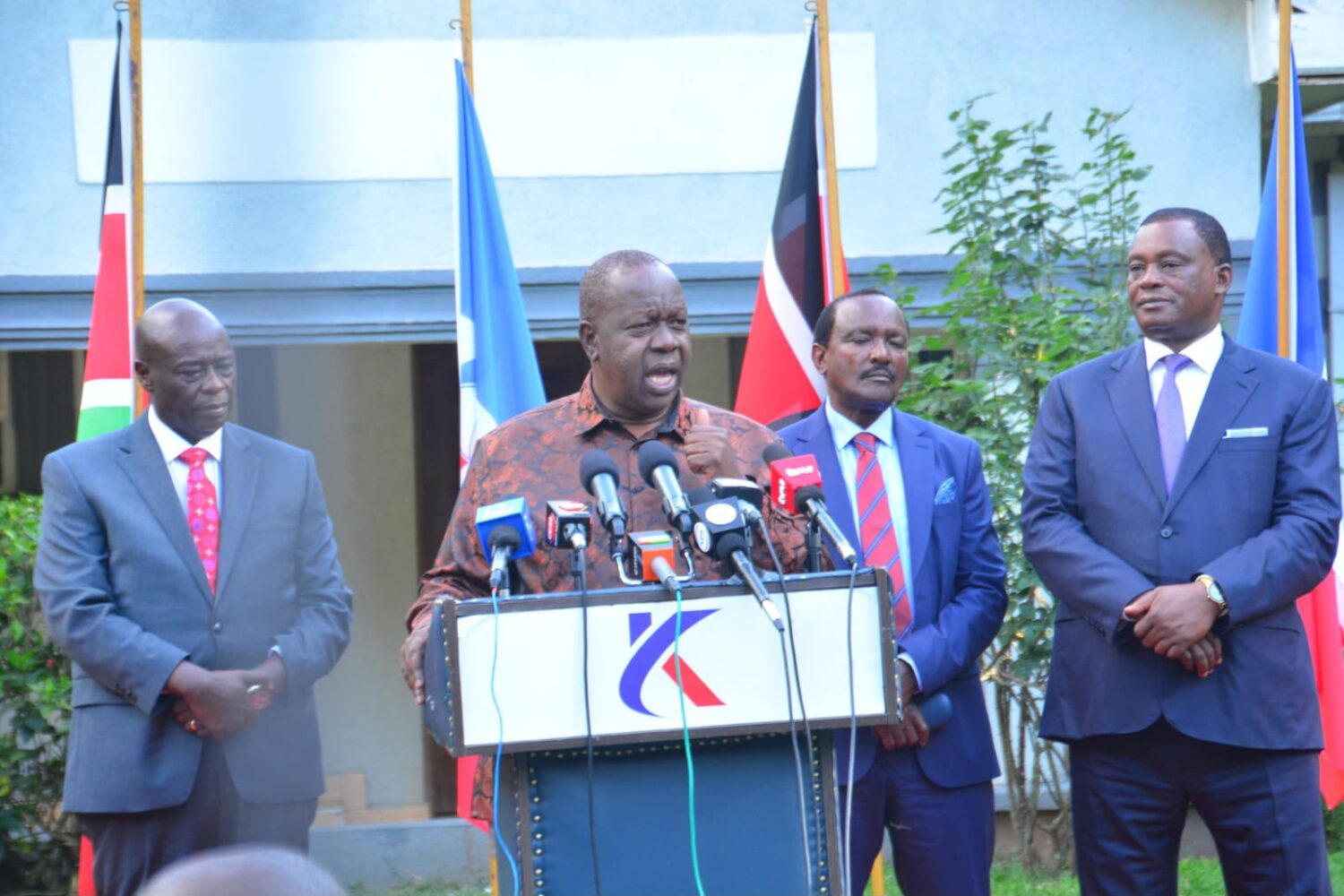
On the eve of one of Kenya’s most closely watched budget cycles, the opposition unveiled an alternative spending plan that challenges not only the government’s economic priorities but also the assumptions that have come to define the country’s fiscal debate.
Presented under the banner of the United Alternative Government, the proposal argues that budget-making has become increasingly detached from the realities facing ordinary Kenyans grappling with rising living costs, shrinking incomes and persistent economic uncertainty.
Rather than beginning with revenue targets and taxation projections, opposition leaders say the conversation should start with citizens.
“We came to write a different budget entirely,” said Wiper Party leader Kalonzo Musyoka. “One built on the principle that in the Republic of Kenya, the government serves the people, not the other way around,” he added.
The alternative budget enters a national conversation already shaped by public anxiety over taxation, household finances and economic opportunity.
In recent years, budget statements have increasingly become political flashpoints as citizens scrutinize not only how the government spends money, but also how it raises it.
Against that backdrop, the opposition’s proposal seeks to position itself as a competing economic vision ahead of the 2027 election cycle.
They argue that government policy should be measured not merely by its ability to collect revenue but by its impact on workers, entrepreneurs, farmers, students and families struggling to navigate a challenging economic environment.
At its core, the proposal presents a familiar but increasingly resonant question: should fiscal policy be designed primarily around balancing government books, or around easing pressure on citizens?
That tension has come to define much of Kenya’s recent economic debate.
Government officials have consistently defended revenue-enhancing measures as necessary to finance public services, manage debt obligations and sustain development projects. Critics, however, argue that many households have reached their limit, with higher taxes and rising costs eroding purchasing power and public confidence.
The opposition’s alternative budget attempts to capitalize on those frustrations.
Throughout the document, its authors frame economic policy as a question of public trust, arguing that citizens are more likely to support government programs when they see tangible returns in service delivery, employment creation and economic opportunity.
The proposal also reflects a broader political strategy.
As opposition parties seek to build momentum ahead of the next general election, economic issues are emerging as a central battleground.
While debates over governance, accountability and constitutionalism remain important, it is often the cost of living that most directly shapes public perceptions of leadership.
In that sense, the alternative budget functions as more than a financial blueprint, it is also a statement of political intent.
By presenting a detailed counterproposal, opposition leaders are attempting to move beyond criticism and demonstrate how they would govern differently if entrusted with power.
Whether the recommendations gain traction remains uncertain. The government’s budget will continue to shape actual spending and taxation decisions, while opposition proposals carry no legislative force unless adopted by policymakers.
Budget season is no longer confined to Treasury officials, economists and parliamentary committees. It has become a contest over competing visions of governance, accountability and the role of the state itself.