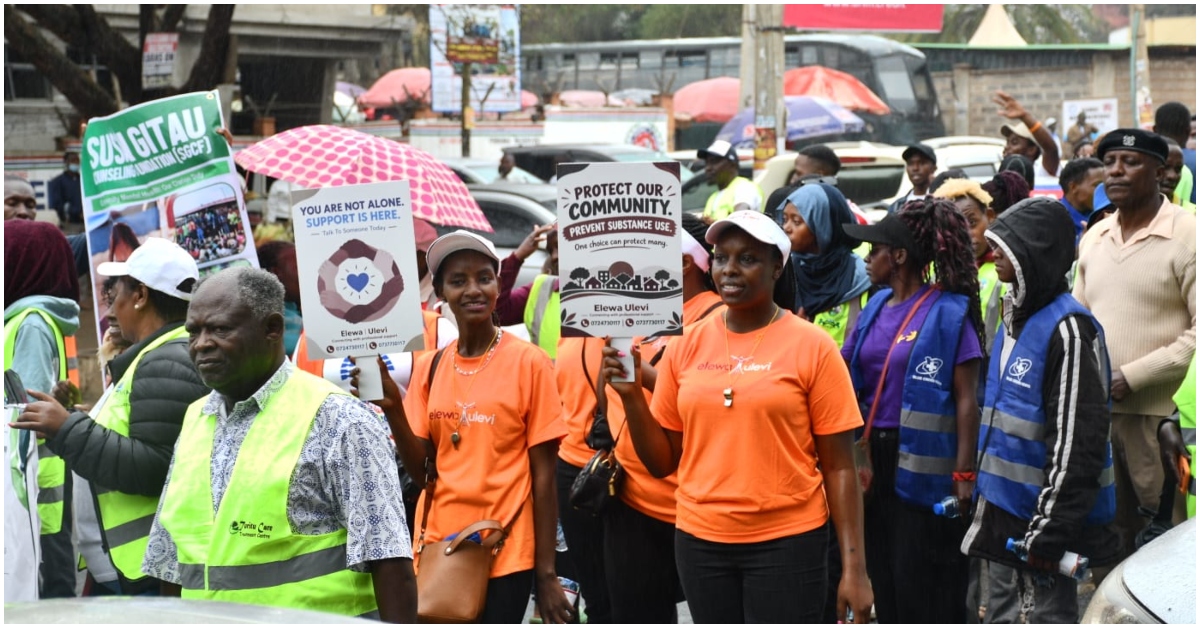
The staggering reality of Kenya’s substance abuse crisis hit the streets of Kiambu yesterday when hundreds of activists and campaigners marched from Kirigiti Roundabout to the Kiambu Bus Stage, revealing that children as young as six years old are now tasting their first sip of alcohol.
The Alcohol & Drugs Prevention Awareness Walk 2026, organized by Blue Cross Kenya alongside local community groups, served as a multi-sectoral battle cry targeting a devastating youth crisis.
The event coincided with coordinated national anti-drug campaigns executing simultaneous activations in Homa Bay, Kakamega, and Kisumu.
The sheer scale of early initiation emerged as a primary driver for the demonstration. Campaigners warned that without immediate intervention, the county risks losing its productive workforce to addiction.
Ground data reveals the onset age of alcohol consumption in Kenya has plummeted to just six years old, with the most severely impacted demographic in Kiambu being youth between 15 and 35 years.
A staggering 28.9% (about three out of ten) of local youth aged 15–24 years report active alcohol use, dwarfing the national average of 11.2%.

“Our main aim is to educate the community because we know the onset age of alcohol use in Kenya is six years. We want our children, youth, and families to be safe and healthy,” said Brian Magwaro of Blue Cross Kenya.
With many families unable to afford high rehab fees, grassroots organizations are stepping in with alternative therapy models. Blue Cross Kenya highlighted their church-partnered self-help groups which offer free 12-step recovery sessions twice a month to dozens of struggling residents.
Similarly, local rehabilitation advocates are addressing the economic gap by equipping recovering users with long-term survival tools.
“We run a 17-week programme using lay providers to equip youth with coping mechanisms, linking addiction directly to mental health. For sustainability, we ensure there is skilling so that when they abstain, they can support themselves and remain functional human beings,” explained the founder of Graceful Youth Recovery Centre.
Activists at the Kiambu Bus Stage press briefing issued a sharp challenge to the local leadership. They urged the Kiambu County Government to establish fully functional, subsidized public rehabilitation facilities under the Alcoholic Drinks Act. There was also a strong push to have the Social Health Authority (SHA) cover rehabilitation costs to make treatment accessible to low-income households.
Representing the regulatory body, NACADA Kiambu County Coordinator Caroline Arimi noted that the war cannot be won by a single entity. She emphasized that NACADA is coordinating a heavy multi-sectoral enforcement approach
combining forces with the Kenya Revenue Authority (KRA), national government administrative officers, and standard boards to choke the supply of illicit brews.