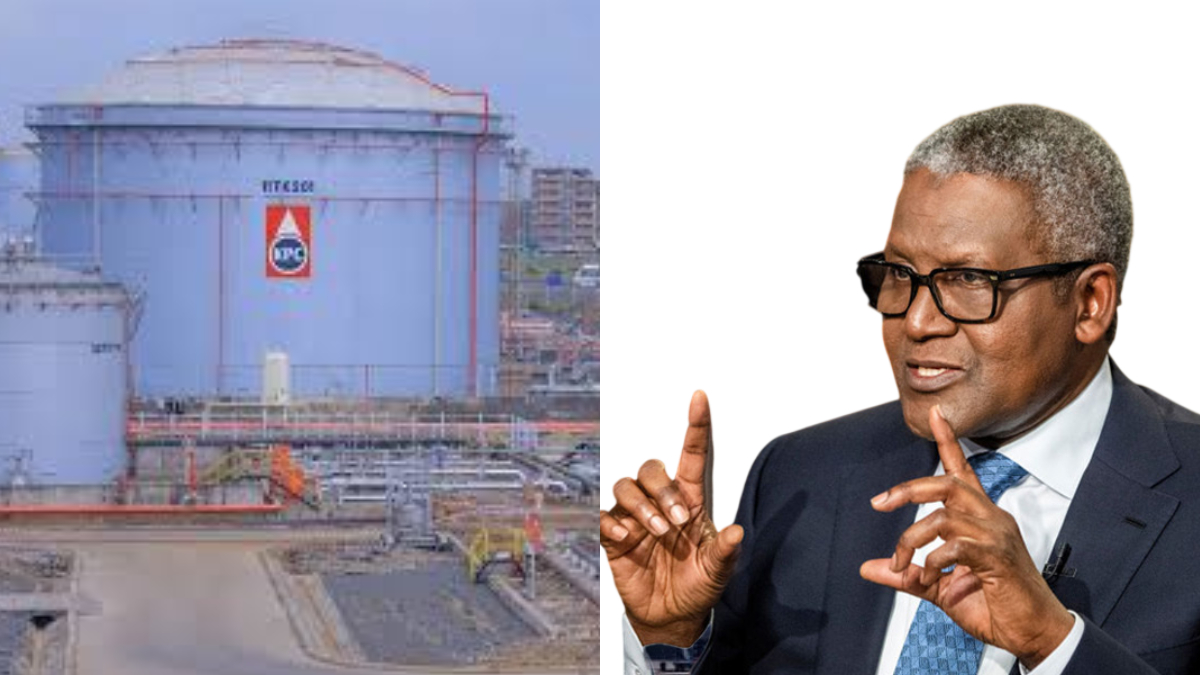
Nigerian billionaire Aliko Dangote has said that his company acquired 25 percent of Kenya Pipeline Company (KPC) PLC, even as Africa’s richest man expands his energy empire across the continent.
“We bought 25% of their pipeline network for the distribution of petroleum products,” the Dangote Industries Ltd. founder and chief executive officer said at an event in London on Wednesday, October 21. However, Dangote did not reveal which of his companies had bought the stake.
Dangote’s revelation comes a day after President William Ruto, during his Mashujaa Day celebration message to Kenyans, revealed that “private investors” had acquired a 25 percent stake in KPC for approximately KSh42.5 billion.
According to President Ruto, the move to privatise KPC will unlock new opportunities in the country’s energy sector.
“In the months ahead, we will unlock new opportunities in our energy sector,” President Ruto announced. “Work in the Lake Turkana Basin is progressing rapidly, with oil exports targeted to begin in December.”
“Just yesterday, in a demonstration of growing confidence in our capital markets, private investors acquired a 25 per cent stake in Kenya Pipeline Company from public entities, marking another step towards mobilising private capital for strategic infrastructure.
“Together, these developments will strengthen our energy sector, attract investment, and create new opportunities for the Kenyan economy.”
KPC shares
In March 10, 2026, President Ruto formally opened trading in KPC’s shares at the Nairobi Securities Exchange, marking the start of public trading after the government sold 65% stake through an Initial Public Offering (IPO), remaining with only 35%.
Consequently, 13 cash-rich state agencies and pension funds injected KSh64.23 billion into the IPO (institutional investors) to save the company from collapse, acquiring 41% of the stake;
- National Social Security Fund (NSSF): Picked up an estimated 23.3% stake.
- Public Servants Pension Scheme: Picked up 7.94%.
- County Workers Pension Fund: Picked up 2.2%.
- Unclaimed Financial Assets Authority (UFAA): Bought 1.98%
Strategic regional buyers across the East African Community would then acquire 21.22% of the company’s shares. The largest among them was the Uganda National Oil Company (UNOC), which purchased a massive portion (20.15%) of this allocation to secure Uganda’s transit pipeline logistics.
Local retail investors, who are basically ordinary Kenyan citizens and small-scale investors purchased a small fraction of the pool (2.56%). Others include; foreign investors (0.02%), KPC employees (0.06%), and oil marketers (0.014%).
What Dangote’s entrance means
The ownership of Kenya Pipeline has now changed significantly, with eight of the state parastatals flipping their shares.
The state agencies executed a massive 4.5 billion shares valued at KSh42.5 billion block trade on the Nairobi Securities Exchange to offload a 24.76% stake directly to Dangote.
Consequently, the “Institutional Investors” slice of the KPC pie has significantly shrunk, with Dangote becoming the single largest private individual shareholder in the company today.
Established in 1973 under the Companies Act (Cap 486 of the Laws of Kenya), KPC commenced commercial operations in February 1978. The listed company is mandated to provide safe, reliable, efficient, and cost-effective transportation, storage, and distribution of petroleum products from the Port of Mombasa to inland markets in Kenya and the broader East African region.
To deliver on this mandate, the Company has developed and continues to maintain an extensive infrastructure network comprising approximately 1,342 kilometres of pipeline, along with strategically located storage, pumping, and loading facilities. This system has a combined capacity of approximately 14 billion litres of petroleum products annually.
Privatisation criticism
No Government programme is above criticism. No leader is beyond accountability. We should debate the merits of competing proposals, question their costs and demand results. But let our disagreements produce better policies, not deeper divisions. No one should seek power without accepting accountability. No one should seek leadership without responsibility.
There is no contradiction between democracy, constitutionalism, the rule of law and economic transformation. The rule of law protects our rights. Constitutionalism limits the exercise of power. Democracy gives citizens the freedom to choose. A credible development agenda gives that choice substance, and accountability gives it consequences. None can replace the others. Together, they give meaning to the sacrifices of our heroes. The freedom they won must never end at the ballot box. It must reach the classroom, the farm, the hospital, the workplace, the marketplace, and every home in every village.