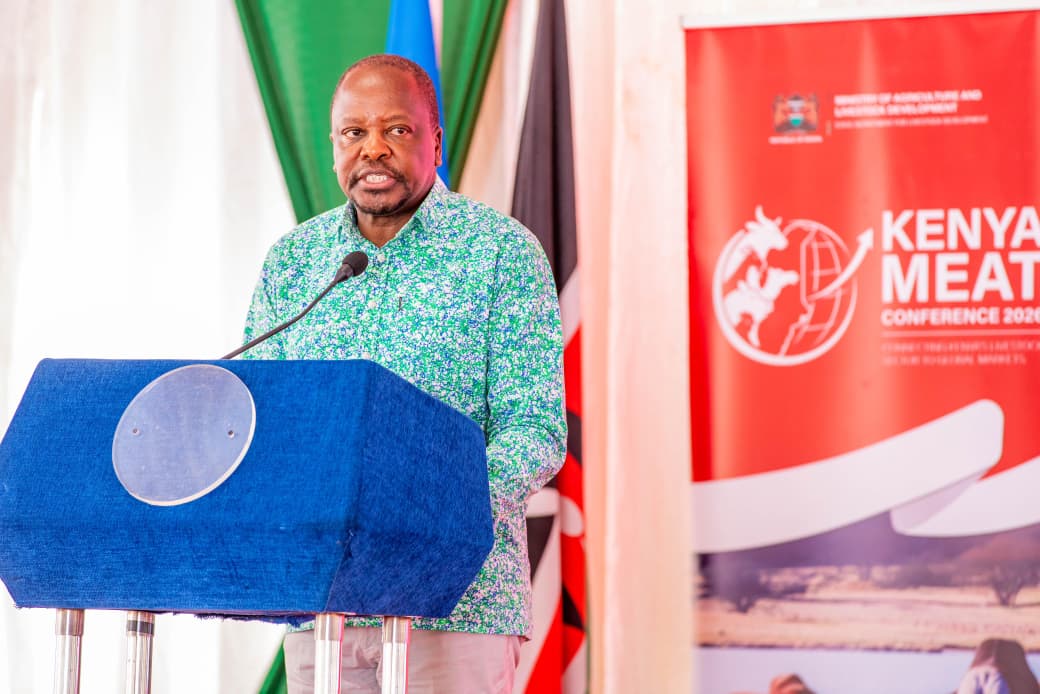
Cabinet Secretary for Agriculture and Livestock Development Mutahi Kagwe has sounded the alarm over the growing threat of antimicrobial resistance (AMR), warning that the misuse of veterinary medicines could not only endanger millions of lives but also shut Kenya out of lucrative international meat markets.
Speaking during the opening of the Kenya Meat Conference 2026 in Nyeri, Kagwe described antimicrobial resistance as one of the greatest silent threats facing global livestock production, saying it has evolved far beyond a veterinary concern into a national economic and security challenge.
According to the Cabinet Secretary, recent global estimates show antimicrobial resistance is associated with approximately 5.5 million deaths annually, with Kenya ranked among countries significantly affected by AMR-related mortality.
“If left unchecked, antimicrobial resistance threatens not only human health but also Kenya’s livestock exports,” CS Kagwe warned.
He noted that premium international markets are increasingly subjecting imported animal products to rigorous testing for antimicrobial residues and responsible veterinary drug use, meaning a single failure could cost Kenya years of painstaking market negotiations.
“A single failure can close markets, destroy years of negotiations and damage the reputation of an entire country,” he said.
CS Kagwe announced that the Government is strengthening both the Kenya Veterinary Board and the Veterinary Medicines Directorate to ensure veterinary medicines remain strictly under the supervision of licensed veterinary professionals.
He emphasized that responsible use of veterinary medicines is no longer simply a matter of good farming practice but has become a prerequisite for international trade.
“Responsible use of veterinary medicines is becoming a passport to international markets,” he said.
The Cabinet Secretary stressed that antimicrobial resistance should now be viewed as a national security issue, a food security issue, a public health concern and ultimately an economic competitiveness issue that demands coordinated national action.
The remarks formed part of a broader Government strategy to reposition Kenya as one of Africa’s most trusted exporters of premium livestock and meat products under the Bottom-Up Economic Transformation Agenda.
Kagwe said the Government aims to increase livestock’s contribution to the country’s Gross Domestic Product from the current 12 percent to 20 percent, while nearly doubling annual meat production from 527,200 metric tonnes recorded in 2022 to almost 990,000 metric tonnes by 2028, generating an estimated KSh450 billion annually for the economy.
He observed that global meat buyers no longer purchase meat alone but increasingly demand confidence, traceability, food safety, disease-free production systems and consistency.
“They purchase trust. That trust must now become Kenya’s greatest export,” he said.
To achieve that ambition,CS Kagwe said the Government has embarked on one of the most comprehensive livestock sector reforms in Kenya’s history through digitisation, stronger veterinary regulation and enhanced compliance systems aimed at guaranteeing international standards from farm to fork.
The Cabinet Secretary said protecting animal health remains the foundation of a globally competitive livestock industry, announcing continued implementation of the National Livestock Vaccination Programme targeting trade-sensitive animal diseases that have historically restricted Kenya’s access to premium export destinations.
He revealed that the Government is making unprecedented investments in the Kenya Veterinary Vaccines Production Institute (KEVEVAPI) to increase annual vaccine production from approximately 45 million doses to more than 70 million doses, reducing reliance on imported vaccines while strengthening national preparedness against disease outbreaks.
Beyond disease control, Kagwe said Kenya is accelerating implementation of the Livestock Identification and Traceability System (LITS) together with the Animal Identification and Traceability System (ANITRAC) to ensure every animal can be identified, tracked and certified throughout the production chain.
“The modern consumer wants to know where the animal was born, where it grazed, which veterinary officer treated it, which medicines it received, which abattoir processed it and which laboratory certified it. That level of transparency is no longer optional. It is becoming the global standard,” he said.
The Cabinet Secretary also launched a scathing attack on illegal donkey slaughter syndicates, describing them as a criminal enterprise threatening public health and Kenya’s export ambitions.
He cited research indicating that Kenya lost more than 301,000 donkeys between 2016 and 2018, representing about 15 percent of the national donkey population due to demand for donkey skins destined for the international ejiao market.
Although commercial donkey slaughter was banned in 2020, Kagwe said intelligence reports indicate that more than 700 donkeys are illegally slaughtered every month across several counties, with some of the meat allegedly finding its way into formal supply chains disguised as beef.
He warned that such illegal operations expose consumers to dangerous zoonotic diseases including anthrax and brucellosis while undermining legitimate livestock farmers, licensed processors and exporters.
“This is no longer merely an issue of animal welfare. It is a food safety emergency, public health emergency, economic sabotage and an attack on Kenya’s international reputation,” he declared.
CS Kagwe announced that he has directed his Ministry’s technical and legal teams to prepare tougher policy and regulatory measures to dismantle illegal donkey slaughter networks, warning that those involved in meat adulteration, livestock theft or illegal slaughter would face the full force of the law.
On value addition, the Cabinet Secretary said Kenya must move beyond exporting raw livestock and instead maximize value from every animal through modern processing, branding and certification.
He said the Government is working with county governments and private investors to modernize meat processing infrastructure, targeting slaughter facilities capable of handling approximately 384,000 animals annually for domestic consumption and export markets.
According to CS Kagwe, modern abattoirs should function as industrial production hubs creating employment for veterinarians, laboratory technologists, engineers, refrigeration technicians, food scientists, leather processors, logistics firms and exporters.
He also challenged financial institutions to develop livestock-specific financing models that recognize biological production cycles instead of conventional lending timelines.
“Financing livestock requires patient capital, flexible financing and innovative financial products that recognise production cycles, climate risks and export realities,” he said.
CS Kagwe concluded by calling for stronger collaboration among government, county administrations, researchers, financial institutions, development partners and private investors to transform Kenya into Africa’s leading supplier of premium meat products.
“Our ambition is not simply to export more meat. It is to export confidence, quality and integrity. When buyers anywhere in the world see the words ‘Product of Kenya,’ they should immediately associate them with safe, traceable, high-quality products that meet the highest international standards,” he said.
The two-day conference has brought together leaders from across the livestock value chain to chart Kenya’s path towards becoming a globally competitive meat producer and exporter.
Among those present were Principal Secretary for Livestock Development Jonathan Mueke, Nyeri Governor Mutahi Kahiga, Chairperson of the ASAL Counties Forum Governor Nathif Jama, directors and chief executives of livestock sector parastatals, development partners, financial institutions, researchers, county government representatives and private sector players.