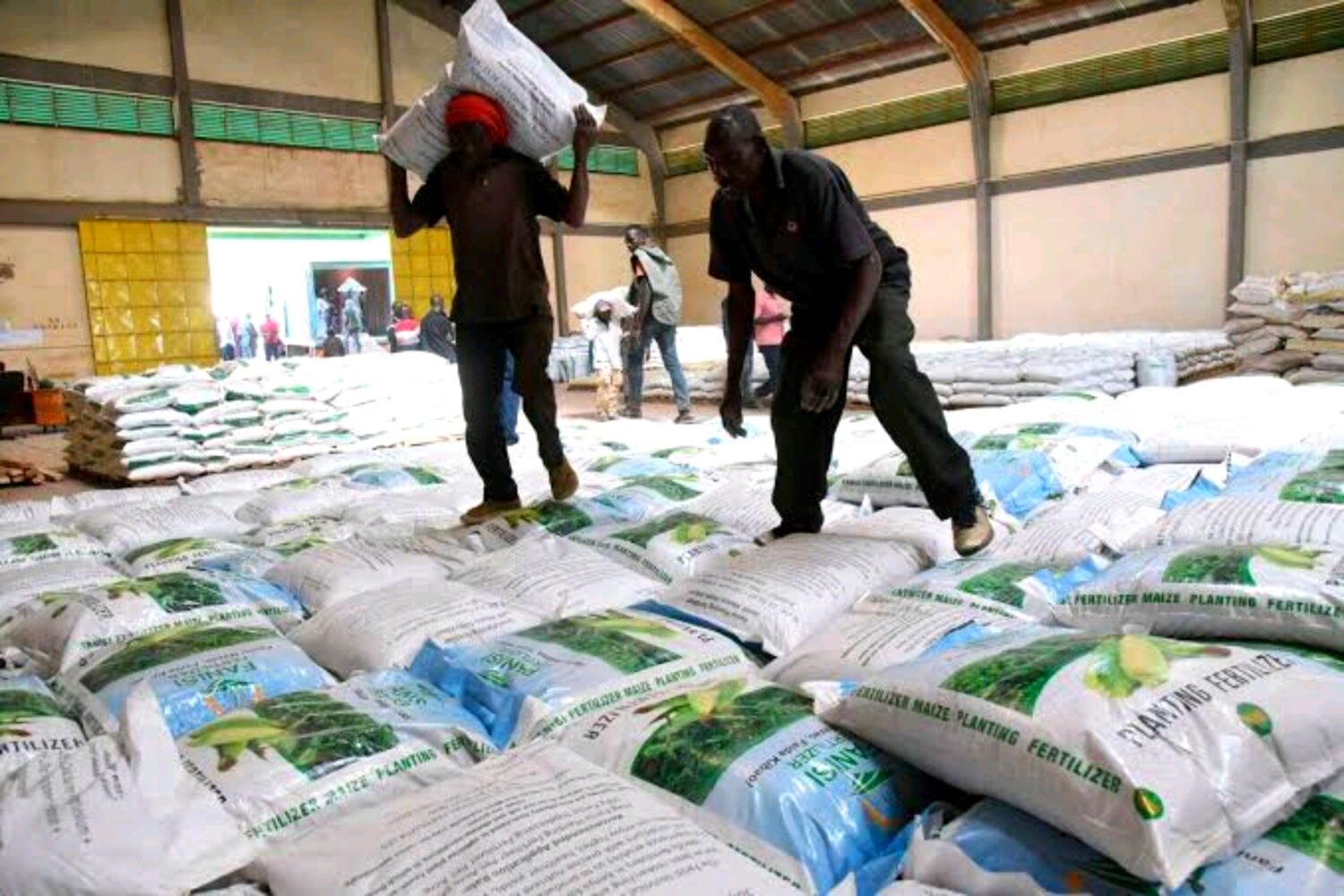
The Government has announced a further subsidy on fertilizer and certified maize seed to cushion farmers from drought-related losses and enable them to return to production.
Under the new intervention, farmers will purchase a 50kg bag of subsidized fertilizer at KSh 2,000, down from KSh 2,500, while the Government will meet 50 per cent of the cost of certified maize seed, reducing the farmer’s price from KSh 300 to KSh 150 per kilogramme.
This means a 2kg pack of maize seed will cost KSh 300 instead of KSh 600; a 10kg pack KSh 1,500 instead of KSh 3,000; and a 25kg pack KSh 3,750 instead of KSh 7,500.
The maize seed intervention targets approximately 40 million kilogrammes, translating to an estimated KSh 6 billion in Government subsidy.
Farmers will access the subsidized fertilizer and maize seed through Government designated distribution channels. These measures are part of President William Ruto’s administration’s shift from subsidising consumption to subsidising production by lowering the cost of inputs, supporting farmers to produce more and strengthening national food security.
In 2022, a 50kg bag of fertilizer retailed at approximately KSh 7,500. The National Fertilizer Subsidy Programme brought this down to KSh 2,500 and the Government is now reducing it further to KSh 2,000 , a reduction of more than 73 per cent.
Since 2022, approximately 33.55 million 50kg bags of subsidized fertilizer have been distributed, reaching about 1.98 million farmers, with Government support amounting to approximately KSh 78.79 billion.
Over the same period, Kenya has also recorded gains in agricultural production. Maize production increased from 34.3 million 90-kilogram bags bags in 2022 to 73 million bags in 2025, while maize imports declined by more than 66.5 per cent over the same period.
“These gains cannot be allowed to be reversed by drought,” CS Kagwe says in a statement. “At the heart of this intervention is a simple principle: a farmer who has lost a crop to drought must not also lose the ability to plant the next crop because fertilizer and seed are beyond reach.”
The Government has pledged to continue supporting farmers to recover from drought, lower their cost of production and return to their farms, while investing in irrigation, water harvesting and other climate-smart interventions to strengthen Kenya’s resilience to changing weather patterns.