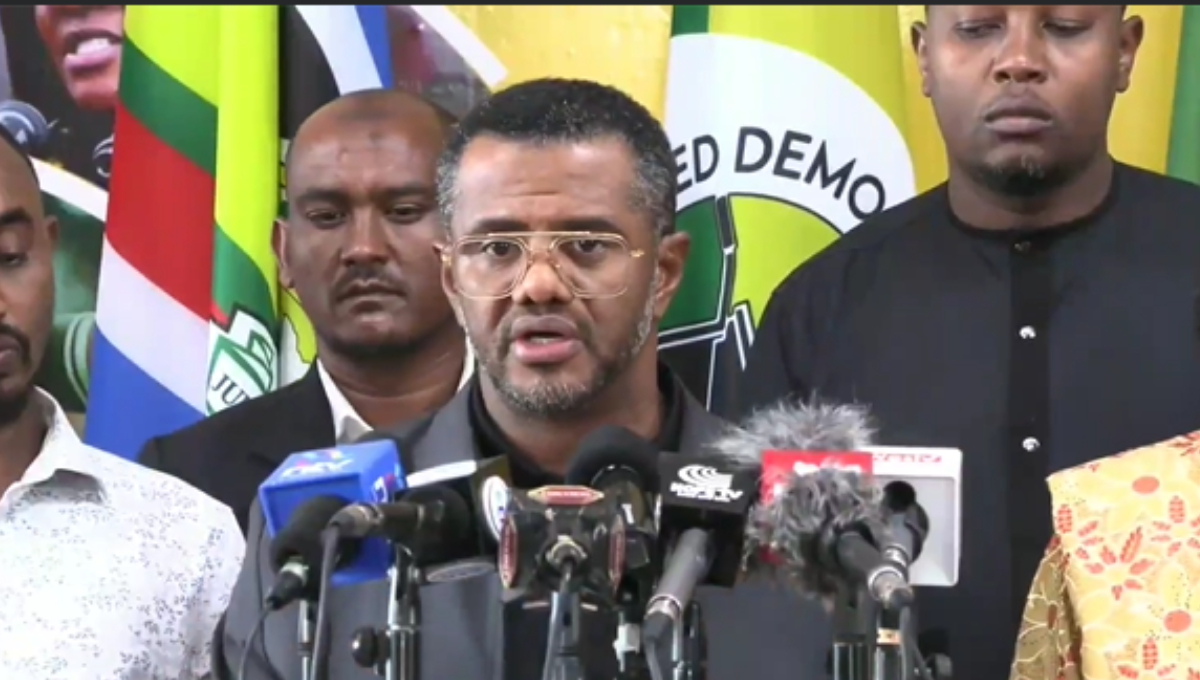
UDA Secretary-General Hassan Omar Hassan has reacted to those behind the ongoing protests and destruction of property, saying Kenyans who are unhappy with President Ruto’s leadership have a democratic option available to them in 2027 and should use it instead of causing chaos.
Addressing a press briefing on Tuesday May 19, 2026, Hassan defended President Ruto’s administration, saying the sharp rise in fuel prices and the resulting transport chaos were driven by global geopolitical tensions rather than local policy failures.
He pointed to disruptions in international oil supply chains linked to the ongoing conflict in the Middle East, which has pushed up crude oil prices, freight charges, insurance premiums, and import costs.
“This is not a crisis of Kenya’s making,” he said, warning political actors against using the situation for short-term political gain.
Hassan expressed frustration at what he described as a deliberate effort by sections of the opposition to exploit fuel price concerns and frustrations among matatu operators to push anti-government narratives instead of supporting solutions.
“We have gotten to that point in our lives where we must say enough is enough. Mnaharibu nchi throughout. Ni nyinyi tu mnang’oa infrastructure, ni nyinyi tu mnaibia watu. Kwani Ruto aliwafanya nini? What has Ruto done to you that is so bad?” he said.
He challenged those calling for Ruto to leave office to explain where exactly they expect him to go, saying the Constitution provides a clear process for changing leadership and that process is an election, not street protests.
“If you sincerely feel he is incapable of leadership, why don’t you just wait for 2027 and exercise your democratic right?” he asked.
Hassan also defended the government-to-government fuel importation arrangement and the subsidy programme, saying they had helped protect consumers from even steeper price increases.
He added that the government had already spent billions of shillings under the fuel stabilisation mechanism.
He argued that without these interventions, fuel prices would have risen far beyond their current levels.
He also pushed back against comparisons between Kenya’s fuel prices and those of neighbouring countries, saying such comparisons are misleading because each country operates under different tax structures, supply chains, and market conditions.
In response to pressure from transport operators, Hassan announced a reduction in diesel prices by Ksh 10.06 per litre for the period from May 19 to June 14, 2026, describing it as part of ongoing efforts to ease tensions in the transport sector.
He also confirmed that President Ruto had directed officials from the Treasury, Energy, and Transport ministries to hold urgent talks with stakeholders in search of a lasting solution.
UDA separately condemned the killing of Rachel Wandeto Mudoni, describing it as a barbaric act and blaming rising political intolerance on divisive politics.
Hassan said no Kenyan should be targeted because of their political views, and warned that violence, vandalism, and looting during demonstrations would be dealt with firmly under the law.
His remarks came as the nationwide matatu strike entered its second day on Tuesday, with transport operators continuing to hold out as they waited for the government to bring fuel prices down before resuming services.