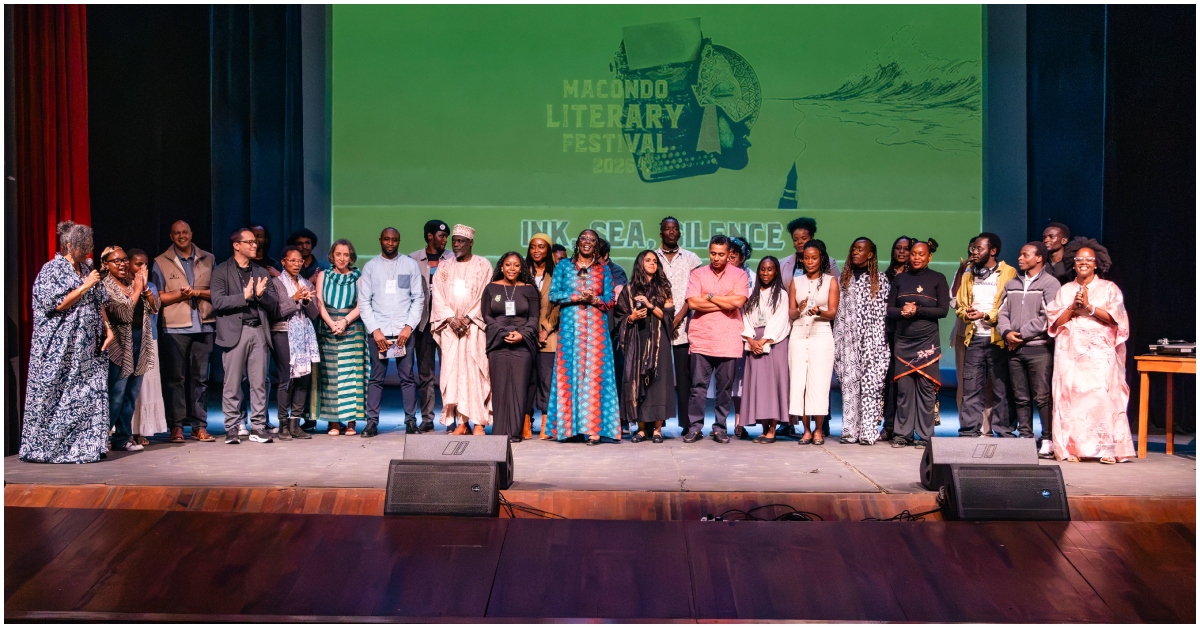
The Macondo Literary Festival 2026 kicked off with a bang on Friday, September 18, with this year’s edition promising incisive, eye-opening conversations that will examine Africa’s contested histories, cultural memory and the restitution of heritage taken from the continent during pre-colonial and post-colonial period.
The sixth edition of the Nairobi-based festival runs from Friday, September 18 to Sunday, September 20 under the theme “Ink, Sea, Silence”, bringing together writers, artists, cultural practitioners, and members of the diplomatic corps, in a classical programme that combines literature, art, film, music, dance and food.
The festival’s programme was unveiled on September 4 at Maktaba Kuu, where discussions centred on the looting of African artefacts, the suppression of African heritage and the impact of these omissions on historical archives.
Speaking during the opening ceremony at the Kenya Cultural Centre in Nairobi, Sweden’s Ambassador to Kenya, H.E. Håkan Åkesson, emphasized on the belief that every child deserves access to books and stories that make them recognize themselves, their communities and their experiences in terms of cultural heritage.
“Stories help us discover new places far beyond our own horizons. And that is certainly true in my own case. I grew up on a farm in southern Sweden and was not given the chance to travel very much when I was young. And I did travel, thanks to my reading and thanks to the library at my school. My very first book by an African writer was, for so many of my generation, Things Fall Apart by Chinua Achebe. A wonderful book which, like so many other stories, has built curiosity, empathy and understanding across borders and cultures,” he recalled, insisting that inspiring a love for reading is one of the most important gifts “we can give to a young person”.
On her part, the Irish Ambassador to Kenya H.E. Caitríona Ingoldsby lauded the event organizers for coming up with a challenging-yet creative theme that calls for everyone to think differently and outside the box. While responding to the question, what story of our humanity on Earth would you love a future generation to inherit? Ambassador Ingoldsby answered, “what I would not like people to lose is the ability to feel glundr”, which means the ability of people to feel pure, deep, heartfelt joy and delight.
“And it’s the kind of happiness that makes your chest feel lighter and your spirits rise. And I think much of the time that feeling comes from other people and our shared humanity, as we experience great art, great literature, music, dancing, or wonderful meals together,” she said.
However, Ambassador Ingoldsby expressed her worry: “And sometimes I worry that our children are losing the ability to feel wonder and to feel glundr. They grow up too quickly, seemingly having all the information in the world at their fingertips, live access to everything, but perhaps at the expense of the human connections, connections with people and the environment and the grounding sense of place that, for instance, I and many of you might have had growing up. And in a way, it’s related to that map and that sense of place that felt that people talked about at the beginning.”
While quoting Brazilian novelist and short story writer João Guimarães Rosa, Brazilian Ambassador to Kenya H.E. João Alfredo dos Anjos Junior underscored, “The most important and beautiful thing in the world is this: that people are not always the same, they are not yet finished, but that they are always changing.”
According to Ambassador Alfredo, literature still matters in the world we live in because it is capable not only reflecting, but of being the change itself.
“Literature matters because it unveils what needs to be unveiled, because it gives voice to those who have been silenced, and because it expresses the reality of people who are not yet finished, but who are shaped by the change.”
It promises to be a content-rich event, with the three-day festival featuring authors from Africa and beyond, including Canadian novelist of Ghanaian heritage Esi Edugyan, Sudanese author Abdelaziz Baraka Sakin, Nigerian writer and photographer Emmanuel Iduma, and Botswana writer Lauri Kubuitsile.
Other featured guests include Réunion Island author Gaëlle Bélem, Indian poet and novelist Meena Kandasamy, Iranian-American Author Said Khatibi, Brazilian novelist Itamar Vieira Junior, Nigerian author Tochi Eze and Indian/UAE-based author Deepak Unnikrishnan, Swedish author illustrator and author Maria Fröhlict.
They will be joined by Kenyan literary prize winners Dominic Maina, Edwin Omindo and Nicholas Ogal, as well as performers Rebian, Adam Chienjo, Dorphanage and Kevin Munyi & Friends.
The programme will feature conversations in French, Portuguese, English, Arabic and Swahili, alongside eight sessions interpreted in Kenyan Sign Language.
Four sessions will also be livestreamed for audiences outside Kenya.
The festival will further screen ‘Dahomey’ (2024), Mati Diop’s film about the return of 26 looted royal treasures from Paris to Benin.
Other events include the interdisciplinary performance “Scribes on Silent Waves”, combining spoken word and dance, live music, and masterclasses covering children’s stories, nature writing, protest writing and “write-to-destroy” techniques.
The festival is open to the public and seeks to use literature and multimedia storytelling to reconnect communities with histories that have been displaced, forgotten or deliberately silenced, while creating space for conversations on identity, cultural heritage, memory and restitution.