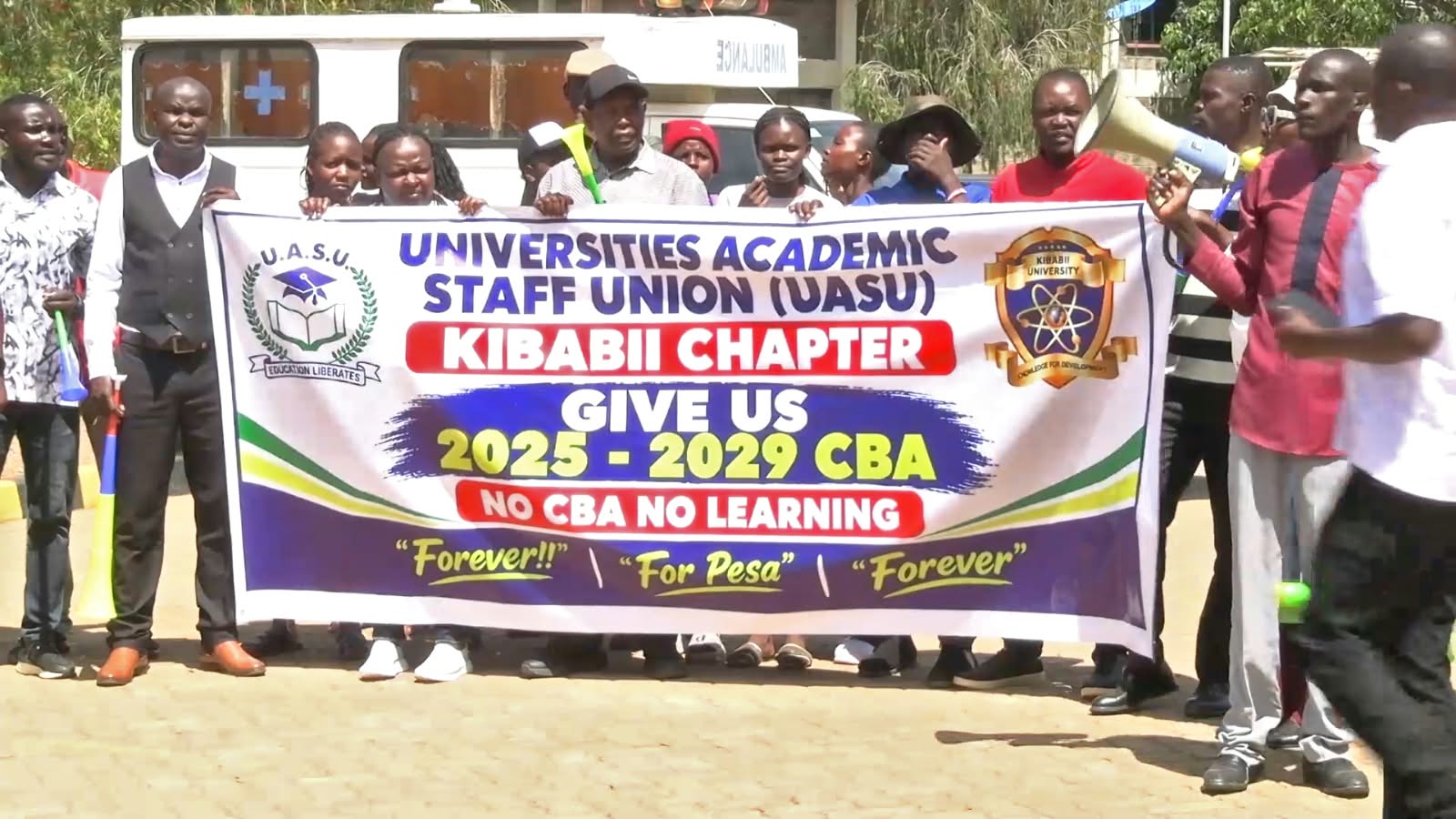
The Universities Academic Staff Union (UASU) has accused President William Ruto’s administration of reneging on promises made to university lecturers, describing them as “lies” and demanding the immediate implementation of the 2025–2029 Collective Bargaining Agreement (CBA).
The lecturers staged demonstrations at Kibabii University in Bungoma County as part of the ongoing national strike, protesting what they termed government failure to honour commitments contained in the return-to-work agreement signed after their last year’s industrial action.
Speaking at the University during the protests, UASU Kibabii University Chapter Secretary General Dr. Robert Nyukuri said lecturers have been forced to take to the streets to demonstrate against the government and its agencies over the unresolved issues.
“We are here at Kibabii University protesting against the government of Kenya and its agencies, including the Ministry of Education, Treasury, SRC and IPUCCF over our unresolved issues,” Dr. Nyukuri said.

He said UASU had called off its previous national strike following the signing of a return-to-work formula on November 5, 2025, which, according to them, provided for negotiations, signing and implementation of the 2025–2029 CBA within 100 days.
However, he accused the government of failing to meet the timelines agreed upon, forcing lecturers to resume industrial action.
“More importantly, why we are striking is because of the failure and lack of commitment by the government to pay University staff directly from the consolidated fund or the exchequer,” Nyukuri said.
He claimed that government agencies had instead maintained that Universities should rely on student related revenue to meet staff salary obligations, a position he described as impossible.
Nyukuri questioned the logic of requiring students to shoulder the responsibility of paying university lecturers, arguing that salaries of public servants should be provided for through established government funding mechanisms.
“We have never seen patients paying medical doctors’ salaries, neither have you seen prisoners paying soldiers,” he posed.
The UASU official also raised concerns over the retirement age of University staff, saying the issue had already been addressed in the registered 2021–2025 CBA.
He alleged that despite the provisions contained in the agreement, government agencies had proceeded to issue retirement notices to some University staff.
Nyukuri further expressed concern over what he described as repeated disruptions to academic programmes in Universities, saying prolonged industrial disputes are affecting students and threatening the continuity of learning.
“We are also parents and guardians. Even some of our colleagues are students. Therefore, it is not our wish to be here now, but it is the wish of the government to distort learning programmes,” he said.
He called on the government to expedite negotiations on the new CBA and address the outstanding issues to enable lecturers to resume teaching.
“We are asking here to compel and petition the government to fast-track the process of negotiating the 2025–2029 CBA, addressing our key issues so that we can pick up services immediately,” Nyukuri said.
His sentiments were echoed by Dr. Makarios Wanjala, the Kibabii University UASU chapter chairperson, who accused the Kenya Kwanza administration of repeatedly making promises that had not been fulfilled.
Wanjala said lecturers had expected the government to conclude the 2025–2029 CBA within the timelines communicated after last year’s strike.
“During last year’s strike, the government promised to finalize the 2025–2029 CBA in one month. From last November to this time is almost a year, but nothing has been done,” he said.
Wanjala said university lecturers were demanding a formal agreement that would provide clear terms and conditions of service before returning to their classrooms.
“We are just saying we are not slaves and we are not going to work under slave terms. We want our CBA signed and implemented before we go back to class,” he said.
The lecturers said they remained open to dialogue with the government but insisted that negotiations should result in a signed and implementable agreement addressing their concerns.