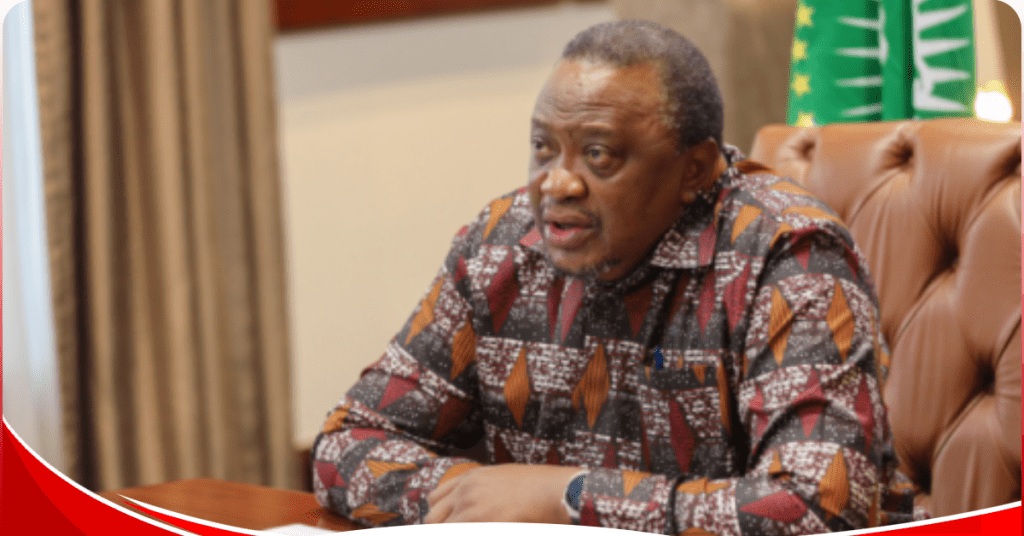
There is an uncomfortable conversation taking place across Mt Kenya, and former President Uhuru Kenyatta would be unwise to ignore it. The argument, increasingly heard among ordinary voters, is brutally simple: We supported Uhuru for ten years. He did not prepare an acceptable succession within the region. In 2022, he tried to lead us in a political direction most of us rejected. When Rigathi Gachagua was impeached, he remained largely silent. Now that Gachagua has rebuilt himself and emerged as a formidable political force, politicians associated with the old establishment suddenly appear determined to cut him down to size.
Whether every part of that accusation is fair is almost beside the point. In politics, perception eventually becomes political reality. There is no publicly demonstrated evidence that Uhuru has summoned Peter Munya, Justin Muturi, Fred Matiang’i or anybody else and instructed them to attack Gachagua. That allegation should not casually be converted into fact.
But Uhuru has a political problem nevertheless. The timing creates suspicion. For nearly three years after the 2022 election, Mt Kenya experienced an extraordinary political transition. Uhuru’s influence diminished dramatically. President William Ruto initially dominated the region politically. Then the relationship between Ruto and his deputy collapsed, culminating in Gachagua’s impeachment.
What followed was even more significant. Instead of disappearing, Gachagua returned to the grassroots. He organised. He travelled. He received delegations. He built a party. He endured ridicule, political attacks and attempts to portray him as finished. Yet he continued engaging ordinary citizens until something unmistakable began emerging: a substantial political constituency had formed around him.
One may dislike Gachagua. One may disagree with his rhetoric. One may question whether he possesses the temperament or national appeal necessary for presidential leadership. But one cannot simply wish away political reality. Gachagua has established political dominance within the Mt. Kenya region and beyond.
And this is where Uhuru risks repeating the great strategic mistake of 2022. His mistake then was not supporting Raila Odinga. Every Kenyan, including a retiring president, possesses the constitutional right to support a candidate of his choice. The mistake was failing to appreciate how profoundly his own political base had shifted.
Millions of Mt Kenya voters went in another direction. They were angry, economically frustrated and increasingly alienated from his administration. Ruto understood that mood and exploited it brilliantly.
The result is history. Uhuru should therefore resist any temptation, real or perceived, to determine from above what Mt Kenya’s next political leadership should look like. Political leadership is not appointed by retired presidents. It is earned among citizens. If Gachagua has built influence through constant grassroots engagement, anybody seeking to challenge him must do exactly the same thing. Go to the villages. Build a party. Organise supporters. Hold meetings. Travel across the country. Articulate an alternative political vision. Persuade voters. That is democracy.
What cannot work is appearing after somebody else has spent years cultivating political ground and announcing that his influence is illegitimate, exaggerated or unacceptable. You cannot abandon a farm during planting season and return at harvest demanding ownership of the crop.
This is precisely why attacks on Gachagua from leaders perceived to belong to the old Mt Kenya establishment may actually strengthen him. Every attack reinforces his preferred political narrative: that powerful interests are frightened by his growing influence and are conspiring to stop him.
Politics frequently rewards the politician who can convincingly portray himself as being persecuted by the establishment. Uhuru should know this better than most. There is also a much larger strategic question. What exactly would be achieved by destroying Gachagua politically? If the objective is building an opposition capable of challenging President Ruto, weakening one of the opposition’s strongest regional mobilisation centres makes little strategic sense.
The opposition needs arithmetic before it needs egos. Mt Kenya brings millions of voters. Ukambani brings millions more. Western Kenya matters enormously. Gusii matters. Nairobi matters. Coast matters. Northern Kenya matters. No single leader and no single community can construct a winning national coalition alone.
The task should therefore be addition, not subtraction. Uhuru’s political networks plus Gachagua’s grassroots mobilisation are potentially more valuable together than either is separately.
Matiang’i’s administrative reputation can complement rather than threaten that equation. Munya’s networks can contribute. Muturi’s institutional experience can contribute. Other emerging leaders can contribute. The objective should not be identifying which politician becomes “king of the mountain.” That mentality is precisely what repeatedly traps the region. Mt Kenya does not need a king. It needs negotiating strength within a national coalition built around constitutional government, economic recovery and accountable leadership.
Nor should anybody resurrect artificial divisions between Mt Kenya East and Mt Kenya West. Meru, Embu, Tharaka Nithi, Nyeri, Kirinyaga, Murang’a, Kiambu, Laikipia and neighbouring communities may have distinct histories and political personalities, but their citizens confront remarkably similar economic problems. Debt does not recognise Mt Kenya East and West. Taxation does not. Youth unemployment does not. Expensive credit does not. Agricultural distress does not. Neither does the cost of living.
Why, then, should politicians manufacture political borders where ordinary people’s economic interests demand cooperation? Uhuru now has an opportunity to write a very different final chapter to his political career. He can use his experience, networks and stature to become a bridge. He can quietly encourage reconciliation. He can tell competing leaders that nobody needs to surrender his political identity for cooperation to occur.
Most importantly, he can recognise that the Mt Kenya of 2026 is not the Mt Kenya he governed ten years ago. New political realities have emerged. Gachagua is one of them. Trying to reverse that reality through elite manoeuvring would be strategically foolish. Engaging it constructively would be statesmanship.
And Gachagua must reciprocate. His current popularity does not entitle him to demand obedience from every leader in the region. Political strength should create confidence to accommodate others, not justification to humiliate them. The mountain has already experienced the consequences of a succession war. It should not repeat them.
The greatest gift Mt Kenya leaders could give President Ruto today would be another vicious internal conflict consuming Uhuru, Gachagua, Matiang’i, Munya, Muturi and their supporters while the governing coalition watches from a safe distance.
They should refuse to provide it. Uhuru need not defeat Gachagua. Gachagua need not defeat Uhuru. They need to defeat the politics that convinces communities that only one powerful man can exist at a time. Because the lesson of 2022 should now be obvious: when Mt Kenya’s leaders fight over who owns the mountain, somebody else eventually inherits its political power.