
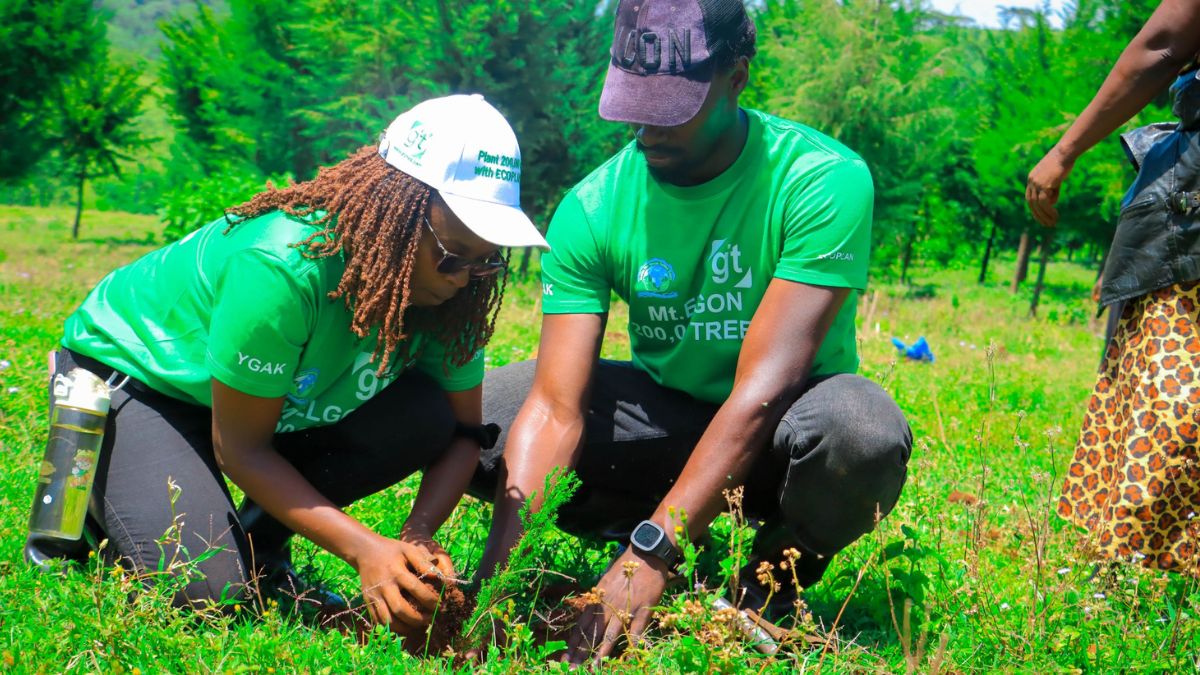
Young people have emerged as the backbone of Kenya’s ambitious plan to grow 15 billion trees by 2032 with experts and environmental stakeholders saying their energy, innovation and active participation in conservation initiatives are critical in restoring the country’s forest cover and combating the effects of climate change.
Students from Egerton University have joined hands with Youths for Green Action Kenya (YGAK) in an ambitious environmental restoration drive that will see 200,000 trees planted in the degraded Baraget Forest ecosystem in Nakuru County as part of efforts to revive its shrinking forest cover and restore biodiversity and mitigate the growing impacts of climate change.
The initiative, driven by youth-led conservation efforts seeks to breathe new life into the once-thriving Baraget ecosystem which in recent years has faced significant degradation due to human activities and environmental pressures threatening its role as a critical water catchment area and habitat for wildlife.
Speaking to the press on Friday in Baraget forest during phase II trees planting, Dennis Asiya, Chief Executive Officer for Youths for Green Action Kenya (YGAK), noted that Baraget forest restoration efforts is a multi- sectoral approach that brings together various stakeholders to plant trees in the forest.
Among the partners driving the restoration of the once- thriving ecosystem includes; the Kenya Forest Service, the community, students from Egerton University, Victoria furniture and volunteers from the Youths for Green Action Kenya.
Further, Asiya said that Youths for Green Action Kenya (YGAK) is largely composed of young people adding that the organization deliberately targets the youth in its environmental campaigns because they are key players in driving the country’s ambitious goal of growing 15 billion trees by 2032.
According to Asiya, young people are more informed about climate change and environmental conservation and possess the energy and creativity needed to champion large-scale tree planting and restoration programmes in their communities.
“We target the youths because they understand more about climate change and climate action, and they also incorporate their energy into tree planting activities across various forests in Kenya,” said Asiya.
He noted that the increasing destruction of forests and indiscriminate cutting down of trees has greatly contributed to the drying up of rivers and other water sources in the region, worsening the effects of climate change and environmental degradation.
Asiya explained that YGAK’s restoration initiatives are aimed at reversing the situation by encouraging communities to embrace tree planting, protect existing forests and restore degraded ecosystems in order to revive rivers, improve biodiversity and secure a healthier environment for future generations.
Richard Bett, Baraget village elder, said that the community has partnered with youths and students from Egerton University to plant 200,000 trees in Baraget forest to restore the degraded ecosystem.
Bett attributed the change in weather patterns to massive deforestation in the region.
“In the recent times our region has faced a change in weather patterns due to this deforestation, with this kind of partnership we are assured that our region will receive enough rainfalls to support Agriculture and improve food security,” Bett affirmed.
He applauded the youths’ efforts in championing for 30% trees cover and aligning with President Ruto’s directive of planting 15 billion trees by 2032.
Design Gallery Chief Operating Officer Desmond Mukolwe said the organization has joined hands with youths in an ambitious environmental conservation campaign aimed at restoring the degraded Baraget Forest through the planting of 200,000 trees.
He noted that the initiative is part of the organization’s broader commitment to environmental sustainability and community empowerment.
Mukolwe said the organization strongly believes that environmental conservation is one of the most impactful ways of giving back to society, especially at a time when the country is grappling with the effects of climate change, deforestation and unpredictable weather patterns.
He added that involving youths in the exercise not only helps restore the environment but also nurtures a generation that is conscious about protecting natural resources.
However, Mukolwe revealed that the organization’s long-term target is to plant one million trees by the year 2027 as part of its contribution towards increasing the country’s forest cover and supporting national climate action efforts.
“By the beginning of this year we had already planted 705,000 trees and by the end of 2026 we are targeting to have planted close to 900,000 trees,” Mukolwe affirmed.
He added, “Our main goal is to increase tree cover, restore degraded ecosystems and make the environment greener and healthier for future generations.”
He further observed that tree planting initiatives play a key role in combating environmental degradation, preserving water catchment areas and improving biodiversity, noting that forests remain critical in regulating climate and sustaining livelihoods for surrounding communities.
Julius Kilembe, Nakuru county director metrological services said the region is currently experiencing heavy rainfall, a condition he noted will greatly support the survival and growth of the newly planted trees in the forest.
Kilembe commended the youth group and stakeholders involved in the exercise for choosing to carry out the restoration programme in Baraget Forest, saying the initiative will significantly contribute towards reversing the adverse effects of climate change in the area.
He emphasized that restoring forest cover will help improve rainfall patterns, protect water sources and reduce the effects of rising temperatures that have continued to affect many parts of the country.