The Government has challenged engineers to move beyond designing and supervising projects and instead become central players in Kenya’s economic planning, as it accelerates infrastructure development through innovative financing models.
Speaking during the opening of the Second African Journal of Engineering Research and Innovation (AJERI) Scientific Conference at Kenyatta University, the National Treasury said the country’s ambitions for sustainable growth, climate resilience and quality infrastructure depend on stronger engineering input from project conception to implementation.
Remarks delivered on behalf of the Cabinet Secretary for the National Treasury and Economic Planning, John Mbadi, by the Director of Public-Private Partnerships (PPP), Eng. Kefa Seda, emphasized that engineering and economic planning are inseparable.
“Economic planning and engineering are inseparable. Every national development plan eventually becomes an engineering project. Every development budget allocation eventually becomes a physical infrastructure. Every policy aspiration eventually requires technical implementation,” said Eng. Seda.
His remarks come as the Government intensifies efforts to bridge Kenya’s infrastructure financing gap through Public-Private Partnerships (PPPs). The National Treasury’s 2025/26 Budget Summary indicates that private investment is being expanded into roads, affordable housing, energy, water, ICT and healthcare infrastructure, with dozens of PPP projects already at various stages of implementation and development.
Eng. Seda said while the Government continues to allocate billions of shillings to key development sectors, the success of those investments ultimately rests on engineers.
“A budget by itself builds nothing. It is engineers who transform these public resources into tangible national assets. After resource allocation to various sectors of our economy, it is the engineer who converts public investments into lasting national wealth,” he said.
Kenya’s infrastructure sector contributes about 11 per cent of the country’s Gross Domestic Product and supports more than 50,000 jobs, making it one of the country’s strongest drivers of industrialization, trade and regional competitiveness.
To sustain future infrastructure development, the Government is pursuing alternative financing mechanisms including infrastructure bonds, green bonds, blended finance and climate finance.
Eng. Seda also pointed to the proposed National Infrastructure Fund and Sovereign Wealth Fund as reforms aimed at attracting long-term domestic and international investment into commercially viable national projects.
He stressed that successful infrastructure projects begin with sound engineering rather than funding alone.
“One of the greatest lessons we have learned over the years is that fiscal discipline begins long before procurement. It begins during project conception. Projects that uphold rigorous engineering studies, solid feasibility analysis and comprehensive risk assessment are more likely to be completed on time, within budget and according to specifications,” he said.
With climate change placing growing pressure on infrastructure across Africa, the Treasury challenged engineers to develop resilient projects capable of attracting climate financing.
“Climate adaptation is no longer optional. It is an economic necessity. Engineers must play an indispensable role in designing resilient roads, flood control systems, renewable energy facilities, water infrastructure and climate-smart technologies capable of withstanding future environmental risks,” Eng. Seda added.
Kenyatta University Vice Chancellor Prof. Paul Okumu urged universities to ensure research translates into practical solutions that drive national development.
“Research achieves its greatest value when it informs policy, stimulates enterprise, creates jobs and improves the lives of our citizens,” he said.
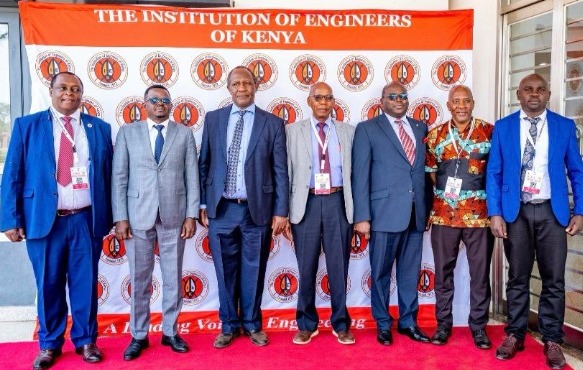
The Chairperson of the Institution of Engineers of Kenya (IEK) Caretaker Committee, Eng. Hillary Nyaanga, called on engineers to champion Africa’s transition to a circular economy through innovation and sustainable resource use.
“Engineering research must not remain only in journals, laboratories or universities. It must contribute to better roads, safer buildings, cleaner energy, improved water management, stronger industries and a better quality of life for our people,” he said.
The AJERI Scientific Conference has brought together engineers, researchers, policymakers, industry leaders and students from across Africa to explore innovations in renewable energy, climate-resilient infrastructure, sustainable construction, digital technologies, water management, resource-efficient manufacturing and the circular economy.
The conference is expected to generate research and policy recommendations that will strengthen engineering’s contribution to Africa’s economic transformation and sustainable development.