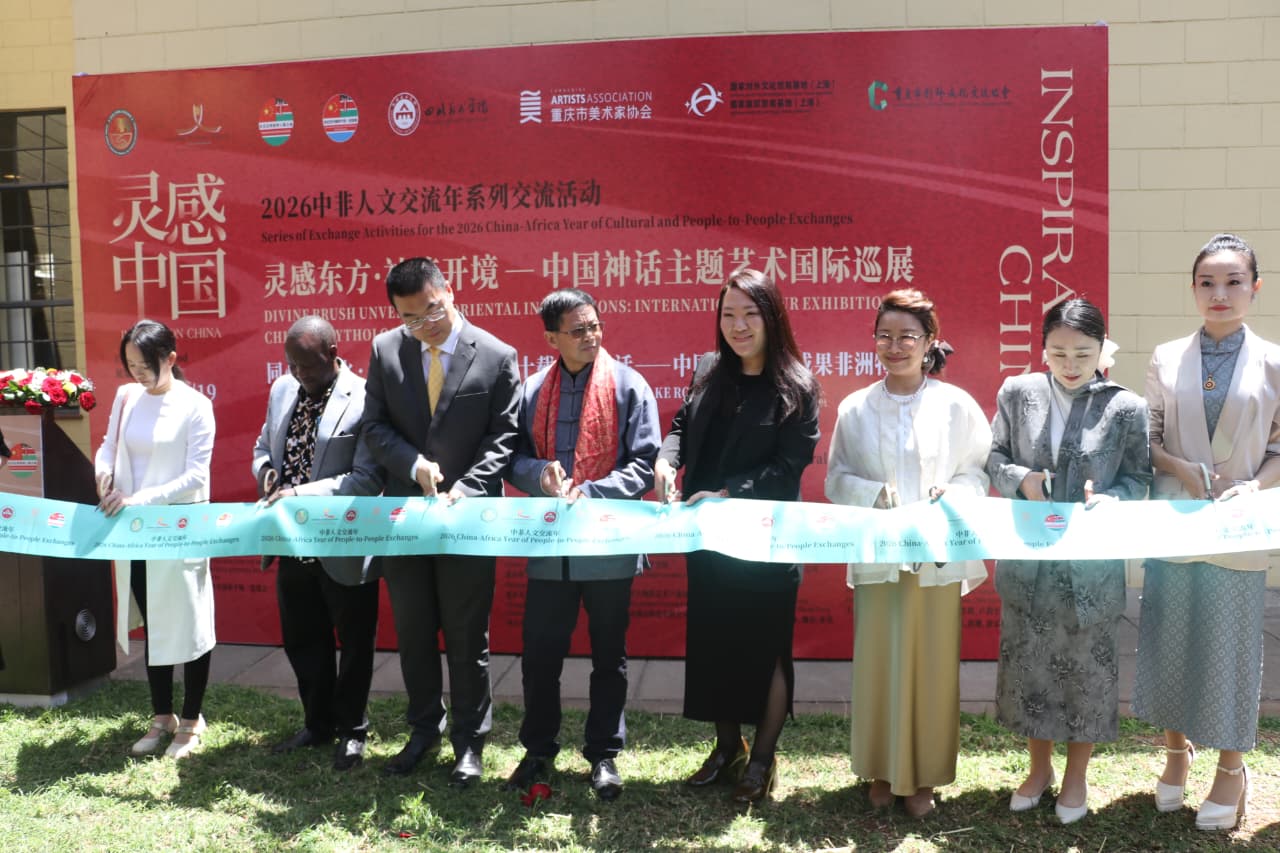
A chapter in Kenya-China relations is unfolding through art, with the National Museums of Kenya receiving 26 contemporary Chinese artworks in a landmark cultural exchange that places people, heritage and creativity at the centre of bilateral ties.
The donation by the Sichuan Fine Arts Institute was unveiled at the Nairobi National Museum during a dual China-Africa art exhibition, bringing together diplomats, cultural institutions, business leaders and the Chinese community.
The event forms part of the 2026 China-Africa Year of People-to-People and Cultural Exchanges, aimed at strengthening mutual understanding and friendship between African and Chinese societies while expanding cooperation beyond trade and investment.
Unlike a temporary cultural display, the 26 artworks will remain in Nairobi as part of the permanent collection of the National Museums of Kenya. The move gives Kenyan audiences, local researchers and international visitors an opportunity to engage with contemporary Chinese art after the exhibition closes.The permanent donation was presented as a lasting symbol of friendship and cultural diplomacy.
Speaking during the event, a representative of the Kenya Overseas Chinese Association said the artworks would give Kenyans greater opportunities to experience contemporary Chinese artistic expression.
The Director General of the National Museums of Kenya, Prof. Mary Gikungu, welcomed the contribution, saying cultural exchanges could help people discover similarities despite differences in historical experiences and artistic traditions.
She noted that both African and Chinese civilisations have expressed strong connections to nature, community, spirituality and intergenerational storytelling. Such common themes, she said, make art a powerful vehicle for building bridges between cultures.
The exhibition combines traditional influences with contemporary artistic approaches, offering visitors a broader view of Chinese culture while creating space for dialogue with African artistic traditions.
One section, titled “Inspiration from the East · Divine Brush Unveils New Horizons”, explores Chinese mythology through ink paintings, ceramics, sculptures and regional textiles. It features artistic traditions associated with regions including Guangdong, Yunnan and Shaanxi, with embroidery and other cultural forms incorporating mythological symbols and historical narratives.
The presentation invites comparisons with African traditions, where mythology, ancestral memory, nature and community also shape artistic expression.
Another component, “Working Hand in Hand on Mountains and Rivers,” focuses on China’s rural revitalisation experience and the role of artists in working with rural communities.
The exhibition highlights how creative practice can contribute to the preservation of intangible cultural heritage, support local creative industries and improve rural living environments. It presents culture not only as an expression of identity but also as a potential driver of social and economic development.
The focus is relevant as African communities seek to preserve heritage while creating opportunities for young people and artists.
The exhibition also reflects a broader evolution in China-Africa relations. While economic cooperation remains a major pillar of the partnership, cultural and people-to-people exchanges are increasingly being presented as essential to building a deeper and more sustainable relationship.
Richard Ndungu, National Chairperson of the Kenya National Chamber of Commerce and Industry’s Kenya-China (Asia) Trade and Investment Promotion Initiative, said the exhibition demonstrated that the relationship between Kenya, China and Africa was not confined to commerce.
He pointed to culture, creativity, knowledge, friendship and interaction between people as equally important dimensions of the partnership.
The event was attended by Chinese Embassy representatives, including Counselor Tang Jianjun, while Professor Zhang Liang of the Sichuan Fine Arts Institute provided curatorial leadership.
The collaboration between the Sichuan Fine Arts Institute, National Museums of Kenya and Chinese community organisations demonstrates how institutional partnerships can turn cultural exchanges into lasting public assets.
The 2026 China-Africa Year of People-to-People and Cultural Exchanges provides an important backdrop to the initiative, underscoring the idea that stronger Africa-China relations require more than government-to-government agreements. They also depend on citizens, artists, students, researchers and cultural institutions developing greater knowledge of one another.
For Nairobi, the arrival of the 26 artworks therefore represents more than an addition to a museum collection. It offers a permanent window into contemporary Chinese creativity and a physical reminder of the growing cultural links between Kenya and China.
As the dual exhibition opens to the public at the Nairobi National Museum, its organisers hope the displays will encourage conversations about shared heritage, artistic innovation and the possibilities created when African and Chinese societies engage directly with one another.
The initiative demonstrates that cultural diplomacy can leave a legacy that extends beyond a single event, helping transform the 2026 China-Africa cultural exchange agenda into sustained relationships between institutions and people.