
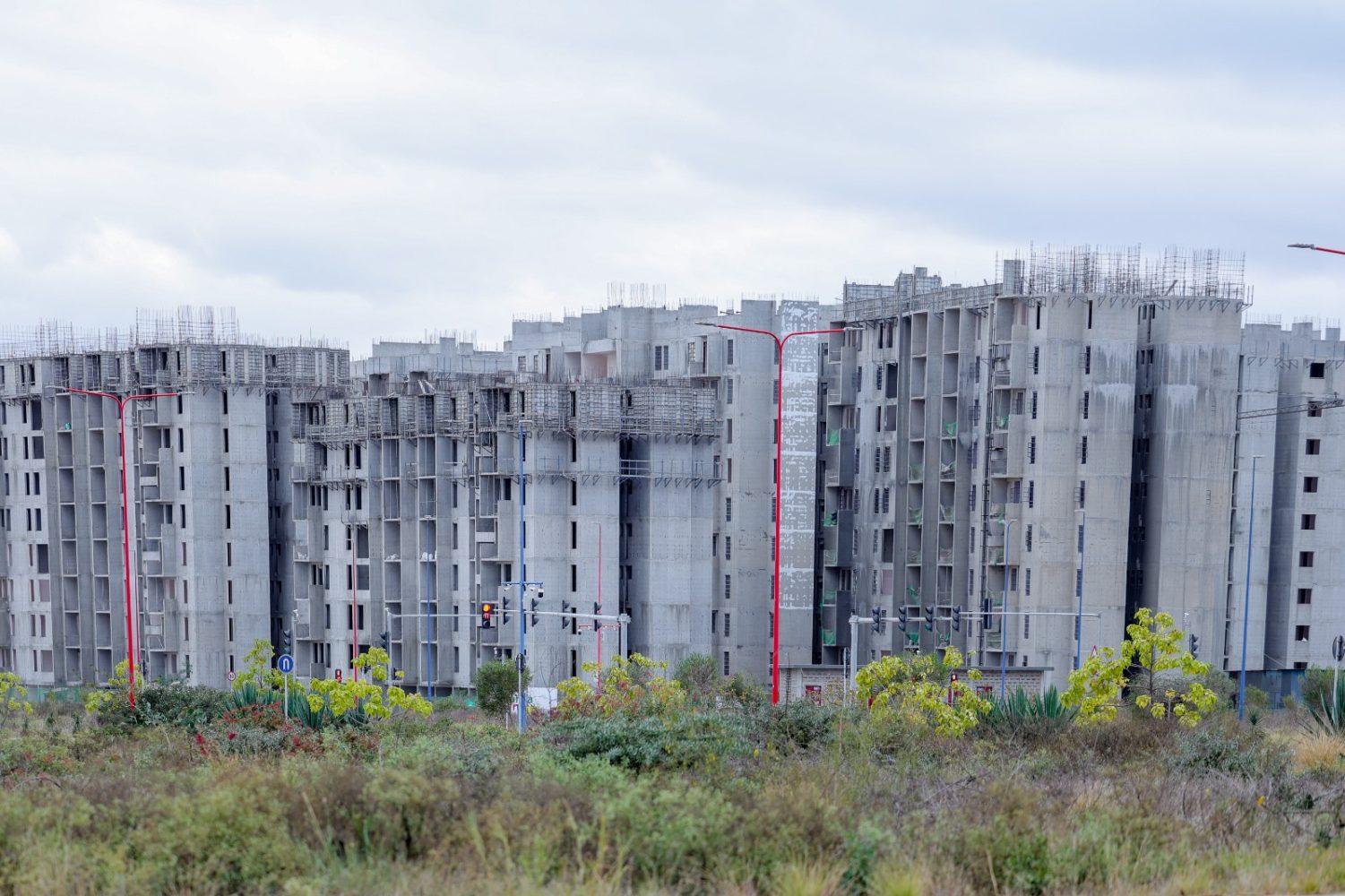
The first phase of Konza Technopolis’s affordable housing programme is expected to provide 1,042 units, as the area’s growing employment base increases demand for accommodation near workplaces.
The development of affordable housing at Konza Technopolis is intended to address the need for accommodation among workers in and around the emerging technology and industrial hub.
Robert Marua, the project’s site agent, said the first phase consists of 11 blocks containing 1,042 units divided into social, affordable and market housing categories. He said approximately 250 units had been sold at the time of the interview.
“First of all, we are building 11 blocks and the 11 blocks have 1,042 units. That is, we start with the social, affordable and the market. So, so far, eight blocks are up. Three is ongoing,” Marua said.
He said the housing was intended to serve people working in the area, including employees of businesses operating at Konza’s Export Processing Zone (EPZ).
“We have like, an EPZ. They have workers. Instead of looking for rental houses outside, they can accommodate them here,” he said.
Eric Fereji, the site safety officer for Landmark Holdings Ltd, said the EPZ already had approximately 2,000 workers, some of whom were struggling to find accommodation nearby.
“Already they have 2,000 workers, and they are really struggling to get areas where they can reside, to come to work here. So this project will offer opportunities for the Kenyans who will be working at that EPZ to ensure that they have good and affordable housing units around,” Fereji said.
The housing project is also creating employment during construction. Marua said the site had almost 500 workers, including those employed indirectly, with workers paid weekly.
“Then, for the workers, right now we have almost 500 workers,” he said.
“Those are the indirect workers. And we do pay them on a weekly basis. That is on Saturdays.”
Fereji said the economic effects extended beyond the construction site. Workers and contractors were sourcing some building materials from surrounding counties, while food vendors and local artisans were also benefiting from the activity.
He said the government had allocated 10,000 affordable housing units for development at Konza, placing the current phase within a broader housing programme.
“We are happy to know that the government has already allocated 10,000 of affordable housing to be constructed here,” he said.
The first phase’s 1,042 units are therefore distinct from the larger allocation for Konza. Fereji said the current phase was expected to be completed around March or April next year, with a partial handover of nine blocks planned for December of the year in which he was speaking.
“Already, in this phase one, we are doing 1,042 units, and we estimate to have completed the entire project by March or early next year; March or April next year will be completed with all these projects. We are planning to partially hand over nine blocks by December this year,” he said.
However, construction progress is not the only requirement for the homes to become operational. Marua said the site still needed permanent water and electricity connections, which were under discussion among the parties involved in the project.
“Like now, we need a water connection. That’s a permanent water connection and a permanent power connection, which is under discussion between the contractor, the client and the coder. We hope soon it will be sorted out,” he said.
Fereji said later phases were also expected to include social infrastructure, including a level five hospital and schools.
“Like the other phases that are to be constructed, there will be a hospital, a level five hospital. We also have schools that will be constructed,” he said.
The scale of the planned housing programme reflects the challenge of matching residential development with employment growth. For Konza, the next step will be turning construction progress into completed, serviced homes that can meet the accommodation needs of people working in the area.