Mount Kenya University (MKU) has strengthened its contribution to digital transformation and technology education with the launch of a Cloud Computing Initiative and the China–Africa Digital Technology Supermarket at its Thika Main Campus.
The initiatives were established in partnership with China’s Nanjing Vocational College of Information Technology (NVCIT) and Nanjing Zhongxing Xinyada Information Technology Co. Ltd, commonly known as Xinyada.
They are expected to expand digital-skills training, innovation, artificial intelligence applications and industry-linked learning while preparing students and working professionals for opportunities emerging from the Fourth Industrial Revolution.
Speaking during the launch, MKU Vice-Chancellor Prof. Deogratius Jaganyi described the initiative as an important milestone in the University’s efforts to position itself at the forefront of technological innovation and digital transformation.
“Cloud computing is no longer simply an emerging technology. It is the foundation of modern digital infrastructure that supports education, healthcare, business, research, manufacturing and government services,” said Prof. Jaganyi.
He said the partnership would give students and members of staff access to advanced technologies, practical training and innovative research platforms. These opportunities would enable them to develop solutions to contemporary challenges and enhance their competitiveness in the global job market.
Prof. Jaganyi added that the initiative reflects MKU’s commitment to building strategic partnerships that create value for students, industry and society. He emphasised that universities must work closely with technology companies and international institutions to ensure academic programmes remain responsive to changing workforce demands.
MKU has collaborated with NVCIT since 2024. The two institutions have jointly implemented the China–Africa Vocational Education Characteristic Project and the International Cooperation Project on Artificial Intelligence.
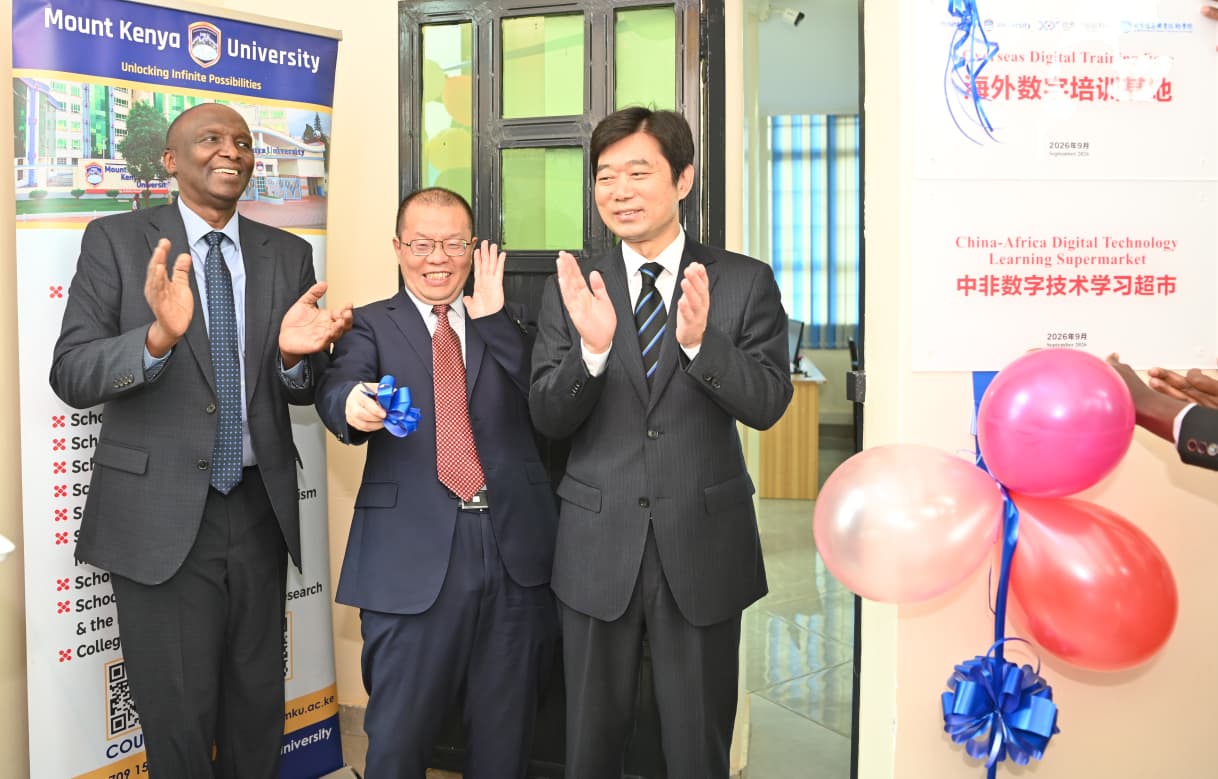
A major highlight of the launch was the inauguration of the China–Africa Digital Technology Supermarket, a practical innovation hub integrating digital teaching resources, cloud technologies and hands-on training.
The facility is expected to help bridge the gap between classroom learning and industry requirements while promoting innovation, entrepreneurship and the development of locally relevant technological solutions.
“During this visit, we will hold the inauguration ceremony for the China–Africa Digital Technology Supermarket. As a key milestone in our partnership, this facility will serve as a physical and practical platform for developing local digital-skills talent,” said NVCIT President Kong Jie.
“It will integrate digital teaching resources to support classroom instruction and hands-on training, empowering young people in Kenya to master the core competencies required in the digital era.”
Kong described education and technology as important drivers of shared development and praised the progress achieved through cooperation between the two institutions.
“Since our cooperation began, we have transformed shared ideas into tangible achievements. Our online training programmes in Chinese language, communication technologies and digital skills have built strong bridges for knowledge exchange and laid a solid foundation for long-term collaboration,” he said.
He expressed optimism that the partnership would expand to include student and staff exchanges, joint curriculum development, collaborative research and capacity-building programmes for lecturers.
Other NVCIT representatives attending the launch included Yang Qianhua, Dean of the School of Network and Communication, and He Miao, Dean of the School of Artificial Intelligence.
As part of the initiative, the MKU Digital Technology Academy has introduced hands-on courses in fifth-generation mobile technology, commonly known as 5G, and the Internet of Things.
Enrolment is open to university students and working professionals seeking practical skills for careers in telecommunications, network engineering and connected technologies.
The academy combines classroom instruction with laboratory simulations to help learners understand how modern communication networks and internet-connected devices are designed, operated and maintained.
Plans are also underway to introduce additional courses in cloud computing, artificial intelligence, drone simulation, Chinese language and cable infrastructure.
The partnership between MKU and Xinyada began in 2024 and has since developed into the MKU–Xinyada–Chinese Higher Education Institutions Consortium. The consortium brings together MKU and five Chinese higher education institutions, with Xinyada serving as the initiator and coordinating partner.
An important early milestone was Xinyada’s donation of laboratory computers to MKU in 2024 to support the establishment of a Cloud Computing Training Centre. The equipment was received in December of that year, after which the University began developing the centre with partial sponsorship from Xinyada.
Xinyada later conducted a needs assessment to gather information about MKU’s ICT infrastructure, training requirements and capacity-building priorities.
The partnership gained momentum in 2025 when Xinyada introduced five Chinese higher education institutions to MKU. This resulted in the development of a tripartite memorandum of understanding to guide cooperation among the University, Xinyada and participating institutions.
Since May 2026, the Cloud Computing Training Centre has trained MKU students and members of staff, strengthening practical digital skills and creating opportunities for professional training, research, innovation and international academic cooperation.
The collaboration was further strengthened by a three-day visit to Kenya by a Xinyada delegation led by the company’s founder and chairman of the board. Accompanied by Prof. Jaganyi, the delegation paid a courtesy call on Dr. Beatrice Muganda Inyangala, Principal Secretary for Higher Education and Research in Kenya’s Ministry of Education.
The delegation also held discussions with MKU founder and Chairman Prof. Simon Gicharu. The engagements reinforced the partners’ commitment to cooperation in information technology, cloud computing, digital education, artificial intelligence and technical-skills development.
A new memorandum of understanding signed on September 18, 2026, provided an expanded framework for training, technology transfer, joint research, innovation and exchanges involving students and members of staff.
MKU is the United Nations Academic Impact Hub Chair for Sustainable Development Goal 9—Industry, Innovation and Infrastructure—for the 2025–2030 period.
The MKU–Xinyada–Chinese Higher Education Institutions Consortium supports this mandate by promoting technological innovation, digital-skills development, institutional cooperation and investment in modern infrastructure.
Through the partnership, MKU is strengthening its position as a regional centre for technology-driven education while equipping students, professionals and members of staff with the competencies needed to thrive in a rapidly evolving global digital economy.
The initiative also demonstrates how cooperation between universities and industry can advance sustainable industrialisation, innovation and infrastructure development while creating new opportunities for young people.